
The Quaker Vision
Solitary confinement was invented as an act of mercy. Philadelphia's Quaker community in the 1780s looked at the criminal justice system they had inherited — public flogging, branding with hot irons, ear-cropping, and execution — and proposed what they believed was a humane alternative. Isolation and silence, they argued, would replace physical punishment with spiritual rehabilitation. A prisoner left alone with nothing but a Bible and his conscience would inevitably confront his sins, repent, and emerge reformed. The theory was elegant, compassionate, and almost entirely wrong.
This article is part of our American Prison History collection.
Benjamin Rush, a physician, signer of the Declaration of Independence, and founding member of the Philadelphia Society for Alleviating the Miseries of Public Prisons, provided the intellectual framework. Rush argued that crime was a disease of the moral faculty — analogous to physical illness — and that isolation was its cure. Just as a fever patient required bed rest and quiet, a criminal required solitude and reflection. The medical metaphor gave the proposal scientific credibility in an era when the boundaries between medicine, philosophy, and theology were porous.
The first implementation came at the Walnut Street Jail in 1790. A new wing of 16 solitary cells was constructed for the most serious offenders, who were confined without work, visitors, or communication. The experiment attracted immediate international attention. European reformers, appalled by the brutality of their own systems, studied the Philadelphia model as a potential alternative. The Walnut Street experiment was small, but its implications were vast — it established the principle that long-term isolation could serve as the primary mechanism of punishment and reform.
The Pennsylvania System
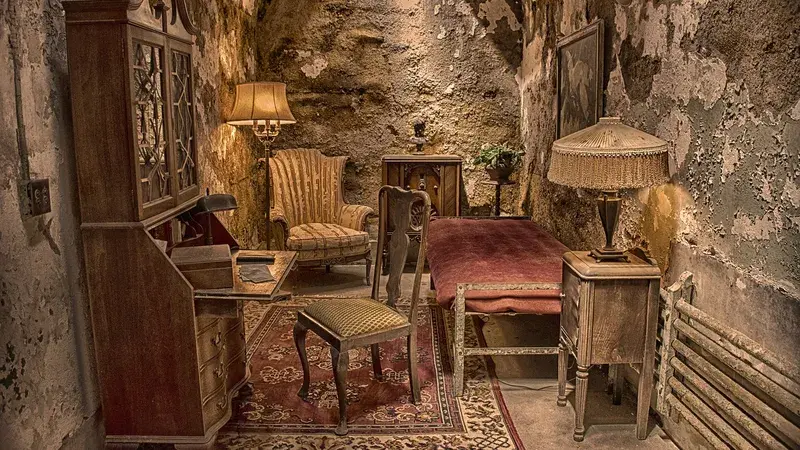
Eastern State Penitentiary, which opened in 1829, scaled the Walnut Street experiment to industrial dimensions. Every prisoner was held in total isolation. Each cell had a private exercise yard, a toilet, a skylight, and work materials. Prisoners were hooded when moved through corridors to prevent them from seeing other inmates or learning the prison's layout. Chapel services were delivered through pipes that fed sound to individual cells. Meals arrived through feeding slots. Human contact was limited to occasional visits from the warden, the chaplain, and — in theory — inspectors from the prison society.
The system's designers believed they had created conditions that made reform inevitable. A prisoner with nothing but silence, a Bible, and his own thoughts would necessarily turn inward. The skylight — called the Eye of God — reminded him of divine observation. The work materials gave him productive occupation. The isolation protected him from the corrupting influence of other criminals. Every architectural detail served the theory.
The practice was different from the theory. Prisoners did not find God in their cells. Many found madness. Prison physicians documented inmates who developed hallucinations, self-destructive behaviors, catatonic states, and permanent cognitive impairment. The prison's own records show elevated rates of mental breakdown among long-term solitary inmates compared to those in congregate systems. Charles Dickens, visiting in 1842, called the system torture — specifically, "the slow and daily tampering with the mysteries of the brain" that he considered "immeasurably worse than any torture of the body." For related history, see our al capone at alcatraz: the fall.
The Auburn Alternative
New York developed a competing model at Auburn State Prison in the 1820s. The Auburn system imposed solitary confinement at night but allowed congregate labor during the day — under strict silence rules enforced by the lash. Prisoners marched in lockstep, ate in silence, worked in silence, and communicated through a system of hand signals that guards attempted, with limited success, to suppress.
The Auburn system won the national debate for economic rather than humanitarian reasons. Congregate labor generated revenue. Silent prisoners working together in workshops could produce goods — shoes, barrels, furniture, textiles — at volumes that solitary cell-based work could not match. Prison administrators who needed to justify their budgets to state legislatures found the Auburn model financially compelling. By the 1860s, most American prisons had adopted some version of the Auburn system, and the Pennsylvania model of total isolation was in retreat.
The competition between Philadelphia and Auburn was conducted through pamphlets, legislative hearings, international conferences, and the investigations of foreign delegations. Gustave de Beaumont and Alexis de Tocqueville studied both systems during their 1831 tour and produced a comparative report that influenced prison design across Europe. The British, French, and Prussian governments all sent official delegations. The American penitentiary became the country's first major institutional export — a product of democratic idealism that other nations purchased with varying degrees of success.
The Global Experiment
Pentonville Prison, opened in London in 1842, adopted the Pennsylvania model with characteristic British thoroughness. Prisoners wore masks when outside their cells. Chapel pews were enclosed in individual wooden stalls that prevented inmates from seeing each other. The exercise yard was divided into radiating pie-slice sections, each holding a single prisoner walking in circles. The system was exported to British colonies — Australia, India, Canada, and throughout the Caribbean — where it was imposed on colonized populations who had no say in the criminal justice theories being tested on their bodies. For related history, see our the birdman of alcatraz: robert stroud's.
The results were consistent across implementations. Prolonged solitary confinement produced mental illness at rates that overwhelmed prison medical facilities. Pentonville's own records show dramatic increases in insanity, self-harm, and suicide among prisoners subjected to extended isolation. By the 1850s, Britain had begun reducing the solitary period from 18 months to 9 months, and eventually to a few months at the beginning of a sentence. The retreat was quiet — no government wanted to admit that its flagship penal reform had been, in essence, a systematic method of driving people insane.
Modern Solitary Confinement
American prisons in the 21st century hold an estimated 80,000 to 100,000 people in solitary confinement on any given day. The practice that the Quakers invented as an alternative to physical punishment has become one of the most widely used punishments in the American system. Supermax facilities — ADX Florence in Colorado is the most prominent — hold inmates in cells for 22 to 24 hours per day, with minimal human contact, for periods that can extend to years or decades.
The conditions in modern solitary differ from the Pennsylvania system in important ways. Eastern State's cells had natural light, private exercise yards, and work materials. Modern solitary cells are typically windowless or nearly so, offer one hour of recreation per day in a concrete pen, and provide no productive activity. The sensory deprivation is more extreme than anything the Quakers envisioned, and the duration often exceeds what 19th-century reformers would have considered acceptable.
Research on the psychological effects of prolonged isolation is extensive and consistent. Studies document elevated rates of anxiety, depression, hallucinations, psychosis, cognitive deterioration, and suicide among solitary inmates. The United Nations Special Rapporteur on Torture has classified solitary confinement exceeding 15 days as cruel, inhuman, or degrading treatment. The American Psychiatric Association has opposed prolonged solitary for individuals with mental illness. The evidence against the practice is overwhelming. Its use persists because it serves institutional management needs — removing disruptive inmates from the general population — regardless of the documented harm it causes.
The arc of solitary confinement's history — from Quaker mercy to international condemnation — illustrates a recurring pattern in criminal justice reform. Well-intentioned innovations, implemented at scale and sustained by institutional inertia, become instruments of the very cruelty they were designed to replace. The Quakers who proposed isolation as an alternative to the lash could not have imagined ADX Florence. But the logic that produced both is the same: the belief that controlling a human being's environment can control the human being.