
Before the Penitentiary: Colonial Punishment
Colonial America had no prisons in any modern sense. Jails existed, but their purpose was to hold the accused before trial, not to punish the convicted. Punishment was immediate, physical, and public — designed to deter through spectacle rather than confine through walls. A thief might be flogged in the town square, locked in stocks for public humiliation, branded with a hot iron on the hand or forehead, or have an ear cropped. Serious offenses — murder, arson, horse theft, repeated burglary — carried the death penalty. The idea that a person should be locked in a building for months or years as punishment was foreign to the colonial legal imagination.
This article is part of our American Prison History collection.
The system served a small, tight-knit society where reputation was currency and public shame was a powerful deterrent. But as colonial cities grew — Philadelphia, New York, and Boston each exceeded 20,000 residents by the Revolution — the intimate social controls that made public punishment effective began to fail. In a city where anonymity was possible, a branded hand or a flogged back carried less stigma. The crowd that witnessed a public whipping might include strangers who would never see the offender again. The punishment's deterrent effect depended on community knowledge, and the community was growing too large for that knowledge to function.
The Philadelphia Reformers
Philadelphia became the laboratory for American penal reform because it concentrated the intellectual, religious, and political resources necessary for systemic change. Benjamin Rush, the physician and founding father, published An Enquiry into the Effects of Public Punishments upon Criminals and upon Society in 1787, arguing that public punishment hardened criminals rather than reforming them. Rush proposed a "house of repentance" where prisoners would be isolated, forced to labor, and subjected to conditions that would produce genuine moral transformation.
Rush was not working in an intellectual vacuum. The Italian philosopher Cesare Beccaria had published On Crimes and Punishments in 1764, arguing that punishment should be proportional and aimed at deterrence rather than retribution — ideas that circulated widely among Philadelphia's educated elite. In England, John Howard's 1777 survey The State of the Prisons had documented the squalor of British jails and proposed systematic reform. Philadelphia's Quaker community provided the religious foundation: the Society of Friends had long opposed violence as a tool of governance, and their theology of the Inner Light — the belief that every person carried a divine spark capable of moral renewal — made solitary reflection a logical alternative to the whip.
The Philadelphia Society for Alleviating the Miseries of Public Prisons (now the Pennsylvania Prison Society, the oldest prison reform organization in the world), founded in 1787 with Rush, Benjamin Franklin, Bishop William White, and statesman Tench Coxe among its members, became the institutional vehicle for reform. The Society lobbied the Pennsylvania legislature, inspected existing jails, published reports on conditions, and developed the theoretical framework for what would become the penitentiary system. Their argument was simultaneously humanitarian and pragmatic: public punishment was cruel, ineffective, and increasingly incompatible with the democratic ideals of the new republic. A nation founded on the premise that all men possessed the capacity for moral improvement should create institutions that cultivated that capacity rather than destroying it.
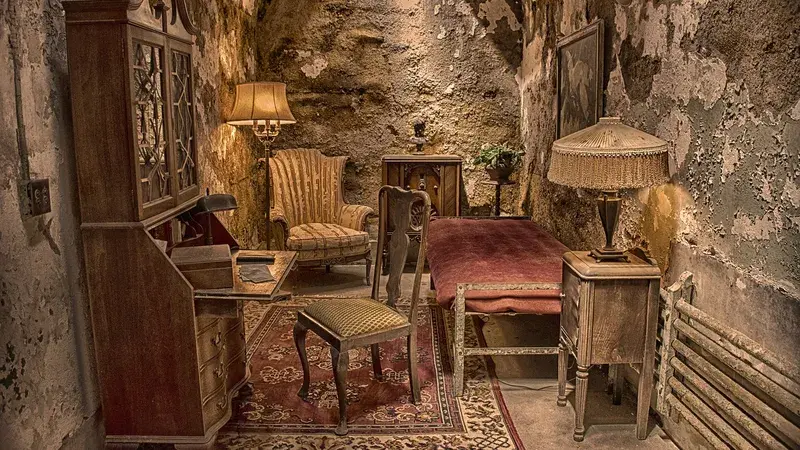
The Walnut Street Jail renovation of 1790 was the first implementation. Sixteen solitary cells—each eight by six feet with nine-foot ceilings, a mattress, water tap, and privy pipe—were constructed in a new \"Penitentiary House\" designed by architect Robert Smith for serious offenders, who were confined without work or human contact in conditions designed to promote reflection and repentance. The experiment attracted immediate international attention — delegations from Britain, France, and Prussia visited to study a model that promised to replace barbarism with rationality. Eastern State Penitentiary, which opened in 1829, scaled the experiment to industrial proportions.
Pennsylvania vs. Auburn: The Great Debate
The competition between the Pennsylvania and Auburn systems dominated American penology for three decades and attracted the attention of the Western world's most prominent intellectuals. The Pennsylvania system, implemented at Eastern State, imposed total solitary confinement — prisoners lived, worked, ate, and slept alone in individual cells with private exercise yards. The Auburn system, developed at Auburn State Prison in New York (opened 1816–1817, first warden William Brittin), imposed solitary confinement at night but allowed silent congregate labor during the day. The Auburn system's daily reality was defined by absolute silence. Principal keeper Elam Lynds enforced discipline through the lash and a system of total control that extended to every movement. Prisoners marched in lockstep — single file, right hand on the shoulder of the man ahead, eyes down — wore striped uniforms, and ate at specially arranged tables designed to prevent communication. Lynds believed that breaking a prisoner's sense of identity was the prerequisite for rebuilding it. In 1825, he marched a column of Auburn inmates to the Hudson River to construct a new prison with their own hands: Sing Sing (completed 1828), which would become the most notorious institution in the Auburn model. Auburn itself later gained infamy as the site of the first execution by electric chair—the electrocution of William Kemmler on August 6, 1890. For related history, see our al capone at alcatraz: the fall.
The debate was conducted through pamphlets, legislative hearings, prison society reports, and the investigations of foreign delegations who traveled to America specifically to study the competing models. Gustave de Beaumont and Alexis de Tocqueville visited both systems during their 1831 tour, producing On the Penitentiary System in the United States and Its Application in France. Tocqueville's more famous Democracy in America grew from the same path — the prison study was the official purpose; the political analysis was a side project that became a masterpiece.
Auburn won the American debate for economic reasons. Silent congregate labor in factory-style workshops generated revenue that solitary cell-based labor could not match. Prison administrators who needed to justify budgets found the Auburn model financially compelling. By the 1860s, most American prisons had adopted some variation of Auburn. The Pennsylvania model survived primarily in its influence on European prison design, where governments with larger budgets were willing to pay the higher cost of individual cells.
The Global Export
The American penitentiary became the country's first major institutional export. Britain adopted the Pennsylvania model at Pentonville Prison in 1842 (designed by Major Joshua Jebb of the Royal Engineers) and exported it throughout its empire. France studied both systems and developed hybrid approaches. Prussia built model prisons that combined elements of each. The penitentiary spread through colonial networks to India, Australia, the Caribbean, and Southeast Asia — imposed on colonized populations who had no voice in the criminal justice theories being tested on their bodies.
The export was ideological as much as architectural. The penitentiary embodied Enlightenment confidence that human behavior could be engineered through environmental design — that controlling a person's physical surroundings could control their moral development. This confidence appealed to governments across the political spectrum, from democratic republics to absolute monarchies. The penitentiary promised order, rationality, and measurable outcomes in a domain — criminal behavior — that had previously been managed through violence and spectacle.
The Legacy of Good Intentions
The American penitentiary system was built on a foundation of genuine humanitarian concern. The reformers who created it were responding to real cruelty — public flogging, branding, and execution — with what they sincerely believed was a more humane alternative. The system they created produced its own cruelties — the madness of prolonged solitary confinement, the exploitation of prison labor, the racial disparities that pervaded the system from its earliest decades — but these outcomes were unintended by the founders, even if they were predictable in retrospect.
The penitentiary's most enduring legacy may be the assumption it embedded in American culture: that incarceration is the default response to crime. Before the penitentiary, imprisonment was one option among many — and not the most common one. After the penitentiary, it became the primary mechanism of criminal punishment in the United States, scaling from a few hundred inmates in the 1820s to over two million today. The Quakers who proposed solitary reflection as an alternative to the lash could not have imagined the system they set in motion. Their good intentions built the infrastructure for mass incarceration.