How a Locksmith Started a Ghost Industry
In 1992, a locksmith named Gary Johnson was restoring cellblock 12 at Eastern State Penitentiary when he experienced something he could not explain. He had removed a lock from a cell door — a routine task he had performed hundreds of times in the decaying prison — when he felt what he described as a force holding him in place. A dark, shadowy figure appeared in the corridor. Negative, tormented faces seemed to emerge from the cell walls. Johnson, a practical tradesman with no interest in the paranormal, reported the experience to site administrators and refused to work in that cellblock again.
This article is part of our American Prison History collection.
Johnson's account circulated among the small community of preservationists and volunteers working to stabilize Eastern State's crumbling infrastructure. Other workers reported their own experiences — unexplained sounds in empty cellblocks, cold spots in rooms with no ventilation, the sensation of being watched in corridors where no one else was present. The prison had been abandoned for over two decades by that point, and the building's decay created an atmosphere of profound unease that blurred the line between genuinely inexplicable experiences and the natural creepiness of a ruined prison.
The ghost stories transformed Eastern State's public identity. When the site opened for regular tours in 1994, the paranormal reputation drew visitors who might not have come for criminal justice history alone. The ghost stories and the history became intertwined — each amplifying the other in a feedback loop that made Eastern State one of the most visited haunted sites in America.
What Investigation Teams Report
More than 150 paranormal investigation teams have conducted organized investigations at Eastern State since the mid-1990s, according to site records. The prison attracts over 300,000 visitors annually, making it one of the most-visited historic sites in Pennsylvania. The prison grants access to qualified teams — typically requiring evidence of experience, insurance, and adherence to site rules that protect the fragile historic structure. Teams typically arrive in the evening, set up equipment in designated cellblocks, and spend the night recording audio, video, temperature, and electromagnetic field data in areas associated with reported activity.
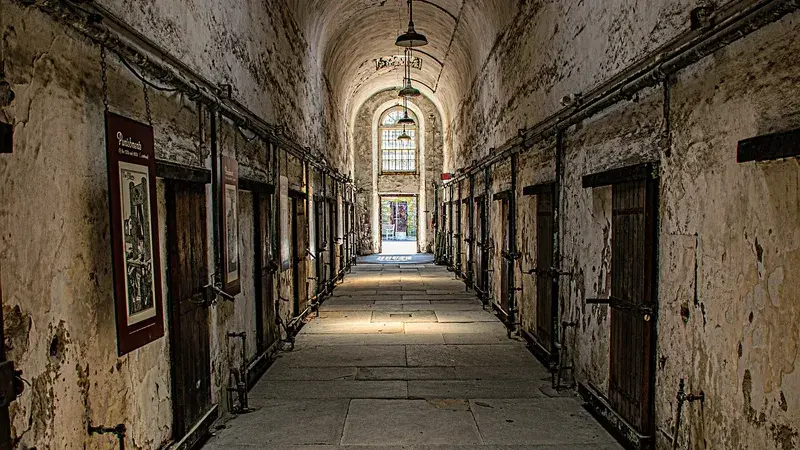
The most commonly reported phenomena cluster in specific locations. Cellblock 6, which once held up to 800 inmates across its two tiers and housed some of the prison's most troubled inmates during its operational years, generates reports of shadow figures, disembodied voices, and sudden temperature drops. The hospital wing produces reports of movement and sound in rooms that contained the prison's most intensive medical interventions. Cellblock 12, where Johnson had his experience, remains the site most frequently cited by investigation teams as producing unexplained data.
Electromagnetic field (EMF) readings regularly exceed 2.0 milligauss in several cellblocks — well above the 0.5 milligauss baseline measured in open areas — a finding that teams typically present as evidence of paranormal presence but that the prison's aging and exposed electrical wiring provides a mundane explanation for. The prison's infrastructure was never properly decommissioned. Corroded wiring, residual electrical connections, and the building's steel-reinforced concrete structure create electromagnetic anomalies that are measurable, repeatable, and entirely consistent with the building's physical condition rather than supernatural activity.
Is There Scientific Evidence for Ghosts at Eastern State?
No paranormal investigation conducted at Eastern State has produced evidence that satisfies the standards of scientific peer review. This is not unique to Eastern State — no paranormal investigation anywhere has met that standard. The fundamental methodological problem is that paranormal research lacks a falsifiable hypothesis. There is no agreed-upon mechanism by which a deceased person could interact with the physical environment, which means there is no way to design an experiment that could definitively distinguish a paranormal event from an unexplained natural one. For related history, see our al capone at alcatraz: the fall.
Eastern State's administration maintains a carefully neutral position. The site neither endorses nor dismisses paranormal claims. Tour guides present ghost stories as cultural history — part of the prison's legacy rather than confirmed fact. The audio tour mentions reported experiences without asserting their supernatural origin. This neutrality serves the institution well: it allows the ghost tourism to continue generating revenue without committing the site to claims that could undermine its credibility as a serious historical institution.
The psychology of the prison environment itself contributes to reported experiences. Eastern State's ruined cellblocks are dark, enclosed, and saturated with historical violence. The human brain is wired to detect threats in such environments — a survival mechanism that produces heightened alertness, pattern recognition in ambiguous stimuli, and the sensation of being watched. These responses are measurable, well-documented in psychological literature, and entirely sufficient to explain the majority of reported paranormal experiences without invoking the supernatural.
How Did Ghost Tourism Save Eastern State?
The Halloween event Terror Behind the Walls ran from 1991 to 2021, transforming Eastern State each October into one of America's premier haunted attractions. At its peak, the event drew over 160,000 visitors per season and generated an estimated $4.5 million in revenue and generated millions in revenue that directly funded preservation work on the historic structure. The event employed professional actors, elaborate sets, and theatrical effects that leveraged the prison's genuine atmosphere to create a manufactured horror experience layered on top of the building's organic creepiness.
Terror Behind the Walls ended after the 2021 season, a decision driven by a combination of pandemic disruption, neighborhood concerns about noise and traffic, and a strategic shift toward year-round programming that emphasizes criminal justice education. The end of the Halloween event represented a conscious choice to prioritize the prison's historical mission over its entertainment function — though the site continues to offer "after dark" experiences that operate at a lower intensity than the full Halloween production.
The commercial success of Eastern State's ghost programming influenced historic sites nationwide. Other prisons, asylums, and historic buildings adopted similar models — combining genuine historical tours with paranormal experiences and Halloween events to generate preservation funding. Eastern State demonstrated that ghost tourism could save buildings that conventional heritage funding could not sustain, a lesson that has been applied to dozens of sites across the country. The ghosts, whether real or imagined, proved to be more effective fundraisers than grant applications.