Park Avenue, Cellblock Seven
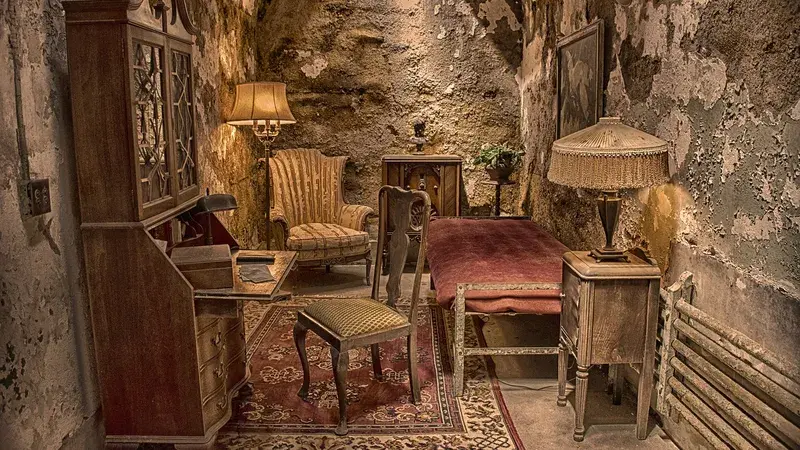
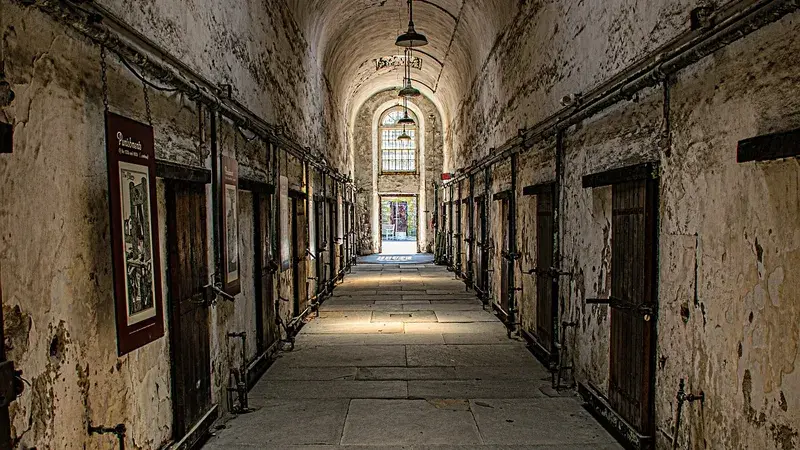
Before Alcatraz stripped him of everything, Al Capone served time in comfort that most law-abiding Americans of the Depression era could not afford. His cell at Eastern State Penitentiary — located on what inmates called Park Avenue, the wide central corridor of Cellblock Seven — reportedly contained fine furniture, Oriental rugs, oil paintings, a standing lamp with a silk shade, a cabinet radio that received broadcasts from the outside world, and a writing desk that would not have looked out of place in a Philadelphia gentleman's club.
This article is part of our American Prison History collection.
Capone entered Eastern State Penitentiary on May 17, 1929, sentenced to one year for carrying a concealed weapon — a charge that was almost certainly a negotiated arrangement between Capone and Philadelphia authorities. The arrest occurred at a movie theater on the day after a conference of organized crime leaders in Atlantic City. Historians have speculated that Capone sought the minor sentence as protective custody — a way to disappear from Chicago during a period of intense gang warfare following the Saint Valentine's Day Massacre on February 14, 1929, three months earlier in Chicago.
The cell that became famous was not his initial assignment. Capone first occupied a standard cell in Cellblock Two before being moved to the more spacious quarters in Cellblock Seven. The transfer and the furnishings that accompanied it raise questions about what arrangements, if any, existed between Capone and the prison administration. Warden Herbert Smith maintained that Capone received no special treatment. The physical evidence in the cell suggested otherwise.
The Photograph and the Historical Debate
The primary source for the luxury cell narrative is a single photograph published in the Philadelphia Public Ledger on August 20, 1929, by photographer John Singleton. The image shows a well-appointed cell with the furnishings described above — a scene dramatically at odds with the spartan conditions that Eastern State's original Quaker designers had intended. The photograph was widely reproduced and became one of the most iconic images of Prohibition-era organized crime.
Modern historians have questioned the photograph's reliability. Some argue it may have been staged — either by journalists seeking a dramatic story or by prison officials making a point about corruption in other institutions. Eastern State's own archives note that the luxury cell account is "contested" and present it with appropriate caveats. The furnishings visible in the photograph were not standard prison issue, but whether Capone actually lived with them daily or whether they were assembled for the camera remains an open question.
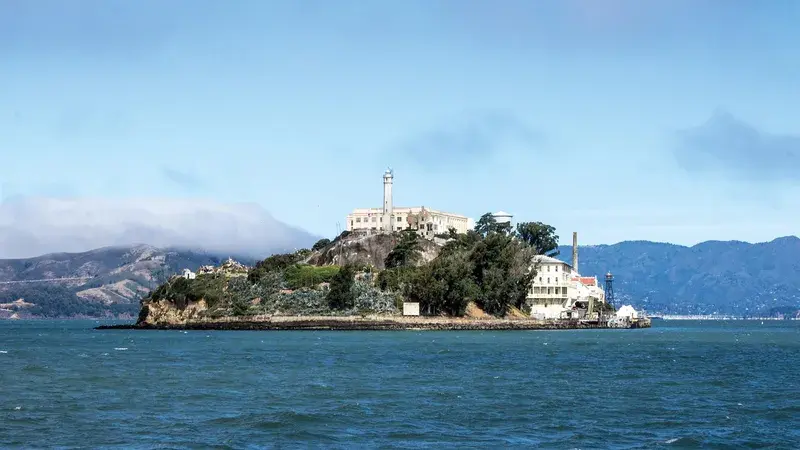
The debate matters because the luxury cell story serves a specific narrative function: it illustrates the corruption that permeated the American criminal justice system during Prohibition and provides the contrast that makes Capone's subsequent experience at Alcatraz so dramatic. The federal government built Alcatraz specifically to end the kind of privilege-buying that the Eastern State photograph represents. Without the evidence of corruption at state facilities, the justification for a maximum-security federal prison on a rock in San Francisco Bay loses much of its force.
Capone's Eight Months
Capone served approximately eight months at Eastern State Penitentiary before his release on March 17, 1930, commuted by Pennsylvania Governor John S. Fisher, — two months early, credited for good behavior. His time there was, by all accounts, unremarkable in terms of institutional management. He did not cause disciplinary problems. He did not attempt escape. He participated in the prison's routine with the compliance of a man who understood that his sentence was short and his situation manageable.
What Capone did during those eight months that attracted less public attention was continue running his Chicago operations through intermediaries. Visitors to Eastern State were not as closely monitored as they would later be at Alcatraz. Communication with the outside world, while theoretically restricted, was in practice permeable. Capone's lawyers visited regularly. Family members visited. Associates visited. The prison was, for Capone, a temporary inconvenience rather than a meaningful interruption of his criminal enterprise. Contemporary observers noted that Capone received preferential treatment in meal quality, visiting privileges, and access to outside communication that contradicted official policy—evidence that state prisons lacked either the resources or the institutional will to prevent wealthy inmates from maintaining their criminal networks. For related history, see our the birdman of alcatraz: robert stroud's.
This ability to maintain criminal operations from within prison walls was precisely the problem that the Bureau of Prisons identified when it designed the Alcatraz program. State prisons like Eastern State lacked the resources, the authority, or in some cases the will to isolate high-profile inmates from their organizations. The federal system created Alcatraz as a facility where isolation was not aspirational but architectural — where the physical separation of an island, combined with strict communication controls, would achieve what willpower and regulation had failed to accomplish.
Cell 68 Today
Visitors to Eastern State Penitentiary today can view Cell 68 (also known as Cell 181) on the ground floor of Cellblock Seven, identified by signage as Al Capone's cell. The cell has been restored — or, more precisely, furnished — based on the 1929 photograph, with period-appropriate items including a writing desk, table lamp, bookshelf, framed artwork, and radio. The restoration is explicitly presented as an interpretation rather than a verified recreation. The audio tour notes the historical uncertainty surrounding the cell's actual appearance during Capone's occupancy.
The cell draws more visitors than any other single location in the prison, including Death Row, the hospital wing, and the solitary confinement cells. This is consistent with a broader pattern in dark tourism — individual stories attract more attention than systemic ones. The thousands of inmates who suffered in Eastern State's solitary confinement system are collectively less compelling to most visitors than one famous gangster's comfortable cell. The disparity between the attention given to Capone's luxury and the attention given to ordinary prisoners' suffering is itself a commentary on how Americans process criminal justice history.
Eastern State's curatorial team has used Capone's cell as a teaching tool, inviting visitors to consider what the luxury arrangement reveals about the criminal justice system of the 1920s. The cell is not presented as a celebration of gangster glamour but as evidence of institutional failure — a physical demonstration of how wealth could purchase comfort within a system theoretically designed to punish all inmates equally. The lesson is uncomfortable precisely because the disparity it illustrates has not been fully resolved. Wealthy inmates still receive better legal representation, more comfortable conditions, and earlier release than poor inmates. The specifics change. The pattern persists. Eastern State's Capone cell represents not a historical curiosity but a structural truth about American incarceration—that privilege, once established in the outside world, translates directly into institutional advantage, and that true deprivation of liberty has historically been reserved for those already marginalized by poverty and social status.
The Capone Legacy at Eastern State
Capone's brief stay at Eastern State left a permanent mark on the institution's public identity. The prison operated for another 40 years after his departure, housing thousands of inmates and undergoing multiple transformations in philosophy and practice. None of this subsequent history competes with the Capone association in the public imagination. The prison that was designed as a monument to Quaker penal reform is remembered primarily as the place where a gangster had nice furniture.
This is not entirely the prison's fault. Eastern State's marketing has always balanced Capone tourism against its broader educational mission. The Capone cell brings visitors through the door; the audio tour, the artist installations, and the criminal justice programming give them something more substantive to consider once they arrive. The strategy works — Eastern State's 300,000 annual visitors spend an average of two hours on site, far longer than the Capone cell alone would justify. The gangster is the hook. The history is the substance.