The Geography of Punishment
Port Arthur occupies the tip of the Tasman Peninsula in southeastern Tasmania, connected to the main island by a strip of land called Eaglehawk Neck that narrows to less than 100 meters at its thinnest point. The British colonial administration recognized this geography as a natural prison in 1830 and established a timber-cutting station that would evolve into one of the most brutal convict settlements in the British Empire. Guards and chained dogs patrolled Eaglehawk Neck around the clock. Lanterns were hung from posts to illuminate the crossing at night. Sharks were rumored — possibly encouraged — to patrol the waters on either side. Escape was not impossible, but it was close enough to impossible that the distinction rarely mattered.
This article is part of our American Prison History collection.
The settlement operated from 1830 to 1877, processing over 12,500 convicts during its 47-year existence. These were not first-offense transportees sent directly from British courts. Port Arthur received convicts who had committed further offenses after arriving in the Australian colonies — men who had already been punished and had failed, in the system's judgment, to reform. The settlement was a prison within a prison, a place of secondary punishment for those the transportation system considered its worst failures.
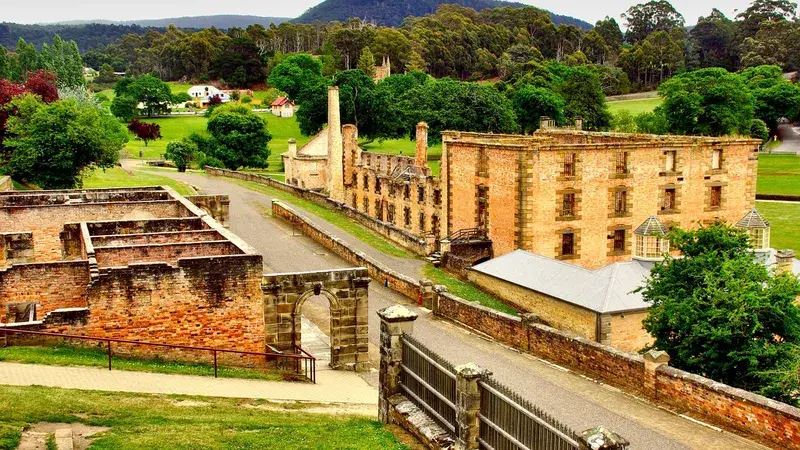
The secondary punishment classification distinguished Port Arthur from other British colonial prisons. Men sent to Port Arthur had already been subjected to the standard transportation sentence in an Australian colony, and then, through re-offense, earned transfer to this harsher regime. The system created psychological layers of punishment: the initial transportation from Britain was a permanent sentence, but Port Arthur suggested an even more permanent social death. The recidivism rate among Port Arthur inmates who were eventually released reflected this reality. Many could not reintegrate into colonial society and instead became permanent residents of the margins, their criminal history marking them as incorrigible even after fulfilling their sentences. The site grew from a rough timber camp into a complex industrial settlement. At its peak, Port Arthur operated a shipyard, a timber mill, a shoe factory, a smithy, and agricultural operations that made the settlement largely self-sufficient. Convict labor built every structure on the site — the massive four-story penitentiary, the church, the hospital, the guard towers, the commandant's residence, and the elaborate gardens that softened the settlement's appearance without softening its purpose. The irony of men building their own prison with their own hands was not lost on the convicts, several of whom documented the experience in letters and memoirs that survive in Tasmanian archives.
The Separate Prison
In 1848, Port Arthur constructed a Separate Prison modeled on Pentonville in London, importing the Pennsylvania system of total isolation that Philadelphia's Quakers had pioneered two decades earlier. The Separate Prison replaced physical punishment — flogging, chain gangs, solitary confinement in darkness — with psychological punishment that its proponents considered more humane. Prisoners wore hoods when outside their cells. They were identified by number rather than name. Chapel services were conducted in individual wooden stalls that prevented inmates from seeing or communicating with each other. Exercise occurred in individual walled yards radiating from a central observation point.
Silence was absolute and enforced. Guards wore felt slippers to muffle their footsteps, adding to the sensory deprivation that defined the experience. Prisoners who violated the silence rule received additional periods of isolation in punishment cells — smaller, darker rooms within an already claustrophobic facility. The progression from ordinary cell to punishment cell to the "dumb cell" (a completely lightless and soundless chamber) represented escalating levels of sensory deprivation that the system's designers believed would produce reflection and repentance.
The Separate Prison produced madness instead. Records document convicts who developed acute psychotic episodes, self-harming behaviors, and permanent cognitive damage. The asylum built adjacent to the Separate Prison — one of Australia's first dedicated psychiatric facilities — filled with inmates driven insane by the conditions intended to reform them. The asylum's patient records, preserved in the Tasmanian State Archives, provide detailed clinical documentation of the psychological destruction that prolonged isolation inflicted on human minds decades before modern neuroscience confirmed what Port Arthur's doctors observed empirically. For related history, see our al capone at alcatraz: the fall.
The Boys
Point Puer, a separate facility across the harbor from the main settlement, held juvenile convicts — boys as young as nine transported from Britain for offenses ranging from theft to pickpocketing. Over 3,000 boys passed through Point Puer between 1834 and 1849, making it the first dedicated juvenile detention facility in the British Empire. The boys received basic education and trade training alongside punishments that included solitary confinement and flogging.
The juvenile facility was considered progressive by contemporary standards — an attempt to separate young offenders from adult criminals and provide them with skills for post-release employment. In practice, conditions were harsh, supervision was inconsistent, and the isolation of the Tasman Peninsula meant that abuses went unmonitored for extended periods. Archaeological excavations at Point Puer in recent decades have uncovered evidence of living conditions substantially worse than official records described.
After Closure
Port Arthur closed as a penal settlement in 1877. The Tasmanian government, eager to shed the colony's convict stigma, renamed the area Carnarvon and encouraged free settlement. Bushfires in 1895 and 1897 destroyed many of the timber structures and damaged the stone buildings. The ruins were left to decay for nearly a century, gradually transforming from a place of active shame into a site of historical curiosity.
Conservation efforts began in the 1970s as Australians developed a new relationship with their convict heritage. What had been a source of embarrassment became a subject of scholarly interest and, eventually, national pride. The archaeological and historical work conducted at Port Arthur since the 1970s has produced one of the most detailed records of convict life in the British Empire — a resource that informs not only Australian history but the broader study of penal systems, forced labor, and institutional cruelty. For related history, see our the birdman of alcatraz: robert stroud's.
UNESCO inscribed Port Arthur as part of the Australian Convict Sites World Heritage listing in 2010, recognizing it as one of the best-surviving examples of large-scale convict transportation and the associated punishment regimes. The listing acknowledged what Port Arthur's builders never intended: that their creation would outlast the empire that built it and serve as a monument not to British justice but to its failures. The site's haunted reputation began in earnest during the 19th century itself. Documented ghost stories emerged from Port Arthur as early as 1870, decades before modern paranormal investigation. Locals and visitors reported footsteps in empty cellblocks, disembodied voices from the Separate Prison, and apparitions moving through the asylum corridors. Contemporary paranormal investigation teams have recorded thousands of unexplained occurrences at the site over the past two decades, making Port Arthur reputedly Australia's most active paranormal location. The Paranormal Investigation Tour allows visitors to experience the site's supernatural phenomena firsthand, with reported encounters ranging from auditory phenomena to full apparitions. Whether attributed to the residual psychological imprint of 47 years of suffering or to literal haunting by the spirits of the dead, Port Arthur's paranormal reputation is as much part of its historical legacy as its architectural innovations.
The 1996 Tragedy and Its Legacy
On April 28, 1996, a gunman opened fire at the Broad Arrow Cafe at Port Arthur, killing 35 people and wounding 23 others in what remains Australia's deadliest mass shooting. The attack, committed by a 28-year-old Hobart man, targeted tourists visiting the historic site on a Sunday afternoon. Victims ranged in age from three to 72. The shooting lasted approximately 15 minutes before the gunman fled to a nearby guesthouse, where he was captured the following morning after a standoff.
The massacre prompted the Australian government to enact sweeping gun reform within weeks. The National Firearms Agreement, brokered by Prime Minister John Howard, banned semi-automatic and automatic weapons, established a national firearms registry, and funded a mandatory buyback program that collected over 650,000 weapons. Australia has not experienced a comparable mass shooting since. The speed and comprehensiveness of the legislative response remains unique among nations that have experienced similar tragedies.
A memorial garden now occupies the site of the cafe where most victims died. The garden is designed as a contemplative space — 35 native plants representing the 35 victims, arranged around a pool of still water. The memorial sits within the larger historic site, adding a layer of modern tragedy to a place already defined by historical suffering. Visitors to Port Arthur encounter both histories — the 19th-century convict settlement and the 20th-century massacre — in a single visit, a combination that gives the site an emotional weight that few heritage locations can match.