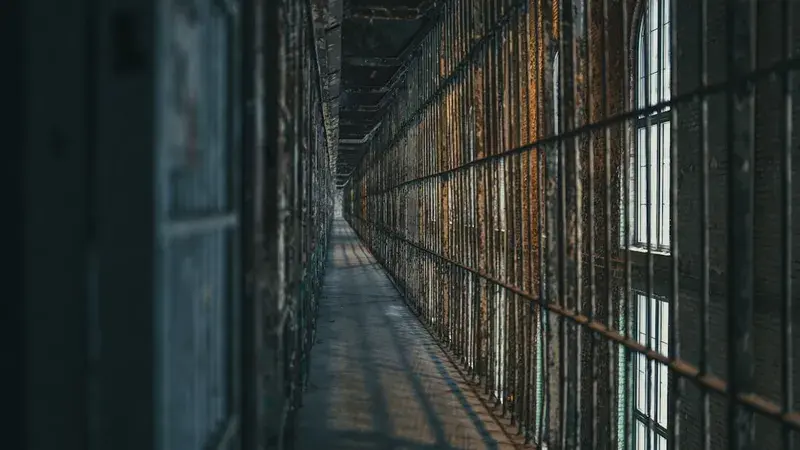
Why Former Prisons Draw Thousands of Visitors Each Year
Something about walking through a decommissioned cellblock hits differently than any haunted house attraction ever could. The walls carry real history — real suffering, real desperation, and if you believe the stories, real ghosts. Across the United States and beyond, former prisons have opened their doors to the public, offering everything from daytime historical tours to overnight paranormal investigations that push even the most skeptical visitors to question what they think they know.
This article is part of our American Prison History collection.
The appeal isn't hard to understand. These are places where human emotion ran at its most extreme — fear, anger, grief, madness. Paranormal researchers argue that kind of concentrated emotional energy leaves a mark on the physical environment, a concept they call residual haunting. Whether or not you buy into that theory, the atmosphere inside these aging institutions is undeniable. Cold spots, strange acoustics, shadows that seem to move on their own — even rational visitors report experiences they can't easily explain.
Eastern State Penitentiary — Philadelphia, Pennsylvania
No list of haunted prisons starts anywhere else. Eastern State Penitentiary opened in 1829 as the world's first true penitentiary, designed to reform criminals through total isolation. Prisoners spent 23 hours a day alone in their cells, forbidden from speaking to anyone. The psychological toll was catastrophic — inmates went mad at alarming rates, and the prison quietly abandoned its solitary model within decades.
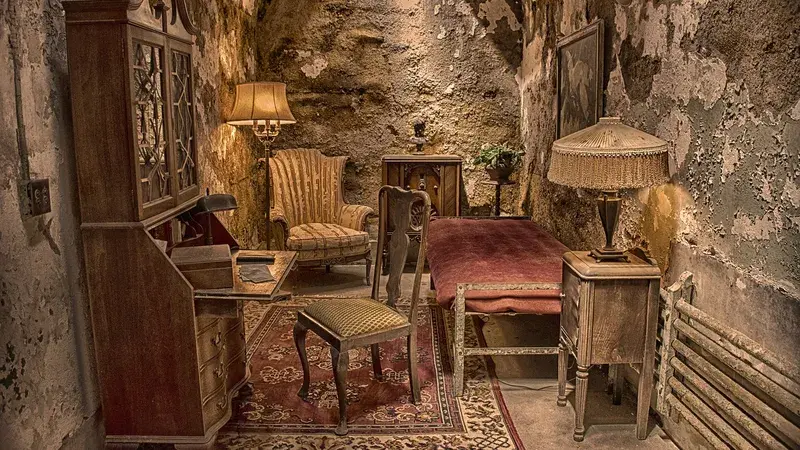
Today, Eastern State operates as a museum and historic site in the Fairmount neighborhood of Philadelphia. Daytime tours wind through crumbling cellblocks where paint peels from vaulted ceilings and rusted cell doors hang open at odd angles. The most popular stop is Al Capone's lavishly furnished cell, recreated based on historical photographs. But it's the after-dark experiences that draw the biggest crowds — particularly the annual Halloween event "Terror Behind the Walls" and the year-round paranormal investigation nights where guests bring their own equipment into the cellblocks.
Staff and visitors consistently report footsteps in empty corridors, cackling laughter echoing through Cellblock 12, and shadowy figures darting between cells in Cellblock 6. The prison's long history of paranormal investigations has produced some of the most scrutinized evidence in the field.
Alcatraz Federal Penitentiary — San Francisco, California
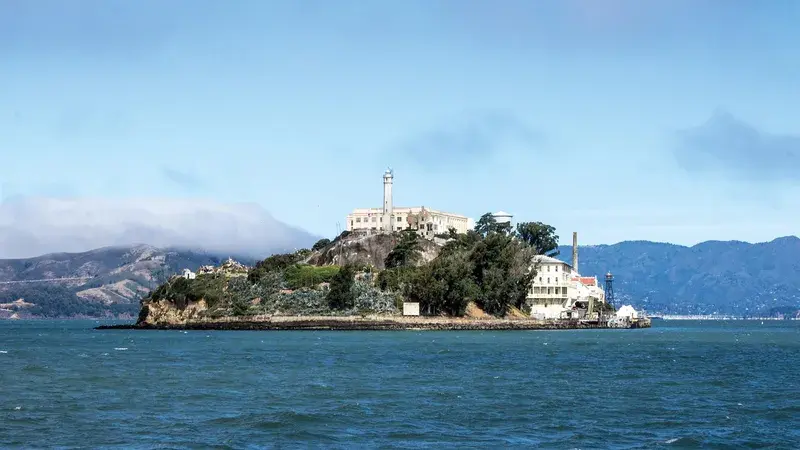
Sitting on a rocky island in San Francisco Bay, Alcatraz operated as a federal penitentiary from 1934 to 1963, housing inmates the government deemed too dangerous or escape-prone for other facilities. The island's isolation, brutal fog, and freezing currents made it the ultimate maximum-security lockup. Names like Al Capone, George "Machine Gun" Kelly, and Robert Stroud all did time on The Rock.
The National Park Service now operates Alcatraz as one of the most visited sites in the national park system. Ferry boats depart from Pier 33 in San Francisco, and tickets regularly sell out weeks in advance — especially for the popular night tours. The evening visits are atmospheric beyond anything the daytime experience offers. As fog rolls across the bay and the city lights shimmer in the distance, guides lead small groups through the main cellhouse with minimal lighting.
Cell 14D in the solitary confinement block — known as "The Hole" — is the most frequently cited hotspot. Visitors report sudden temperature drops of 20 degrees or more, and some describe an overwhelming feeling of dread that lifts the moment they step back into the corridor. Rangers have documented hearing unexplained banjo music in the shower room, which some attribute to Capone, who played banjo in the prison band.
The Old Idaho State Penitentiary — Boise, Idaho
Operational from 1872 to 1973, the Old Idaho State Penitentiary housed inmates for 101 years and witnessed numerous riots (particularly the violent uprising of 1973), public hangings, and attempted escapes. The distinctive sandstone cellhouses were constructed largely by the inmates themselves, who quarried local stone from the foothills surrounding the Boise location. Conditions were harsh even by nineteenth-century standards — overcrowding, inadequate heating, and a series of violent riots in the 1970s finally forced the state to build a new facility.
The site operates today as a museum managed by the Idaho State Historical Society. Visitors can walk through the original cellhouses, solitary confinement wing, gallows building, and the women's ward. The facility is remarkably well-preserved, with many of the original fixtures still in place. Staff members have reported hearing cell doors slam shut on their own, footsteps in corridors that are clearly empty, and cold spots concentrated around the solitary wing.
What makes the Old Idaho Pen particularly compelling is its accessibility. Unlike Eastern State or Alcatraz, it rarely draws enormous crowds, meaning visitors often find themselves alone in cellblocks with nothing but the sound of their own breathing and whatever else decides to make itself known.
Ohio State Reformatory — Mansfield, Ohio
Film buffs know the Ohio State Reformatory as the filming location for "The Shawshank Redemption," but the building's real history is far darker than anything Hollywood dreamed up. Built in 1886 by architect Levi T. Scofield with a striking Romanesque Revival facade featuring red brick and sandstone that looks more like a Gothic cathedral than a prison, the reformatory housed over 155,000 total inmates during its 104 years of operation (1886–1990). Overcrowding was extreme — cells designed for one person routinely held three, and violence was a daily occurrence.
The reformatory closed in 1990 after a federal court ruling on inhumane conditions. Today it operates as a museum, event venue, and paranormal destination. The Mansfield Reformatory Preservation Society offers historical tours, ghost walks, ghost hunts with full equipment access, and even overnight stays in the cellblocks. The six-tier east cellblock — the tallest freestanding steel cellblock in the world — is a jaw-dropping sight, its rusted tiers stretching upward into shadow.
Paranormal activity centers on the administration wing, particularly the warden's quarters where Warden Glattke's wife died from a gunshot wound in 1950 — officially ruled an accident, though rumors persist. Visitors report smelling perfume in the empty rooms, and EVP sessions have captured what investigators claim are female voices in the same area.
Moundsville Penitentiary — Moundsville, West Virginia
The West Virginia State Penitentiary at Moundsville, located in Marshall County approximately 12 miles south of Wheeling, operated from 1876 to 1995 across 119 years, earning a reputation during that span as one of the most violent prisons in American correctional history. The U.S. Department of Justice once named it among the top ten most violent correctional facilities in the nation. Ninety-four men were executed within its walls — thirty-six by hanging, nine in the electric chair nicknamed "Old Sparky."
Since closing in 1995, the penitentiary has become one of the premier paranormal tourism destinations in the eastern United States, attracting thousands of ghost hunters and paranormal investigators annually. The facility offers a range of experiences from basic historical tours to extended overnight ghost hunts. The "Sugar Shack" — a basement recreation area where extreme violence was common among inmates — is considered the most active location. Visitors and investigators report shadow figures, disembodied voices, physical sensations like being touched or pushed, and equipment malfunctions concentrated in specific areas.
The prison's proximity to the Grave Creek Mound, a massive Adena Native American burial mound built approximately 2,000 years ago and located just yards from the prison walls, has led some researchers to speculate that the site itself carries a deeper spiritual significance rooted in indigenous history that substantially predates European settlement by over 18 centuries.
Planning Your Visit
Most haunted prison sites operate on a seasonal schedule, with significantly expanded hours and special paranormal events during October (peak Halloween season). Booking in advance is essential — particularly for overnight paranormal experiences, which often sell out months ahead. Eastern State and Alcatraz require advance tickets year-round. The Ohio State Reformatory and Moundsville are more flexible but still draw significant crowds during peak season.
Practical considerations matter more than most visitors expect. These are old, deteriorating structures with uneven floors, narrow stairways, and limited lighting. Comfortable shoes and layers are non-negotiable — stone and steel buildings hold cold air even in summer. Bring a flashlight for after-dark tours, and if you're participating in a paranormal investigation, check with the venue about what equipment is permitted.
Whether you visit for the history, the architecture, or the ghosts, these former prisons deliver an experience no theme park can replicate. The stories embedded in their walls are real, the atmosphere is earned through decades of genuine human drama, and whatever you encounter inside — natural or otherwise — stays with you long after you walk back into the daylight.