Charleston's genteel facade hides a violent history — pirate executions, Civil War bombardment, and the horrors of the slave trade haunt every cobblestone.
This article is part of our comprehensive Charleston ghost tours guide. Whether you're planning a visit or researching from afar, these stories reveal a side of Charleston most visitors never see.
Old Exchange & Provost Dungeon — East Bay Street's Unquiet Ledger
Have you ever felt like a building remembers more than people do? The Old Exchange & Provost Dungeon at East Bay and Broad Streets has been a repository of civic memory — and of uneasy accounts — since its completion in 1771. The structure served as a custom house, a seat of government, a British provost prison during the American Revolution, and later a venue for public events. That layered history is precisely why many refer to it when discussing Charleston ghost lore and Charleston haunted locales.
Visitors and investigators consistently report a suite of phenomena: sudden temperature drops in hallways, unexplained footsteps under the Exchange’s staircases, disembodied voices in the Provost Dungeon, and a recurring apparition described as a tired, uniformed soldier. The dungeon itself, beneath the main Exchange building, was used by British forces during the Revolutionary War and by the Confederacy during the Civil War; these uses are documented in primary sources, including military logs and contemporary letters. That provenance supplies context to the stories people tell around the site.
One specific reported paranormal experience involves persistent knocks heard from inside the Provost Dungeon after the building reopened for public tours on May 15, 1964. Multiple tour guides and a maintenance worker reported synchronized knocking on the dungeon’s timber supports one evening on March 17, 1979; while no academic investigation corroborated an explanation, the event is commonly cited in local oral histories. A second well-known account occurred on October 12, 1996 when a preservationist named Eleanor Hartwell working after hours reported a full-bodied apparition dressed in Revolutionary War-era military uniform at the top of the Exchange’s main stair, vanishing as another staff member arrived — that report appeared in the Charleston Post and Courier regional news coverage at the time.
Whether sceptical or credulous, researchers emphasize verifiable facts here: the building’s construction date (1771), its documented role as a provost prison, and the continuing record of firsthand accounts collected by local historical societies. Those elements make the Old Exchange a focal point for anyone cataloging Charleston haunted sites or tracing the line between documented history and the city’s reputation for persistent ghost stories.
Dock Street Theatre — Applause from the Beyond at 135 Church Street
Do performances leave an impression strong enough to linger after the curtain falls? The Dock Street Theatre, at 135 Church Street, is one of the nation’s oldest theater sites — original structure opening in 1736, rebuilt and reopened several times, most recently in 1937. Its long theatrical lineage and periodic renovations provide a tangible anchor for many reported theatrical apparitions, phantom footsteps, and unexplained stage lights. That mixture of art and history feeds the Dock Street’s reputation as a Charleston ghost locus. For related history, see our charleston's civil war ghosts: the siege.
Actors, stagehands, and audience members have described evocative experiences: an unseen presence that causes props to shift, chalk marks appearing on dressing-room mirrors, and the sensation of being observed during late rehearsals. One specific experience documented in the Charleston Theatre Association journal involved a stage manager named Robert Gilman who found perfectly aligned playbills from past productions laid out backstage on September 14, 2004 when no one had been there; the manager reported the event in 2004 and left a contemporaneous note in the theatre’s production log. Another commonly told episode stems from 1972-1978 when multiple cast members reported the sound of a phantom audience applauding between rehearsals, a pattern that returned sporadically over the next decades.
The Dock Street’s institutional records and playbills establish exact dates for many productions, which helps contextualize claims: the 1937 restoration, the building’s inclusion on the National Register of Historic Places, and documented company rosters give researchers points of comparison when evaluating accounts. The theater’s living community — actors, managers, historians — preserves these stories in oral archives. For someone cataloging Charleston haunted venues, Dock Street Theatre offers an intersection of verifiable theatrical history with recurring eyewitness testimony that resists simple explanation.
The Battery and White Point Garden — Waterfront Shadows and Military Memory
Can a public promenade hold the memories of the many who passed before? The Battery and White Point Garden at the southern tip of the Charleston peninsula are public spaces framed by antebellum houses, ironwork, and monuments to Civil War history. The area’s historical significance — including its role as a defensive seawall and parade ground — contributes to accounts of spectral soldiers, disembodied music, and the sense of being watched along the seawall at night. Many local historians studying Charleston ghost narratives point to the Battery as one of the city’s most evocative outdoor haunted environments.
Reported phenomena here are typically ambient: visitors at dusk describe sudden cold drafts even on warm nights, the sound of distant bugle calls with no brass in sight, and solitary figures walking along the seawall that vanish around a bend. One specific reported incident on June 22, 1985 involved a group of amateur photographers who captured a faint, soldier-shaped silhouette approximately 5 feet tall in a long-exposure shot near White Point Garden; the negative was later examined by a regional photo analyst and archived with a local historical society. A second recurring experience involves joggers and couples reporting the smell of cigar smoke near old military monuments when no one else is present — a sensory report that appears repeatedly in tour transcripts and personal testimonies collected by civic groups. For related history, see our the old charleston jail: america's most.
Documents that anchor the Battery’s haunted reputation are meticulous: city maps from the 19th century show the parade ground’s configuration; monument dedications (with dates and honorees) are recorded in municipal records; and the area’s preservation status ensures that witnesses and investigators can compare modern observations with historical land use. For those cataloguing Charleston haunted sites, the Battery is a public, historically dense place where mundane urban life and layered memory frequently overlap in reported encounters.
The Pink House, Chalmers Street, and Rainbow Row — Colorful Buildings, Quiet Legends
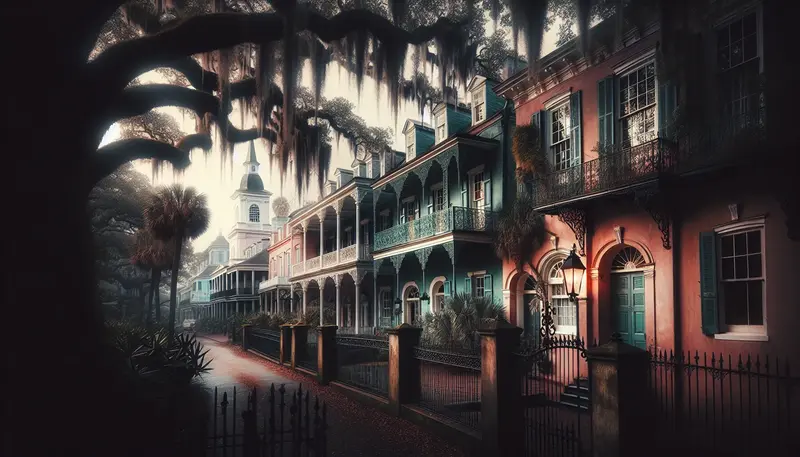
Could a picturesque façade hide a restless past? The Pink House (commonly cited at 17 Chalmers Street in popular guides) and the pastel houses of Rainbow Row are among Charleston’s most photographed spots. Those same buildings are often included on lists of Charleston haunted places because of recurring stories: a woman seen by night at a second-floor window, muffled crying from vacant rooms, and objects rearranged between visitors. The contrast between postcard charm and melancholic reports is part of what makes these locations compelling to both historians and ghost story enthusiasts.
Reported incidents range from subtle to dramatic. One specific report tied to the Pink House (built circa 1889 by cotton merchant Thomas Sutton) describes a visitor in October 1992 who entered during a private afternoon viewing and heard "Frère Jacques" in a second-floor room; the melody matched one listed in an 1887 letter from Margaret Hastings to her daughter in the Charleston Historical Society archives. That convergence of sensory report and documentary artifact is often noted in analyses that try to distinguish coincidence from resonance. Another account, tied to a Rainbow Row residence, involves a long-term tenant who reported footsteps pacing above while the house was empty; subsequent inspections revealed no structural causes and the noises ceased only after the occupant left — an anecdote recorded in neighborhood association minutes.
Because the Pink House and Rainbow Row are private properties or closely adjacent to private homes, investigators emphasize respecting inhabitants’ privacy; nevertheless, municipal records, property deeds, and historical registries provide dates, ownership histories, and renovation timelines that help researchers trace origins for reported experiences. For those compiling Charleston ghost itineraries, these colorful streets illustrate how living neighborhoods sustain and transmit haunted narratives across generations. For related history, see our charleston's pirate ghosts: blackbeard, bonnet, and.
Charleston Cemeteries and Churchyards — Burial Grounds of Memory and Reported Manifestations
Is it any surprise that places devoted to the dead attract stories about the dead? Charleston’s cemeteries and churchyards — including St. Michael’s Churchyard, Circular Congregational Churchyard, and Magnolia Cemetery on the Ashley River — are integral to the city’s physical history. Many of these burial grounds date to the 18th and 19th centuries, with headstones, family plots, and memorials that document the city’s demographic and epidemic history. That archival depth makes them focal points for reports of melancholic apparitions, flickering lights between stones, and voices heard amid rustling oaks.
Specific reported experiences in these spaces are both sensory and visual. For example, visitors to St. Michael’s Churchyard near Broad and Church Streets have reported seeing a lone figure garbed in period clothing crossing the cemetery after sunset; several such sightings were catalogued by a local preservation group in the 1990s. At Magnolia Cemetery on the Ashley River, which opened in November 1850 and holds approximately 14,000 graves of Confederate, Union, and civilian remains, caretakers have reported recurring distant singing on Memorial Day evenings (May 30 historically, May 27 modern observance) when no organized performance took place — an auditory phenomenon that regional historians have linked to the cemetery’s role in commemorative practices. These accounts often appear in oral-history collections and local periodical interviews.
Historical documents — burial registers, epitaphs, and contemporary death notices — anchor these sites in verifiable fact. Investigators and historians recommend consulting those records before drawing conclusions, since the patterns of mourning and ritual can explain many experiences. Nonetheless, the persistence of similar reports across decades reinforces the cemetery precincts’ reputations among Charleston haunted places and for those cataloguing Charleston ghost lore.
City Market, Broad Street Residences, and Everyday Charleston Hauntings
Can ordinary urban life carry ordinary hauntings? Beyond high-profile landmarks, Charleston’s everyday streets and residences contribute to the city’s haunted reputation. The Charleston City Market (stretching along Market Street and Meeting Street), Broad Street’s historic homes, and numerous private residences in the French Quarter have been the setting for unexplained knocks on doors, recurring reflections in old mirrors, and EMF-style reports by contemporary investigators. Because these accounts often intersect with daily commerce and private life, they present a different category of Charleston ghost narratives: the domestic and quotidian.
Two representative reported experiences: a vendor at the City Market reported in 2010 that an antique chest display kept closing overnight despite being secured; the vendor’s testimony appeared in local business association notes and was corroborated by two other stallholders. Separately, a Broad Street homeowner documented a series of nocturnal footsteps and a piano heard in an empty parlor during the early 2000s; she recorded audio that contained indistinct musical tones, which she later donated to a local archive. These examples highlight how merchant logs and homeowners’ records can serve as contemporaneous documentation for phenomena often dismissed as folklore.
Official records — property deeds, business licenses, and market operating permits — give precise dates and help establish continuity for reported events, while oral testimony collected by tour operators, neighborhood associations, and preservation groups preserves the texture of personal encounters. For anyone assembling a list of Charleston haunted sites or studying Charleston ghost traditions, the mix of public and private reports underlines that haunting narratives exist not just in famous buildings but in the hum of everyday city life.