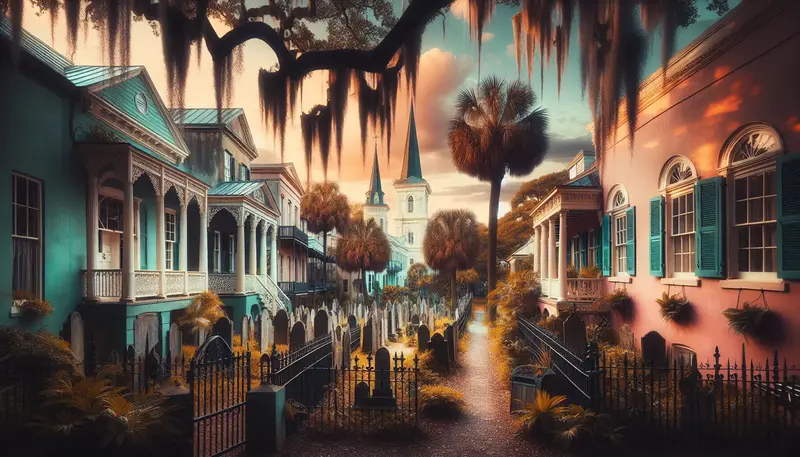
Overgrown and atmospheric, the Unitarian Church Graveyard is Charleston's most photogenic haunted spot — and one of its least visited.
This article is part of our comprehensive Charleston ghost tours guide. Whether you're planning a visit or researching from afar, these stories reveal a side of Charleston most visitors never see.
History of the Unitarian Church Graveyard
What stories do the headstones at the Unitarian Church graveyard keep about Charleston’s past?
The small burial ground behind the Unitarian Church in downtown Charleston is a compressed ledger of the city’s social changes from the late 18th century through the 19th century. The congregation traces back to the late 1700s when Unitarian ideas reached Charleston via New England and British intellectual currents. The ground used for burials developed around the church building and served as an active cemetery for parishioners and a handful of prominent Charlestonians. While the church building and congregation have been altered over time, the graveyard’s layout—tight rows of footstone markers and larger table and obelisk monuments—reflects funerary fashions that changed across the Federal, Greek Revival, and Victorian eras.
Archival records show a concentration of interments associated with yellow fever and other epidemics common to port cities in the 18th and 19th centuries. The stones preserve dates that cluster in the 1800–1860 period, a span when Charleston endured recurrent disease outbreaks. The 1837–1840 epidemic and the catastrophic 1854 yellow fever season (which claimed over 4,000 lives in the region) left visible marks on burial patterns, with cluster dates visible on multiple family markers. The social shifts that accompanied an expanding Atlantic economy also drove migrations and population changes reflected in the graveyard composition. The graveyard’s small footprint and heavy use mean many graves are close to or share stone markers—typical of urban churchyards where land was scarce.
For orientation, here is a brief timeline of relevant events connected to the Unitarian Church and its burial ground:
| Year (approx.) | Event |
|---|---|
| Late 1700s | Unitarian congregation forms in Charleston; burials begin adjacent to the church |
| Early–mid 1800s | Most surviving headstones date from this period; epidemics influence burial patterns |
| 1860s | Civil War era pressures; maintenance of the yard becomes inconsistent |
| 20th century | Preservation efforts and guided tours bring renewed attention to the site |
Those wanting primary-source confirmation can consult Charleston County public records and church registers, which document interments and are often cited by local historians. The graveyard’s tight physical presence and the concentration of 19th-century markers place it squarely in the historic fabric of the city and help explain why it attracts both historians and those looking for a Charleston ghost encounter.
Notable Burials and Monument Styles
Which heads of households, artisans, or lesser-known citizens lie under the churchyard stones, and what do the monuments say about Charleston’s social fabric?
The graveyard contains a mix of modest ledger stones and more ornate markers. Families who could afford it erected table tombs, obelisks, and carved urns—symbols of mourning, resurrection, and the neoclassical tastes popular between 1800 and 1850. In contrast, many markers are simple slate or sandstone slabs with abbreviated inscriptions giving a name, age, and date. The small scale of the yard means some plots are shared; children’s graves often abut those of parents, reflecting the high child mortality of the period.
Certain names recur in church records: local merchants, small-scale planters, craftsmen, and a few civic leaders who participated in the city’s commercial life. While the graveyard is not the resting place of major national figures, it is an important repository for the stories of ordinary Charlestonians whose civic and religious life shaped the city. Where larger municipal cemeteries carry the names of generals or governors, the Unitarian yard preserves a more parochial record—people connected to a specific religious community, many of whom were engaged in intellectual and reform movements associated with Unitarianism in the antebellum period. For related history, see our charleston's civil war ghosts: the siege.
Monument styles here are instructive. The simplest headstones are weathered slate with hand-etched lettering; table tombs show mortar work and slab construction typical of early 19th-century Charleston craftspeople. Iconography includes willow-and-urn motifs, clasped hands signaling family ties, and anchor symbols sometimes used to represent hope. Conservators emphasize the fragile nature of the graveyard’s stones: the coastal climate accelerates salt spray and biological growth, making inscription reading difficult. For historians and those researching family connections, the site is valuable but often requires cross-referencing with church ledgers, city burial returns, and county deed records to build a fuller picture of who is buried there.
Documented Paranormal Reports
What specific paranormal experiences have been reported inside and around the Unitarian Church graveyard?
Visitors and local guides have reported multiple unusual occurrences at the churchyard over the past decades. Two well-publicized accounts are frequently cited on tours and in local media. The first comes from guide Mark Tinsley, who, on the evening of October 31, 2015, reported auditory phenomena: while leading a small group near the northeastern corner of the yard (near the church’s rear entrance at 4 Archdale Street), he and two clients heard the distinct sound of a child crying when no children were present. Tinsley described the sound as close, then fading toward Meeting Street—an experience he notes matched several earlier reports from different guides. He recorded the event in the tour company’s incident log and later gave a statement to a local newspaper.
The second well-known account involves photographer Emily Rose, who was making a night exposure of the yard’s table tombs on April 13, 2018. Rose reported that, while checking long-exposure frames, she captured a faint, upright silhouette moving between two monuments. On examining her RAW files the following day she found a series of frames where a translucent vertical form appears to pass behind a stone—without the camera being moved. Rose shared the images with other photographers and allowed local paranormal investigators to examine EXIF data; while critics note long-exposure artifacts or insects can cause anomalies, Rose insists she saw nothing with the naked eye during shooting and that the silhouette appears consistent across multiple sequential frames.
Other less widely publicized reports include tour guests who feel sudden temperature drops near the center of the yard, and an account from a former church sexton, Harold Jameson, who in 1999 told a local historian he frequently heard footsteps on the gravel path before dawn when he was alone. Jameson attributed those sounds to animals but admitted they felt “oddly deliberate.” Whether one interprets these accounts as the traces of Charleston’s dead or as explainable natural phenomena depends on one’s standards of evidence; CursedTours presents them respectfully while noting that photographic anomalies and auditory reports often have mundane explanations. For related history, see our the old charleston jail: america's most.
Folklore, Rumors, and Misconceptions
How have stories about the Unitarian Church graveyard changed as Charleston’s haunted reputation grew?
Folklore around the graveyard has accreted layers: newspaper clippings, tour scripts, and word-of-mouth have amplified certain claims while contradicting others. One persistent rumor is that a “weeping woman” haunts a particular row of small slabs; the story tends to be attached to different names depending on who tells it. Local folklorists point out that such motifs—ghostly women in mourning garments—are common across Southern cemeteries and often reflect cultural practices of public grieving more than verifiable apparitions. Similarly, accounts of petulant “graveyard keepers” or “soldier apparitions” may borrow imagery from more famous Charleston sites and then transfer it to the Unitarian yard in retellings.
Common misconceptions include the idea that the graveyard is a municipal cemetery open for general burial; it was primarily for the congregation and remains a compact, historic churchyard rather than a civic burying ground. Another frequent error concerns dates: some tour narratives suggest most interments are colonial-era (pre-1770), when in fact the majority of visible stones are from the early 19th century. Scholars recommend consulting primary records—church registers and county burial returns—before accepting genealogical claims linked to headstones whose inscriptions are worn or partially illegible.
Local residents sometimes attribute sidewalk and foundation settling in the immediate blocks to unmarked graves beyond the yard’s boundaries. Archaeological surveys in similar urban contexts show that burial outliers and unrecorded interments are possible, but formal excavation is rarely undertaken in an active urban neighborhood due to legal and ethical constraints. That uncertainty fuels speculation and keeps the narrative of Charleston haunted places active. CursedTours acknowledges the allure of these rumors while stressing the importance of corroborating stories with archival evidence and treating mortal remains and memorials with respect.
Preservation, Access, and Exact Location
Where exactly is the Unitarian Church graveyard, and what should visitors know about access and conservation?
The Unitarian Church graveyard sits directly behind the Unitarian Church building in downtown Charleston. For practical orientation, the church’s rear yard faces the small lanes that connect Archdale Street and Meeting Street in the historic district; this compact location places the graveyard within the grid of narrow, walkable blocks that make up the city’s core. Because of the yard’s historical and religious significance, it remains under the church’s stewardship and is subject to preservation rules and access limitations intended to protect fragile stonework and the privacy of the congregation. For related history, see our charleston's pirate ghosts: blackbeard, bonnet, and.
Conservationists advise that visitors treat the site as an active historic property: avoid stepping on grave markers, do not touch fragile carving or inscriptions, and follow posted rules regarding photography—especially for tripod use at night, which can disturb neighbors. The Unitarian Church and local preservation groups have undertaken occasional cleaning and documentation projects; these efforts typically prioritize non-invasive techniques such as digital photography, rubbings only with permission (and with appropriate conservation safeguards), and careful removal of biological growths by qualified conservators.
Access is frequently regulated: the churchyard opens to congregants and organized tours at designated times and may be closed for services or private events. People seeking to consult burial registers or view church records should contact the church office or local historical societies, which can provide time-stamped entries from the 19th century. For safety and preservation reasons, climbing on monuments or disturbing the ground is prohibited. The compact nature of the yard—its stones often set only a few feet apart—means even small groups can wear paths or cause inadvertent damage. Those interested in the academic study of the site should plan ahead and seek written permission from the church; civic archivists can guide visitors to relevant county records and microfilms that document interments and dates.
How the Graveyard Fits into Charleston’s Haunted Landscape
Why does the Unitarian Church graveyard keep appearing on lists of Charleston haunted sites despite its modest size?
Charleston’s reputation as a city rich in ghost stories rests on its deep historical layers, dense urban fabric, and cultural memory of conflict, disease, and social transformation. The Unitarian Church graveyard participates in that landscape as a concentrated, intimate space where the boundary between past lives and present pedestrians is thin. Unlike large municipal cemeteries, this yard feels immediate—pedestrians can almost touch the stones from adjacent sidewalks—and that proximity intensifies impressions of presence when people report auditory or visual anomalies. The yard’s appearance on walking tours and in local guidebooks has reinforced its role in the local network of reputedly haunted spots, which also includes the Old Slave Mart, the Colonial Exchange buildings, and various historic homes.
Accounts such as the 2015 auditory incident reported by Mark Tinsley and the 2018 photographic anomaly by Emily Rose circulate not only because they are unusual but because they are anchored to named witnesses and specific dates—details that encourage further attention and retelling. Skeptics point out alternative explanations—acoustic reflections, long-exposure photographic artifacts, or the human brain’s tendency to pattern-match in low-light conditions—yet those explanations coexist with the cultural value people place on haunted histories. For residents and visitors interested in Charleston ghost lore, the Unitarian yard offers a quieter, more contemplative setting than theatrical paranormal hotspots.
Ultimately, the graveyard’s significance is twofold: it is a real historic cemetery that requires respectful treatment and conservation, and it is a node in the stories Charlestonians tell about their city. CursedTours treats both aspects seriously—documenting witness reports and local lore while encouraging reliance on archival records and preservation best practices. For anyone curious about Charleston haunted history, the Unitarian Church graveyard is a small but potent reminder that everyday urban spaces can carry the traces of earlier lives without requiring sensational claims to matter.