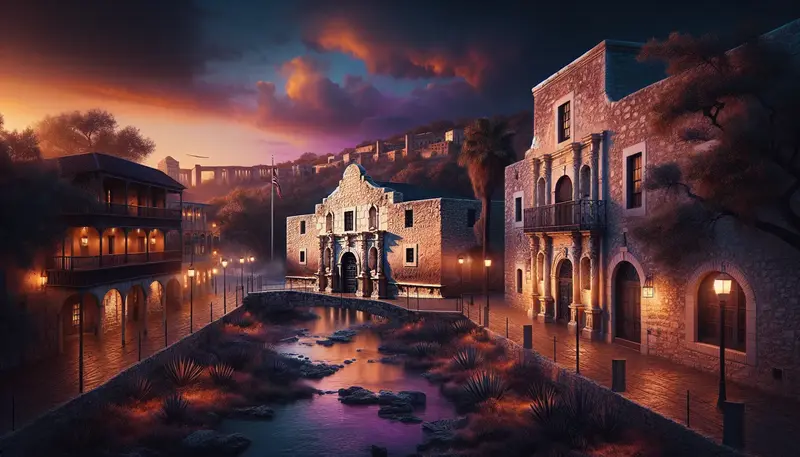
San Antonio's history stretches back 300 years through Spanish missions, the Texas Revolution, and frontier violence. The ghosts reflect every era.
This article is part of our comprehensive San Antonio ghost tours guide. Whether you're planning a visit or researching from afar, these stories reveal a side of San Antonio most visitors never see.
The Alamo — 300 Alamo Plaza: The Heart of San Antonio’s Haunted History
What does it feel like to stand where history turned deadly on March 6, 1836? The Alamo (300 Alamo Plaza, San Antonio, TX 78205) is the city’s most iconic landmark and one of its most persistent San Antonio ghost stories. The 1836 Battle of the Alamo is a historical fact: approximately 189 Texian defenders fell to the Mexican Army under General Antonio López de Santa Anna during the thirteen-day siege from February 23 to March 6, 1836. That violent history has seeded accounts of residual activity, apparitions, and unexplained sounds that make the site a focal point for San Antonio haunted lore.
Historical context and why the site is charged
Mission San Antonio de Valero (the Alamo) dates to the early 18th century but became a military fortress by the 1800s. The 1836 siege is recorded in primary sources, letters, and official reports; those same sources describe desperate close-quarters fighting and personal loss, factors that often anchor ghost narratives. Preservation efforts by the Daughters of the Republic of Texas and later the Texas General Land Office mean the site now blends museum curation with public visitation — a combination that produces many reported encounters.
Reported phenomena and eyewitness accounts
Visitors and staff report a range of phenomena: footsteps in closed rooms, echoes of battle cries, cold spots in the chapel, and shadowy, uniformed figures moving along the barracks area. In one oft-cited account from the 1990s, a night-security officer reported seeing a group of figures in period dress moving across the parade ground before vanishing through a wall. In recent years, multiple tour guides and evening staff have described EVPs (electronic voice phenomena) and unexplained mechanical malfunctions in rooms that are otherwise climate-controlled and monitored by cameras. Those accounts are documented in local media and in oral histories collected by tour operators. The Alamo’s long residency as a museum and memorial means encounters are often reported by eyewitnesses who can place their experience within the larger documentary record.
Mission San José and the San Antonio Missions — 6701 San Jose Dr and Mission Row
Could the missions built in the 18th century still carry echoes of a colonial past? Mission San José y San Miguel de Aguayo (6701 San Jose Dr, San Antonio, TX 78214) anchors the San Antonio Missions National Historical Park, a stretch of mission complexes founded between 1718 and 1731. These missions were religious, cultural, and economic centers that witnessed epidemics, shifting geopolitical control, and daily hardships — fertile ground for stories that mark the park as San Antonio haunted territory.
Why these missions feel haunted
Mission San José is sometimes called the “Queen of the Missions” for its impressive size spanning 8.2 acres and its artistic stone carvings and dome. The missions’ stone churches, living quarters, and granaries were scenes of baptism, labor, and death. Spanish Franciscans, indigenous Coahuiltecan people, and Spanish colonial settlers lived, worked, and were buried in these places between 1718 and the Mexican secularization of 1824. The combination of ritual, mortality, and cultural overlap explains why observers often report atmospheric disturbances: sudden changes in temperature, faint chanting, and the sensation of being watched near ancient cemeteries. For related history, see our the alamo's ghost stories: the battle.
Specific reports from the missions
Park rangers and visitors have reported hearing voices near the mission cemeteries after hours and seeing pale figures in doorway arches when no other visitors were present. In 2008, a volunteer reported hearing group footsteps in the mission convento long after the facility had closed; security footage showed no one entering but captured a fleeting shadow crossing a corridor. Such reports are part of the missions’ modern oral record; park staff approach them cautiously, noting environmental explanations but documenting the frequency and locations of claims. For people interested in San Antonio ghost lore, the missions offer a mixture of verifiable history and persistent, respectfully reported anomalies.
Menger Hotel — 204 Alamo Plaza: A Victorian Hotel Full of Stories
What makes a hotel built in 1859 one of the most frequently reported San Antonio haunted locations? The Menger Hotel (204 Alamo Plaza, San Antonio, TX 78205) opened on March 1, 1859, and has hosted businessmen, politicians, and military figures, including President Theodore Roosevelt and the Rough Riders cavalry regiment in May 1898. Its long continuous use, Victorian furnishings, and close proximity to the Alamo create an atmosphere rich for legend and repeated unexplained occurrences.
History that feeds the legend
The Menger’s history is well documented: it was built by William Menger, a German-born merchant and hotelier, and it has preserved much of its 19th-century character through multiple renovations while maintaining original architectural details. That preservation means original woodwork, antique fixtures, and small service areas remain in active use, and such features can produce creaks and thermal shifts that are then layered with stories of past residents. The hotel’s staff and guests have compiled a trove of anecdotal experiences that contribute to the Menger’s reputation as a San Antonio haunted site.
Notable reported encounters
There are numerous accounts of guests and employees encountering unexplained phenomena: chambermaids feeling an unseen presence tugging at blankets, guests hearing faint piano music from an empty parlor, and a recurrent sighting of a man in an 1870s-style uniform on the mezzanine. One well-documented case involves a late-night front-desk clerk who, in the 1970s, reported seeing the figure of a small woman in period maid’s attire standing beside an unoccupied bed; subsequent staff placed the sighting in a pattern of similar reports. Another frequent report concerns toys and small objects that were left in a storage area apparently moved or rearranged overnight, witnessed by multiple housekeeping staff across different years. While skeptical investigators note natural explanations — settling floors, old plumbing, or mislaid items — these repeated reports by long-term employees contribute to the hotel’s storied reputation. For related history, see our the menger hotel: san antonio's grand.
Emily Morgan Hotel (Medical Arts Building) — 705 E Houston St: From Patients to Paranormal
How does a former medical facility become one of the city’s most visited paranormal locations? The Emily Morgan Hotel (705 E Houston St, San Antonio, TX 78205), now a boutique hotel, occupies a structure that once housed medical offices and a regional medical clinic. Buildings with medical histories often attract ghost stories because of the associations with illness, death, and intense human emotion — and the Emily Morgan is no exception.
Architectural and institutional background
The Medical Arts Building, completed in 1927 and later known as the Emily Morgan Hotel, was designed in Gothic Revival style and served doctors, clinics, and at times psychiatric services throughout the 20th century. That institutional past, coupled with a Gothic revival facade and ornate interior corridors, lends itself to an atmospheric presence at night. Historians note that medical facilities of that era lacked modern sanitation and treatments, increasing mortality rates and the likelihood of tragic personal stories — which later generations will sometimes interpret as residual hauntings.
Common reports and investigations
Guest reports at the Emily Morgan include disembodied footsteps in empty hallways, a sense of being watched from doorways, and occasional cold spots in specific rooms. One frequently cited story involves a business traveler who checked into a room and found medical equipment noises and whispered speech when no staff were present; hotel staff later noted the guest insisted the sounds were clinical in nature. Paranormal investigators who have recorded EVP sessions on property have claimed to capture faint voices and indecipherable murmurs in the service corridors. The hotel’s management treats these reports seriously but emphasizes safety and factual documentation over sensational claims. The building’s role in San Antonio haunted narratives arises from a mix of verifiable institutional history and consistent, respectfully reported visitor experiences.
Spanish Governor’s Palace and La Villita — 105 Plaza de Armas and Historic District
Why do colonial administrative centers often feel like crossroads between eras? The Spanish Governor’s Palace (105 Plaza de Armas, San Antonio, TX 78205) served as the seat of colonial governance in the 18th century and sits in La Villita, one of San Antonio’s oldest neighborhoods. Its adobe walls, carved doors, and interior patios recall early Spanish civic life, and those physical markers anchor stories of presences, inexplicable drafts, and the occasional apparition. For related history, see our san antonio's spanish missions: faith, disease,.
Civic architecture and lingering narratives
The Palace dates to 1749 as a seat for Spanish colonial governance and has been restored and interpreted as a museum by the National Park Service. Administrative centers like the Palace were the site of proclamations, legal disputes, and personal dramas; burial grounds and execution sites from the colonial period were often nearby. Such associations can seed reports of lingering impressions — unusual sounds in the archive rooms, watches of shadowy figures in the Plaza at closing time, and sudden changes in air that staff attribute to structural quirks.
Eyewitness reports and cultural memory
Museum docents and La Villita artisans report seeing figures moving behind curtained windows after hours and hearing the sounds of voices in languages from the 18th and 19th centuries when no events were scheduled. A consistent local account tells of an apparition in formal Spanish colonial dress glimpsed from the Plaza, though such sightings are infrequent and often reported by tourists looking back on the building’s dramatic façade. The Spanish Governor’s Palace is often included in San Antonio ghost tours because it combines clear, documented colonial history with occasional, respectfully recounted experiences that visitors and staff say resist easy explanation.
St. Anthony Historic Hotel — 300 E Travis St and a Final List of Addresses
Can a turn-of-the-century grand hotel collect stories over a century and still feel present? The St. Anthony Historic Hotel (300 E Travis St, San Antonio, TX 78205) opened on May 3, 1909, and was once billed as the “Waldorf of the West,” hosting presidents, celebrities, and dignitaries throughout the 20th century. Such grand hotels frequently accrue reports of lingering presences, often associated with former proprietors, long-term staff, or guests who died on the premises. The St. Anthony’s scale and continuous operation make it a repository of anecdotes and occasional unexplained occurrences.
Key reported phenomena at the St. Anthony
Reports associated with the St. Anthony include random elevator behavior, transient guests sensing an unseen presence, and employees hearing music from the early 20th-century bandstand when none is scheduled. One long-term maintenance worker described finding a hallway light repeatedly toggled on at dawn despite the circuit being locked — the worker tested the wiring and found no fault that explained the precise timing. Whether interpreted as mechanical quirks or something more, these repeat occurrences feed the hotel’s San Antonio haunted reputation.
Quick-reference table of addresses and focus points
For readers who want a concise reference, the table below lists the places covered and their addresses. These remain public, documented sites where historical fact and ghost lore meet.
| Location | Address | Why it’s noted |
|---|---|---|
| The Alamo | 300 Alamo Plaza, San Antonio, TX 78205 | Site of 1836 battle; frequent reports of apparitions and EVPs |
| Mission San José (San Antonio Missions) | 6701 San Jose Dr, San Antonio, TX 78214 | 18th-century mission with cemetery and atmospheric reports |
| Menger Hotel | 204 Alamo Plaza, San Antonio, TX 78205 | Victorian hotel (1859) with repeated staff and guest reports |
| Emily Morgan Hotel (Medical Arts) | 705 E Houston St, San Antonio, TX 78205 | Former medical facility; accounts of footsteps and EVPs |
| Spanish Governor’s Palace | 105 Plaza de Armas, San Antonio, TX 78205 | Colonial administration site; occasional sightings and voices |
| St. Anthony Historic Hotel | 300 E Travis St, San Antonio, TX 78205 | 1909 grand hotel with repeated anomalous reports |
Across these sites, San Antonio ghost lore arises from a clear historical base and repeatable firsthand reports. Whether a visitor approaches these accounts skeptically or as an open-minded observer, the combination of verified history, architectural continuity, and persistent stories makes San Antonio haunted narratives compelling to historians, folklorists, and curious members of the public alike.