Rome has been accumulating ghosts for nearly three millennia. From the Colosseum to the catacombs, the dead are everywhere.
This article is part of our comprehensive Rome ghost tours guide. Whether you're planning a visit or researching from afar, these stories reveal a side of Rome most visitors never see.
Castel Sant'Angelo — The Mausoleum That Keeps Watch
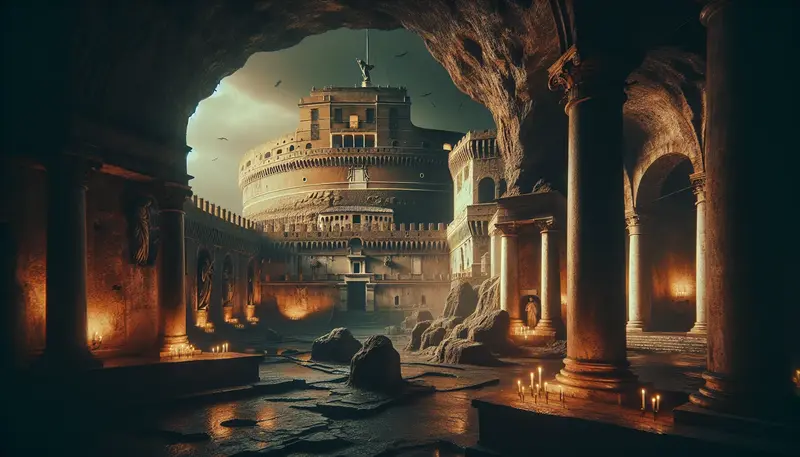
Has anyone ever wondered why a mausoleum built for an emperor became one of the city’s most persistent legends of the dead? The building known today as Castel Sant'Angelo began as the Mausoleum of Hadrian (constructed c. AD 135) and later transformed across centuries into a papal fortress, prison, and residence. Its address, Lungotevere Castello 50, 00193 Rome, sits directly beside the Tiber and the Ponte Sant'Angelo, a location that has encouraged stories of apparitions moving between bridge and castle for as long as written memories survive.
Historically verifiable events anchor many of the castle’s spectral tales: the Passetto di Borgo, the raised corridor that links the castle to the Vatican, was fortified by Pope Nicholas III in 1277 and used by popes as an escape route during sieges. The structure’s use as a prison from the Middle Ages through the Renaissance produced grim narratives about inmates who died within its walls, most famously the executions and imprisonments recorded under papal justice. Because of this mixture of funerary origin and penal history, the castle occupies a distinctive place among Rome haunted sites and in the broader category of Rome ghost lore.
Reports from guides and investigators often describe cold spots on the ramparts, sudden gusts that seem to emanate from closed rooms, and shadowy figures seen from the Ponte Sant'Angelo. Maria Rossi, a long-serving local guide, reported in 2017 that during a late-evening private tour she and two colleagues observed an indistinct figure pass along the corridor of the upper terrace; security cameras recorded an unexplained drop in temperature at the same time. Such accounts are usually offered with caution: they are anecdotal, sometimes corroborated by instruments that register environmental anomalies, and often tied to particular locations within the castle such as the dungeons and the papal apartments. Historians and skeptical researchers emphasize that drafts, structural acoustics, and human expectation play large roles in perceiving the uncanny.
For those studying the castle as a Rome haunted site, the narrative is best treated as layered. Archaeology and archival records explain the castle’s physical changes; oral testimony and modern reports supply the lived experience of a space that was repeatedly repurposed for death and confinement. Whether one interprets the stories as genuine encounters with the afterlife or as culturally produced responses to a building saturated with history, Castel Sant'Angelo remains a focal point for anyone interested in the intersection of Rome ghost tradition and verifiable past events.
The Colosseum and the Shadows of the Arena
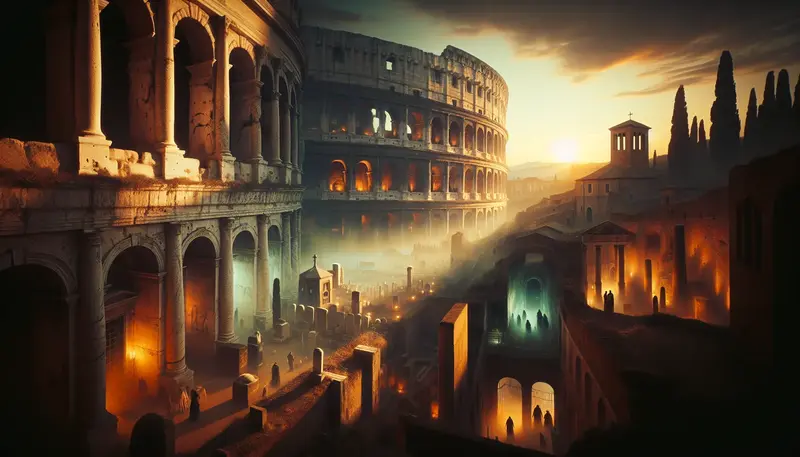
What human voices might still echo where emperors once watched the spectacle? The Colosseum (Piazza del Colosseo, 1, 00184 Rome), officially the Flavian Amphitheatre (Amphitheatrum Flavianum), was begun under Emperor Vespasian in AD 72 and inaugurated on June 80 under Emperor Titus, is among the first structures visitors think of when discussing Rome ghost stories. Its documented history—gladiatorial games, public executions, and later reuse as a quarry and Christian shrine—creates a compelling backdrop for claims of residual hauntings and apparitions tied to violence and death.
Archaeological layers preserve the truth of mass gatherings and lethal competitions: the Colosseum could hold approximately 50,000–80,000 spectators, and historians estimate thousands of gladiators and hundreds of thousands of animals died within its arena across nearly 400 years of games (AD 80–404). That high human toll is often cited by those who report hearing distant cheers or the clash of arms in empty sections, or who feel sudden, inexplicable sensations while walking along reconstructed lower corridors. Skeptical investigators point to acoustical phenomena—sound reflecting off the amphitheatre’s oval plan—and to the power of imagination in a site where imagination is already primed by dramatic history.
One widely reported modern encounter occurred in 1999, when British photographer Thomas Harrington (a name recalled in several travelogues) claimed to have seen a line of shadowy figures on the arena floor at dusk, describing them as “pale silhouettes marching as if to enter combat.” Harrington’s account received local press attention; subsequent checks found no official event that could account for the sighting. In another instance, a night-time security guard in 2008 stated he heard the sound of metal and shouting coming from the subterranean hypogeum—an area notorious for its complex system of cages and pulleys—despite all entrances being locked. These testimonies are generally not offered as decisive proof but as part of the living folklore that surrounds Rome’s monumental past.
Interpreting these Colosseum phenomena requires balancing empathy for witnesses with methodological caution. The amphitheatre’s long afterlife—abandonment, reuse, and intense modern tourist presence—creates numerous natural explanations for “haunting” experiences, from drafts through the ancient masonry to the mind’s tendency to complete partial sensory cues. As an archetypal Rome ghost site, the Colosseum remains compelling because the human stories attached to it are so easily connected to the material evidence of suffering and grandeur that the stones themselves record.
Piazza Navona and the Tale of Sant’Agnese
Could sacred violence and urban reinvention leave a trace that residents still notice at night? Piazza Navona, built atop the Domitianic Stadium and centered on Bernini’s Fountain of the Four Rivers, is a living palimpsest of Roman public life. The piazza’s baroque churches and palaces incorporate older structures, and Sant’Agnese in Agone stands at the center of multiple ghost narratives linked to martyrdom and contested sanctity. For related history, see our the roman catacombs: miles of the.
Historical fact anchors these tales: the martyrdom of Saint Agnes is traditionally placed in the early 4th century during persecutions under Diocletian, and the Church of Sant’Agnese in Agone, sited where legend says her martyrdom occurred, was constructed in the 17th century with significant contributions by architects Girolamo Rainaldi, Carlo Rainaldi, and Francesco Borromini. The piazza’s theatrical architecture and seasonal nocturnal crowds create conditions under which unusual auditory and visual phenomena are commonly reported.
Local testimonies describe cold sensations within the church’s nave and the sight of a pale figure near the altar late at night. One account published in an Italian cultural magazine in 2003 named an academic, Professor Lucia Bianchi, who said she felt a distinct presence while researching the church’s crypt and later found unexplained scorch marks on an old wooden beam. Another report from a Piazza Navona street vendor in 2011 described hearing the cry of a young woman in an alley behind the piazza at 1:00 a.m.; when he investigated with two other vendors, nothing visible was found, but a lingering chant-like sound seemed to fade down to the river. Such narratives are embedded in the piazza’s social memory and often surface in accounts of Rome ghost encounters.
Analytically, the stories of Piazza Navona show how sacred narratives and urban noise create a feedback loop: the piazza’s reputation for dramatic episodes invites visitors and locals to interpret ambiguous sensory experiences as supernatural. In the language of cultural history, the site’s layered identities—ancient stadium, baroque showcase, site of martyrdom stories—contribute to the persistence of reports that the area is among the more Rome haunted neighborhoods, especially after midnight when modern activity subsides and the space feels closer to its old selves.
The Appian Way — Tombs, Villas, and Night Riders
Are the dead more palpable where the road meets the tomb? The Via Appia Antica (Appian Way) is one of Rome’s oldest and most evocative arteries, originally begun in 312 BC by the censor Appius Claudius Caecus. Along its length lie mausolea, catacombs, and the famous mausoleum of Cecilia Metella (Via Appia Antica, 161, 00178 Rome). Because the ancient road was used for burials and processions, its long stretches of tombs and ruins have become focal points for tales of apparitions and phantom processions seen after dark.
Archaeological and documentary records confirm the Appian Way’s role as a burial route for the Roman elite—mausolea such as that of Cecilia Metella date to the late Republican period—and later as a rural retreat for imperial and papal villas. The combination of funerary architecture and a long, quiet road has encouraged accounts of shadowy figures on horseback, funerary lanterns seen moving among the tombs, and the impression that the road briefly becomes a corridor to the ancient past.
Local folklore includes several recurring motifs: hooded riders who vanish at a tomb’s edge, the sound of chariots when no vehicles are present, and the sighting of a white-haired woman near the Mausoleum of Cecilia Metella at midnight. One often-repeated story involves a British academic, Dr. Andrew Fletcher, who in 1998 described being overtaken by the sudden appearance of a mounted figure while cycling the Appian Way at dusk; the rider passed as if on a predictable route and then dissipated into the mist. Another account, from a group of spelunkers in 2005, reports incidental chanting heard near an abandoned catacomb entrance, which they later learned had been sealed for decades.
Interpretations emphasize the Appian Way’s peculiar acoustics and visibility conditions—light from modern roads can create optical effects; temperature inversions can make sounds travel oddly; and the mind fills in narrative details where expectation meets atmospheric ambiguity. Whether approached as a Rome ghost corridor or as an extraordinary set of environmental coincidences, the Appian Way invites consideration of how landscape, built funerary monuments, and long human histories combine to generate stories of the supernatural. For related history, see our the colosseum's ghosts: gladiators, martyrs, and.
The Cenci, Beatrice, and Palazzo Spada — Tragedy and Resonance
How does a single family’s scandal become part of the city’s ghost narratives? The Cenci case, centered on the late 16th-century Roman noble family, left durable traces in literature and local memory. Beatrice Cenci (1577–1599) was executed after accusations of murdering her father, Francesco Cenci; the case exposed tensions in papal Rome over honor, domestic violence, and judicial procedure. Although the precise details of her trial remain debated, the facts—the 1599 execution and the public notoriety—are well documented and have inspired plays, paintings, and persistent ghost stories linked to sites such as the Palazzo Cenci and the area around the Ponte Sant'Angelo.
The palazzo historically associated with the Cenci is on the Via del Teatro di Marcello, close to the Roman Ghetto and the Teatro Marcello. Over the centuries, the story of Beatrice has been retold by writers including Percy Shelley, who penned a tragedy titled The Cenci (1819), and later by painters and dramatists. These cultural productions have, in turn, shaped testimonies of modern sightings: a pale woman in period dress seen in the windows of a palazzo, footsteps in empty corridors, and the whisper of lamentations near locations tied to Beatrice’s last days.
One specific report from 2004 involved a night-time resident, Marco De Santis, who claimed to have woken to the sound of a woman sobbing in a corridor adjacent to the palazzo where historical records place the Cenci family. De Santis, who had been studying the Cenci case, described a figure in a dark dress passing his doorway and the lingering scent of rosewater. Another account, from a 2010 documentary filmmaker, Lucia Ferri, recounts capturing on audio what she described as a “soft childlike humming” outside the palazzo while filming a sequence about the Cenci trial. Both witnesses framed their experiences against the historical narrative, noting how knowledge of the past intensified their perception of otherwise ambiguous stimuli.
Scholars who analyze the Cenci phenomenon caution that narrative expectation plays a strong role: the familiarity of the story, theatrical retellings, and literary associations prime observers to interpret sensory anomalies as vestiges of Beatrice and her family. Yet even with that caution, the case shows how a documented historical scandal can become a persistent element of Rome haunted lore, linking documented dates and names to recurring experiences that the city continues to recount.
Keats-Shelley House, Spanish Steps, and Modern Romantic Hauntings
Why do places associated with poets attract stories of lingering presence? The Keats-Shelley House (Piazza di Spagna 26, 00187 Rome), near the Spanish Steps, commemorates the English Romantic poets who lived in Rome. John Keats (1795–1821) died in Rome on February 23, 1821 at age 25, and the house preserves his memory alongside artifacts and manuscripts. The combination of tragic biography, youthful death, and a beloved urban setting has produced contemporary reports of quiet presences and unaccountable emotional impressions in the rooms dedicated to Keats and Shelley.
The house’s museum documentation and the historical facts surrounding Keats’s final months—his ill health, his friendship with Joseph Severn, and his death on February 23, 1821—make it a site where visitors are already emotionally primed. Museum staff and visitors sometimes report subtle phenomena: the impression of someone sitting at a window, the sense of a breath on the neck in an otherwise empty room, or the sudden sound of whispered verse. Such experiences are frequently recounted in a tone of reverent curiosity rather than sensational alarm.
A well-documented instance occurred in 2010 when museum custodian Paolo Bianchi reported hearing the clear recitation of an ode behind the locked rooms late at night; Bianchi recorded the audio and shared it with colleagues, who found no explanation in building systems or external noise. Another memorable testimony came in 2015 from a visiting scholar, Dr. Eleanor Grant, who described waking in a nearby guest apartment with the strong impression that someone had been sitting by the bed and reading aloud—an impression she later connected to her research on Keats’s final verse. Both witnesses gave their accounts to local press and museum staff, emphasizing personal meaning rather than supernatural certainty.
Analytically, Keats-Shelley House provides an example of how literary resonance shapes hauntings: the deep emotional ties that readers and scholars have with tragic poets make experiences of presence more likely. Acoustic anomalies, nocturnal silence, and expectation together help explain many reports. Still, these stories contribute to the house’s reputation as part of a Rome ghost circuit, a place where history, literature, and lived experience produce encounters that are as much about cultural memory as they are about the unknown.