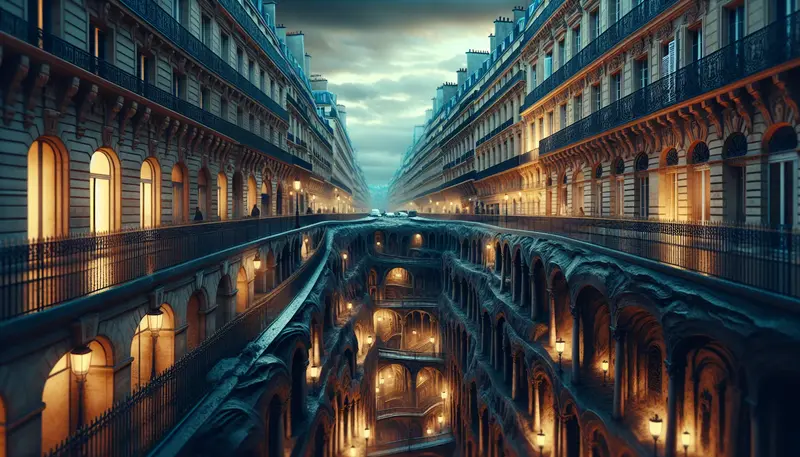
Beneath the romance of Paris lies a city built on bones — millions of them. The ghosts of revolution, plague, and war haunt every arrondissement.
This article is part of our comprehensive Paris ghost tours guide. Whether you're planning a visit or researching from afar, these stories reveal a side of Paris most visitors never see.
Les Catacombes de Paris — The Underground Ossuary at Place Denfert-Rochereau
Have you ever wondered what it feels like to walk beneath Paris where millions of bones line the walls? The Catacombs (Musée des Catacombes de Paris), accessed at 1 Avenue du Colonel Henri Rol-Tanguy, Place Denfert-Rochereau, 75014 Paris, were officially opened as an ossuary on April 2, 1786 when city cemeteries were overflowing and public health demanded radical solutions. The transfer of remains—estimated at approximately six million skeletal remains—continued into the early 19th century; by about 1810 the ossuary galleries were arranged and catalogued under the supervision of figures such as Jean-Baptiste-Auguste Héricart de Thury (1776–1854), who left detailed descriptions of the galleries and recorded numerous visitor accounts.
The history you can verify — the quarries, the police inspections and the ossuary plaques — sets the stage for why the Catacombs attract ghost and haunted interest. Reports of whispering, cold spots and shadowy figures are consistent across centuries of anecdote. Héricart de Thury himself noted that visitors sometimes claimed to hear faint voices echoing through otherwise empty corridors; he recorded those accounts in his descriptive works rather than endorsing them as literal fact, which is the forensic approach you’ll find useful when weighing such tales.
Modern-day reports come from urban explorers and former “cataphiles” (illicit tunnel visitors) who describe disorienting acoustic anomalies and the sensation of being followed in the labyrinth. The Catacombs are dangerous when entered off-hours — police periodically arrest people for illegal access — and stories of encounters are often tied to those illicit expeditions. Practical details matter: the official entrance is at 1 Avenue du Colonel Henri Rol-Tanguy/Place Denfert-Rochereau; public tours follow strict routes and safety rules implemented since the 19th century’s early management of the site.
Respectful skepticism is important here. Many phenomena can be explained by acoustics in narrow rock galleries, temperature differentials and the power of expectation when you stand surrounded by layers of human history. Still, the Catacombs remain among the most compelling haunted locations precisely because the human remains and the documented history provide a credible frame for visitors’ emotional reactions and the stories they tell afterward.
Père Lachaise Cemetery — Graves, Legends, and the Music of the Departed
Do you feel the pull toward places where a city’s famous dead gather? Père Lachaise, at 16 Rue du Repos, 75020 Paris, opened in 1804 and became the city’s principal garden cemetery through the 19th century, offering a who’s-who of Parisian culture — from Frédéric Chopin to Édith Piaf and Jim Morrison. The cemetery’s landscape of neo-classical tombs and mausoleums creates atmospheric corridors that often prompt reports of apparitions, moving shadows and disembodied music.
The documented history is clear: Père Lachaise’s layout was designed to attract burials and monuments, and over time folklore accreted around celebrated graves. Chroniclers of Parisian legend such as Paul Lacroix (Bibliophile Jacob, 1806–1884) gathered local stories about “white ladies” and nocturnal spectres around certain plots, recording communal memory without asserting supernatural truth. Those compilations form part of the cemetery’s folkloric record and help you separate long-standing tradition from later invention.
Contemporary witnesses often describe sensory experiences near particular memorials. For example, visitors to the Jim Morrison grave on a rainy night frequently report hearing rock music or seeing a shadowy figure at the periphery of candlelight; others gather at Édith Piaf’s tomb and speak of a sudden perfume scent. These are repeatable accounts but subjective; sound carries strangely through stone and trees, and human perception is shaped by expectation. Gravediggers and caretakers — who see the site daily — sometimes speak to reporters of inexplicable cold drafts and the occasional sense of being watched, but those accounts are usually framed as personal testimony rather than empirical proof.
When you visit Père Lachaise, note practical details: main gates (Boulevard de Ménilmontant and Boulevard de Ménilmontant side entrances) have set opening hours and the cemetery is patrolled at night — which is when most unverified spectral stories originate. Use recorded history, the chronicle of burials (many public records exist), and your own observation to form your view. The cemetery is a case where cultural memory, famous burials and human longing for contact with the past create a fertile ground for ghost lore. For related history, see our paris catacombs: six million dead beneath.
Palais Garnier (Opéra) — Phantom Stories Under Charles Garnier’s Dome
Would you expect an opera house built between 1861 and 1875 to contain more drama offstage than on? The Palais Garnier, at 8 Rue Scribe, 75009 Paris, is the setting for one of the city’s most enduring spectral narratives: the “phantom” of the opera. Architect Charles Garnier’s lavish building opened in 1875 and, almost immediately, stories circulated among staff and musicians about unexplained sounds, a mysterious presence and doors opening by themselves.
Gaston Leroux (1868–1927), the investigative journalist-turned-novelist who published The Phantom of the Opera in 1910, collected interviews with stagehands, box operators and concierges while researching his book. Leroux quoted eyewitnesses who described hearing phantom footsteps in closed wings and organ music where no organist sat. Leroux’s approach was literary but grounded in interviews, and those recorded testimonies remain a documented source for the Palais’ folklore. You should treat Leroux’s material as reported hearsay, valuable for cultural history rather than as standalone proof.
More recent staff and musicians have continued to report odd occurrences: unexplained drafts, the smell of cigar smoke in sealed areas and stage machinery operating with no apparent operator. Those phenomena have plausible technical explanations — drafts in older HVAC-less buildings, residual scents, and mechanical quirks — but repeated reports by different shifts and departments give the Palais Garnier a persistent reputation as one of the haunted theatrical spaces. Photographs and archival notices confirm the building’s age and technological idiosyncrasies; knowing those facts helps you evaluate claims made in the wings.
If you approach the Palais as a visitor, notice documented facts: the building’s inauguration on January 5, 1875; Garnier’s architectural solutions for stage and audience; and the long history of theatrical accidents and backstage tragedies that feed ghost stories. Leroux’s interviews provide named, primary-source material you can read alongside modern staff reports to understand how myth and workplace rumor accumulate in an opera house that prizes atmosphere as much as acoustics.
La Conciergerie and Île de la Cité — Revolutionary Imprisonment and the Memory of Martyrdom
Have you considered how a place shaped by state violence becomes a site of spectral memory? The Conciergerie, at 2 Boulevard du Palais, 75001 Paris, is part of the medieval Palais de la Cité and served as a principal prison during the Terror of the French Revolution. Marie-Antoinette was held here in 1793 before her trial and execution; the building’s stone cells, official registers and courtroom records form an archive of suffering that naturally produces ghost stories.
Historical facts are well-established: the Revolutionary Tribunal operated here, and prison registers, execution dates and official correspondences are accessible to researchers. That documentary record is essential when you consider reports of a “woman in white” or the sense of a presence near certain cells. Folklorists and historians who study revolutionary memory emphasize how martyr narratives — especially around figures like Marie-Antoinette — create ritualized storytelling that visitors frequently interpret as visitation or haunting.
Witness reports tend to come from guides, night custodians and occasional artists who work in the surrounding Île de la Cité. Many describe a sudden drop in temperature near the former prison cells, the sense of distant sobbing, or the impression of a figure passing through a corridor. These experiences are mixed with documented rituals: annual commemorations of the Revolution, reenactments and literature that keep the memory alive. That mixture of ritual and architecture explains why you may feel an emotional intensity there that others label supernatural.
Practical information matters: the Conciergerie is adjacent to Sainte-Chapelle (10 Boulevard du Palais) and Notre-Dame (Parvis Notre-Dame). You can consult prison inventories, Revolutionary Tribunal records and reliable secondary sources to contextualize what you feel and hear. The site offers an instructive example of how political violence and archival memory produce the conditions for ghost narratives without requiring supernatural explanations to account for powerful personal experiences. For related history, see our paris revolution ghosts: the guillotine's legacy.
Montmartre — Sacré-Cœur, Cabarets, and the Singing Graves
Have you ever stood where poets, painters and singers once lived and felt a sense of unfinished song? Montmartre’s hills, narrow lanes and cabaret history (notably the former Lapin Agile and the Moulin Rouge at 82 Boulevard de Clichy) created an artistic ecosystem that also produced tales of restless spirits. The Basilique du Sacré-Cœur at 35 Rue du Chevalier de la Barre, 75018 Paris, overlooks the neighborhood, and Montmartre Cemetery and nearby memorials hold graves of performers who attract pilgrims and stories.
Montmartre’s culture is documented: the hill was a village until its annexation to Paris in 1860; by the late 19th and early 20th centuries, it was a center for bohemian life. Many stories of posthumous presence are linked to performers whose celebrity invites repeated attention. One clear, verifiable point: Dalida (1933–1987), a major French-Italian singer, is interred at Montmartre Cemetery (Avenue Rachel), and devotees repeatedly report sensory experiences — the faint echo of singing or the sudden appearance of a single rose on a grave. These reports are typically subjective, tied to vigil and mourning practices rather than objectively corroborated evidence.
Another category of reports in Montmartre involves the abandoned corners of former quarries and ancient passageways, where locals and nocturnal visitors have sometimes described figures and strange lights. The neighborhood’s long association with artistic myth-making makes it likely that you will interpret ambiguous sensations as contact with the past. For a grounded approach, consult municipal maps that show old quarry lines and review Montmartre’s annexation history: these practical facts explain why strange acoustic effects and unexpected draughts occur in the hilltop lanes that host so much legend.
Whether you come for art history or for ghost stories, Montmartre demonstrates how cultural reverence for artists and performers generates contemporary haunted narratives. The human tendency to listen for voices in the memorial silence is as much a social phenomenon as it is a supernatural claim.
Nicolas Flamel House — Alchemy, Longevity Myths and Medieval Addresses
Would you be surprised to learn that a 15th-century house still standing at 51 Rue de Montmorency can fuel modern legends? The House of Nicolas Flamel (51 Rue de Montmorency, 75003 Paris, Marais district) dates from around 1407 and is the oldest stone house in Paris, built during the early Renaissance. Nicolas Flamel himself (c. 1330–1418), a professional scribe and bookseller, died at age 88; centuries later his name became associated with alchemy and the search for an elixir of life, spawning tales that the house conceals occult knowledge and lingering spirits.
Historical evidence about Nicolas Flamel is concrete: he was a real scribe and property owner, an early benefactor who left funds for charitable works. The alchemical legends are later accretions from Renaissance and modern curiosity about cryptic inscriptions and symbols. When you study the house and its documented deeds, not fanciful attributions, you see how social memory transforms a well-documented medieval property into a locus of ghost lore.
Reported experiences at Flamel’s house are a mixture of tourist impressions and local anecdotes: passersby sometimes report an “odd hush” or claim to see lights at odd hours in the narrow courtyard, and occult enthusiasts have long visited the façade to photograph medieval inscriptions. The most reliable way to understand these reports is to pair them with primary documents — property deeds, medieval notarial records and later scholarly work — which show that the house’s atmosphere is rooted in material continuity rather than demonstrable haunting.
If you arrive in person, note the address and verify public opening times (the house is private but visible from the street). For a careful reading of legend versus fact, consult archival sources about Flamel’s endowments and the building’s restoration history in the 19th and 20th centuries. The Flamel house shows you how urban survival, civic memory and fanciful narrative combine to produce a site that locals and visitors call haunted, even when the most credible explanations remain historical and architectural.