The world's most visited cemetery holds Oscar Wilde, Jim Morrison, Chopin, and Edith Piaf — and ghost stories attached to many of their graves.
This article is part of our comprehensive Paris ghost tours guide. Whether you're planning a visit or researching from afar, these stories reveal a side of Paris most visitors never see.
History, Name, and Layout of Père Lachaise
Have people long been drawn to a place where the dead are also celebrities, and can that attention itself breed stories that feel like hauntings?
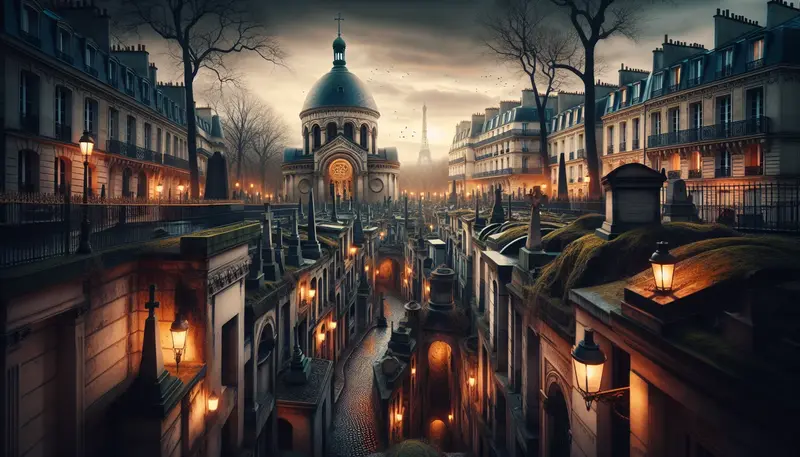
Père Lachaise was established by imperial decree in 1804 during the Napoleonic era and is named for Père François de la Chaise (1624–1709), the confessor to Louis XIV. The municipal cemetery sits at 16 Rue du Repos, 75020 Paris, and covers roughly 44 hectares of winding pathways, terraces, and tree-lined avenues. The yard is divided into numbered “divisions” that help visitors locate tombs and monuments; the layout resembles a small city of memorials rather than a simple burial ground. That urban character—angled lanes, dense clusters of mausolea, and sculpted angels—creates the visual conditions for many of the cemetery’s ghost stories.
Design and public function
The cemetery’s plan was deliberately picturesque: a late-18th/early-19th-century response to overcrowded parish churchyards that combined landscaped promenades with funerary architecture. By the mid-19th century, Père Lachaise had become fashionable, attracting the interments of famous writers, musicians, and actors; that celebrity concentration is one reason it remains one of Paris’s most visited cemeteries. Visitors should note the official entrance (main gate on Rue des Rondeaux leading to the central avenue) and the proximity of the Père Lachaise Metro station (Lines 2 and 3), which places the site within the city’s daily circulation.
Numbers and atmosphere
The cemetery contains tens of thousands of grave monuments and receives many hundreds of thousands of visitors annually; the precise count of interments and monuments has varied as family plots are reused and mausolea are maintained. That human density—historical layers compressed into a small area—helps explain both the documented history (burials, restorations, inscriptions) and the folklore. Researchers and careful guides treat the place as a historical archive first and as a setting for stories second: the architecture and the biographies are well documented, even when anecdotes blur into legend.
Famous Graves and Exact Locations
Which graves draw crowds, and why do certain tombs become focal points for memory and rumor?
The cemetery’s roster of famous interments is part of its institutional identity: people come both to pay respects and to witness the memorial culture that surrounds celebrity graves. Several graves have easily verifiable locations and are frequent waypoints for historians and visitors alike. Here are some of the most visited sites, with approximate divisions and on-site references that help people find them.
Key graves and divisions
| Notable Person | Reason Known | Division / Location |
|---|---|---|
| Oscar Wilde | Writer (1854–1900); internationally famous tomb sculpture | Division 89 (south-central area) |
| Jim Morrison | Singer, The Doors (1943–1971); pilgrimage site for rock fans | Division 6 (western slope) |
| Frédéric Chopin | Composer and pianist (1810–1849); elegiac memorial | Division 11 (central-east) |
| Édith Piaf | Singer (1915–1963); national icon | Division 97 (northeastern sector) |
Finding graves on the ground
Divisions are the most reliable wayfinding tool: plaques at many entrances list division numbers, and cemetery maps (printed at the main gate and sometimes online via the Mairie de Paris site) allow precise navigation. For individuals who need exact placements, the office at the main entrance can provide directions and verified maps. That practicality is important for researchers documenting epitaphs, sculptors, and historical dates before they address any accompanying folklore or reported paranormal claims.
Vandalism, Restoration, and How Memory Shapes Myth
Can the history of damage and repair to a tomb alter how people interpret odd sounds, shadows, or visitor behavior?
Many of the cemetery’s most famous monuments have experienced repeated vandalism and subsequent restoration work—events that are factual and well documented, and which have amplified the cemetery’s aura. For example, Oscar Wilde’s tomb became a focus of ritual kissing by admirers, which led to the bronze sculpture’s surface suffering from persistent lipstick marks and patina loss. In response, custodial authorities instituted protective measures and, after documented incidents around 2011, implemented a controlled restoration and visitor guidance to limit damage. Similarly, Jim Morrison’s grave frequently attracted late-night gatherings that sometimes turned destructive; cemetery managers at times erected barriers to protect memorials.
How conservation fuels stories
Conservation work and visible repairs change the visual cues visitors interpret: a scuffed statue or a newly replaced plaque can be read as the trace of dramatic events. That reading can morph into ghost story material—scratches become “claw marks,” a restored bronze face becomes “a vanished apparition replaced in the night.” Researchers treat such transformations as opportunities to separate verifiable incidents (dates of vandalism, official restoration records, police reports) from folklore that accrues later. Those interested in the cemetery’s physical history can consult municipal restoration reports held by the City of Paris archives for specific dates and work details.
Reported Paranormal Encounters and Credibility
What kinds of strange experiences do people report at Père Lachaise, and how do investigators evaluate them?
Accounts range from quiet, subjective sensations—drops in temperature, feelings of being watched—to sensory reports like footsteps, whispered voices, or distant music. Specific reported experiences include visitors who describe hearing a faint guitar or distant vocalization near Jim Morrison’s gravesite late at night, and others who describe hearing piano-like tones near Chopin’s memorial at evening hours. Staff, including cemetery attendants and long-standing local guides, have also reported unexplained phenomena: for example, several attendants over decades have described inexplicable chills in narrow alleys and occasional sightings of figures that vanish when approached. These reports are part of the living oral record and are often repeated on social media and in tour-operator logs. For related history, see our paris catacombs: six million dead beneath.
Assessing these reports
Serious investigators apply methodological caution: they log the conditions (date, time, weather), seek corroboration from multiple witnesses, and look for natural explanations—wind in tree branches, echoes from nearby traffic, electrical anomalies from nearby street lighting, or even the psychological priming that occurs after hearing a ghost story. The tone here is respectful skepticism: the experiences are worthy of recording because they reflect what people perceive, but they are not immediate proof of the supernatural. Documentation—photographs, audio files, time stamps, and witness statements—helps distinguish repeatable phenomena from one-off personal impressions.
Two frequently cited encounters
1) Multiple visitors have reported hearing rock-style guitar strains and indistinct chanting at night near Jim Morrison’s tomb (Division 6); these accounts often occur after late concerts or informal commemorations, which complicates attribution. 2) Several tour guides and a small number of cemetery personnel have told reporters that they once encountered a woman in period dress near a cluster of family mausolea; she reportedly stood motionless, then drifted away when approached. Both accounts persist in local oral tradition and are often cited in walking-tour narratives; they remain unproven but widely reported.
Guides, Researchers, and Responsible Visiting
How should historians, paranormal researchers, and casual visitors treat Père Lachaise as both a site of human memory and a place where stories circulate?
The site requires decorum and factual attentiveness. Researchers prioritize primary sources—burial registers, municipal permits, artist signatures on tomb sculpture, and restoration logs—before interpreting anecdotes. Paranormal investigators who conduct fieldwork usually seek permission from cemetery authorities, work daytime to map features, and follow strict protocols at night if granted access: they document with time-stamped audio and video, collect environmental data (temperature, humidity, electromagnetic fields), and avoid disturbing graves or leaving offerings that could be misconstrued as defacement.
Practical visitor information
Location and access: main entrance at 16 Rue du Repos, 75020 Paris; nearest Metro station: Père Lachaise (Lines 2 and 3). Hours are seasonal—typically opening early in the morning and closing before dusk; visitors should check the current schedule via the City of Paris website. Etiquette: maintain quiet, do not sit on graves, do not leave candles or alcohol, and refrain from disruptive photography during funerary services. Many tour operators and researchers emphasize that respectful observation reduces conflicts and helps protect both monuments and public safety. For related history, see our paris revolution ghosts: the guillotine's legacy.
Separating Myth from History and Practical Tips
Which legends are rooted in fact, and how can one responsibly satisfy curiosity about the cemetery’s supernatural reputation?
Many of the cemetery’s myths have straightforward historical kernels: vandalism incidents, celebrity pilgrimages, and nocturnal gatherings are documented events that later get overlaid with supernatural meaning. To separate myth from history, consult primary documents (burial registers, municipal restoration reports, contemporaneous press coverage) and treat eyewitness accounts as data: useful for understanding human experience, but incomplete as proof. The cultural practice of kissing Oscar Wilde’s tomb, for example, was an observable ritual that damaged the monument’s patina and led to official action; the ritual’s existence is historical fact, and some ghostly associations grew around the ritualized attention.
Quick-reference table: practical facts
| Item | Detail |
|---|---|
| Address | 16 Rue du Repos, 75020 Paris |
| Metro | Père Lachaise (Lines 2 & 3) |
| Typical rules | No candles or open flames; no sitting on monuments; maintain silence |
| Research tip | Consult Mairie de Paris archives for burial and restoration records |
Final note on stories and scholarship
Père Lachaise exists simultaneously as a historical record and as a stage for public emotion. The cemetery’s legends—those about a here or a corner there—are meaningful because they reveal how living communities remember, revere, and sometimes invent their past. A respectful, evidence-minded approach honors both the dead and the living storytellers who keep those memories alive.