Between 1817 and 1821, the Bell family of Adams, Tennessee endured what may be the most documented haunting in American history.
This article is part of our comprehensive Nashville ghost tours guide. Whether you're planning a visit or researching from afar, these stories reveal a side of Nashville most visitors never see.
The Setting: Red River, the Bell Farm, and a Tennessee Landmark
What would a haunting rooted in early 19th-century Tennessee look like when the land itself still remembers the names of families and disputes? The Bell Witch legend is tied to a specific place and community: the Bell farm on the banks of Red River near present-day Adams, Tennessee (Robertson County). That rural setting — dense woods, limestone bluffs, and a long history of small-farm life — shaped both how contemporaries recorded the events and how later retellings framed them.
John Bell’s property lay a few miles north of what is now U.S. Highway 31A. The Bell family residence and surrounding fields were the locus of reported phenomena between 1817 and the early 1820s. Today, the Bell Witch Cave — frequently given an address of 430 Bell Witch Cave Road, Adams, TN 37010 — is a privately owned tourist site that preserves a tangible link to the story. The cave, the river valley and the nearby road names keep the haunting anchored to place for researchers, visitors, and locals who point to real coordinates when they recount incidents.
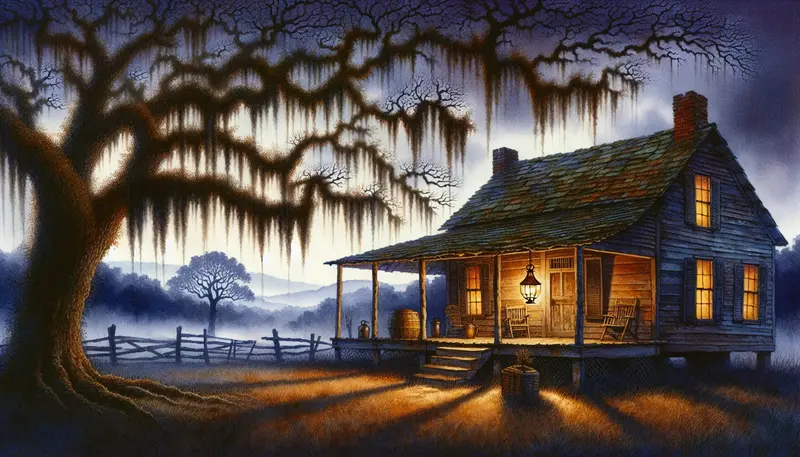
Because the haunting originated on a working farm, records and recollections come from farmers, neighbors and later chroniclers who treated land tenure, fences and debts as hard facts; those same materials also created motives and rivalries that folklore often highlights. When examining the Bell Witch, it helps to visualize the geography: a solitary log house near Red River, outbuildings and pastures, a community of neighbors within earshot, and a cave less than a mile from the homestead where later episodes and legends cluster. For anyone studying Tennessee haunted history, the spatial specificity of the Bell case is one of its strongest features — it’s not an unnamed house or vague “southern swamp,” but a named farm, a named road, and a named cave.
The Timeline: From 1817 to John Bell’s Final Illness
How quickly did what began as small disturbances turn into the region’s most persistent haunting? Contemporary accounts and near-contemporary retellings fix key points in a concise timeline. Reports usually begin in late 1817 with unexplained noises and move through several seasons of increasingly aggressive incidents before reaching a climax in 1819–1820 and continuing in memory and print thereafter.
According to early chroniclers such as Martin V. Ingram (who published An Authenticated History of the Bell Witch in 1894), the first disturbances were noises on the roof, the sound of heavy objects striking the house, and poltergeist-like activity that neighbors initially assumed to be natural or caused by children. By 1818 the phenomena escalated: knocking and rapping answered questions, objects were moved, and the entity — later identified verbally as “Kate” by those present — spoke audibly. Ingram’s narrative places the most dramatic domestic incidents in 1819, when physical contact, vocal taunts, and direct interactions with family members were reported.
John Bell’s health declined during this period. Local reports and later accounts attribute a wasting illness and intermittent delirium to the influence of the spirit; Bell died on December 20, 1820—a vial of dark liquid was reportedly found at his bedside, which the spirit claimed to have administered as poison, after which manifestations reportedly continued for a time. Historians emphasize that our strongest documentary trail derives from regional oral history codified decades later; however, multiple independent accounts from neighbors, visitors and Bell family members converge on the same multi-year arc. The result is a clear chronological framework: initial disturbances in 1817, intensified activity through 1818–1819, John Bell’s sickness and death by late 1820, and a lingering legacy that was cemented by nineteenth-century publications. For related history, see our the hermitage hotel: nashville's grand haunted.
Key Figures and Documented Witnesses
Who were the people at the center of the story, and which witnesses left records that researchers can consult? The Bell Witch legend revolves around several named individuals whose identities and testimonies anchor the folklore in human lives.
John Bell (often styled “John Bell Sr.” in local records) was the landholder and patriarch. His wife is commonly recorded as Lucy (sometimes spelled “Lucy Williams Bell” in genealogical references). Their children figure prominently: daughter Betsy Bell (Elvira “Betsy” Bell) and son Richard Powell Bell (commonly cited as R.P. Bell). These family members repeatedly appear in firsthand recollections and later interviews. A notable neighbor and antagonist in the stories is Catherine “Kate” Batts, who owned land adjacent to the Bells; the entity within many accounts referred to itself as “Kate,” which shaped debates about motive and identity.
Beyond the family, Martin V. Ingram is the most important post-event chronicler. Publishing in 1894, Ingram compiled interviews, oral histories and folklore into the narrative that most people reference today. His volume provides names, anecdotal dialogues and event sequencing — though it was written decades after the fact. Other named witnesses include Joshua Gardner, who is sometimes noted as a neighbor or visitor, and various local ministers and magistrates who reportedly heard accounts. Some versions claim Andrew Jackson visited the Bell farm around 1819 with a party of men; historians call this unsupported by contemporary documentation, though the claim has shaped public memory. The spirit reportedly bade the family farewell after John Bell’s death, promising to return in seven years—and local tradition holds it reappeared briefly in February 1828.
When evaluating the Bell case, scholars treat these named individuals as primary anchors. The value of the accounts depends on proximity (family members and immediate neighbors are highest), documented corroboration and the timing of recorded testimony. In short, the story is anchored by a specific cast — the Bells and their neighbors — whose recorded statements, even when altered by time, provide the best available evidence for the events that made this a Tennessee haunted landmark.
Reported Paranormal Experiences: Testimonies and Physical Interactions
What did people actually report experiencing? The Bell Witch story is notable for how many reports describe direct physical contact, audible speech, and specific interactions rather than only eerie feelings or shadows. Two examples stand out because the people involved are named in multiple accounts: Betsy Bell and Richard (R.P.) Bell.
Betsy Bell is repeatedly cited in Ingram’s compilation and in local oral history as a primary target of the entity’s attention. Her testimony — relayed by family members and later chroniclers — recounts episodes in which she was slapped, pinched and touched despite no visible assailant. On one well-known occasion Betsy reportedly described being violently thrown across a bed while the spirit mocked her. These physical assaults are presented as recurrent, often accompanied by a disembodied voice that spoke, taunted and at times provided intelligible dialogue. Betsy’s interactions are central because she survived and later spoke about them to neighbors who then recounted the incidents to Ingram and others. For related history, see our most haunted places in nashville: music.
Richard Williams Bell—who later published a firsthand account titled Our Family Trouble (written 1846)—also reported sustained and specific phenomena. According to later published accounts, R.P. recounted incidents where the spirit pinched his nose and face, slapped him, and physically restrained him. One frequently cited episode describes the entity entering the Bell home, engaging in conversation with the family, and intentionally placing physical marks on furniture and people; R.P. is sometimes described as sustaining bite marks or bruises that contemporaries examined. Additionally, the spirit reportedly addressed individuals by name, quoted local events and even recited Bible verses at times — a detail often used to emphasize the entity’s apparent intelligence and malice.
Another distinct and well-recorded element is the entity’s self-identification. The spirit frequently said, “I am Kate,” which many sources link to neighbor Catherine Batts. Whether the voice intentionally adopted a human name, whether this represented a mischievous tactic, or whether it reflected local rivalry remains debated. Regardless, the presence of multiple, named witnesses who claimed to have been touched, spoken to and marked physically makes the Bell case unusually testimony-rich in the canon of Tennessee ghost narratives.
Investigations, Publications, and Critical Assessment
How did the Bell story come to public attention, and what should a careful reader make of the sources? The Bell Witch legend entered broader circulation primarily through nineteenth-century oral tradition and Martin V. Ingram’s 1894 book. Ingram claimed to base his work on local interviews and “authenticated” reports; however, modern scholars treat his volume with caution because of the decades between events and publication and the editorial choices he made.
Scholarly assessments note several points for critical consideration: the inevitability of memory distortion over decades; the tendency of oral traditions to amplify dramatic details; and the social context, in which land disputes, political rivalries and family tensions could be reframed as supernatural conflict. For example, the land dispute between John Bell and Kate Batts is frequently cited as a plausible motive for a “spirit” identifying as Kate. Researchers ask whether human antagonisms, combined with the human propensity for patterning and narrative, produced the phenomenon or whether some unexplained element deserves further attention.
There have been attempted modern investigations by folklorists, historians and local enthusiasts. Scholars often focus on documentary corroboration: land deeds, court records, family Bibles and contemporaneous newspaper entries (many of which are thin or silent). The famous claim that Andrew Jackson personally investigated the Bell home is treated skeptically because no reliable contemporary documentation confirms such a visit. Nonetheless, the persistence of the narrative in regional newspapers, guidebooks and tourist literature is itself a historical fact — it shows how the haunting became part of Tennessee haunted culture. For related history, see our nashville's civil war ghosts: the battle.
Responsible treatment of the Bell Witch balances respect for eyewitness reports with methodological caution. Folklorists value the story for what it reveals about community, memory and belief; historians value the verifiable records that remain. For the reader, this means acknowledging both the vividness of firsthand claims and the limits of what can be established conclusively from available sources.
Legacy, Tourism, and Visiting the Bell Witch Sites Today
Why does the Bell Witch matter now, and how can someone approach the sites with historical awareness? The haunting has become a central item in Tennessee’s paranormal tourism — influencing books, films and local economies — while also remaining a subject of scholarly interest. Visitors to Marshall County often seek the Bell Witch Cave (address commonly listed as 430 Bell Witch Cave Road, Adams, TN 37010) and the surrounding landscape to connect with a story that shaped local identity.
When visiting, there are a few practical and interpretive things to keep in mind. The Bell Witch Cave is privately owned, typically open May through October with guided tours; the cave’s features (a shallow entrance, limestone formations and adjacent woods) help explain why the location inspired storytelling. The original Bell homestead no longer stands as it did, though local markers and place names (Bell Road, Red River approaches) point to where the farm was. The site is treated as a cultural landmark: tourists, paranormal investigators and historians come to understand it as both folklore and an element of Marshall County history.
For researchers and tourists interested in Tennessee haunted material, the Bell Witch functions as a classroom in how stories form and endure. There are also safety and preservation concerns: visitors are asked to respect private property, follow posted rules and avoid damaging fragile cave formations. Local museums, historical societies and published compilations (such as Ingram’s volume and subsequent studies) give context and help separate documented facts from later embellishments.
Finally, the Bell Witch remains part of local identity; phrases like “ ghost” and “ haunted” resurface in marketing and storytelling. Whether one approaches the story as an example of genuine unexplained phenomena or as a rich and enduring piece of folkloric fabric, the Bell Witch offers a concentrated case study in how a specific place, named people and repeated testimony can produce a haunting that lasts for centuries.