The Ryman has hosted everyone from Hank Williams to Johnny Cash. Staff and performers say some of them never left.
This article is part of our comprehensive Nashville ghost tours guide. Whether you're planning a visit or researching from afar, these stories reveal a side of Nashville most visitors never see.
History, Name, and the “Mother Church” Legacy
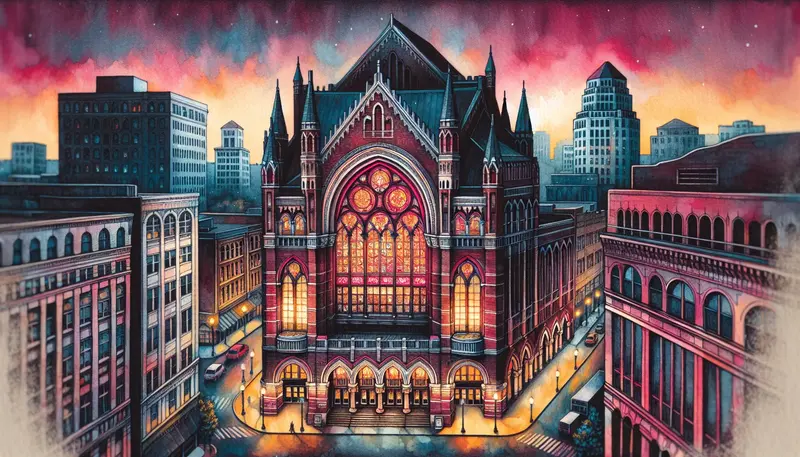
Has the building on 116 5th Avenue North always felt like more than bricks and timber to those who pass its doors? The Ryman Auditorium opened on October 30, 1892, at 116 5th Ave N, Nashville, TN 37219, as the Union Gospel Tabernacle, the project of riverboat captain, whiskey magnate, and businessman Thomas Gould Ryman (1825–1904), a Kentucky-born entrepreneur who accumulated considerable wealth during the Reconstruction era. Over the following decades it acquired the sobriquet “Mother Church of Country Music” for its role hosting the Grand Ole Opry from 1943 to 1974, while remaining an architectural anchor in downtown Nashville.
The building’s evolution maps onto Nashville’s cultural shifts. Thomas Ryman’s evangelical beginnings gave way to a performance venue that drew tent revival fervor, revivalist preacher Samuel Porter Jones, and later radio and recorded-music industries. The Ryman’s auditorium, with original construction completed in 1892 and major restorations throughout the 20th and 21st centuries (notably 1994–1999 restorations and a 2010s accessibility upgrade), has retained much of its exterior and interior character — wooden pew-style seating, a horseshoe balcony, and a stage that carried both hymn and honky-tonk.
Because of that layered history — sacred performance, entertainment, grief, and public celebration — the Ryman is fertile ground for folklore. The “Mother Church” label is not merely marketing; it reflects how the building functions in collective memory. Many accounts of the Ryman’s uncanny center on continuity: repeated performances that echo across decades, the sensation of historical figures lingering around the stage, and the acoustics that allow past voices to feel present. For researchers of the ghost phenomenon and students of haunted places, the Ryman offers a clear model of how architecture, community, and memory combine to produce haunting narratives.
Architectural Features and How They Feed Reports of the Uncanny
Why do so many people report odd sensations, apparitions, or sounds at the Ryman? Part of the answer lies in physical space. The auditorium’s timber frame, sloping floors, and layered balconies create a mix of standing and reflected sound, sudden drafts, and pockets of cooler air — conditions that heighten perception. The original structure used heavy, dense wood; old nails, metal fittings, and service corridors beneath the stage provide natural conduits for settling noises that can be interpreted as footsteps or voices.
Those who study architecture and perception point out that historic theaters are especially prone to reported paranormal effects because they preserve material traces of performance rituals: old dressing rooms, faded curtains, backstage corridors, and remnant labeled storage. At the Ryman, the artist green room, the “barbershop area” under the stage, and specific balcony boxes have been focal points for repeated reports. The building’s long professional life means it accumulated prop storage, framed photographs of past performers, and historical sound equipment — all of which prime visitors to expect historical presence. For related history, see our the bell witch: tennessee's most famous.
Environmental monitoring carried out during several informal investigations has found temperature variations near old doorways and beneath the stage, attributable to legacy HVAC conduits and the way cold air pools in older structures. That technical explanation doesn’t disprove personal testimony, but it helps explain why many witnesses describe the same sensations: sudden cold spots, the smell of tobacco or powder from another era, and the impression of someone standing nearby when no one is visible. Those phenomena are consistent with both natural causes and the patterns reported in haunted narratives.
Reported Apparitions and Named Witness Accounts
The Ryman has attracted numerous firsthand reports. A well-circulated account attributed to a longtime Ryman tour guide, Connie Turner (who began guiding in the 1990s and worked at the venue for over two decades), describes a late-night encounter on an evening in 2001: while alone checking the balcony section during routine closing procedures, Turner reported hearing measured footsteps behind her and a faint, high-pitched whistle that stopped as she turned. On inspection she found an empty aisle but later discovered a pair of neatly folded, period-style ballet slippers in a broom closet used for prop storage — items that she insisted had not been in that closet earlier that evening.
Another specific reported event came from a former stage manager, Michael Reed, who worked at the Ryman from 1988 to 2005. In a 2012 oral-history interview recorded for a local historical society, Reed said that during a 1996 midnight sound check, a spotlight system would not respond to any operator command until he announced, aloud, “We’re trying to leave.” At that moment, the lights snapped to life and a disembodied female voice — described by Reed as “soft, like someone humming between words” — sang a single bar that matched a hymn once used during the building’s early tabernacle years. Reed attributed the interruption to an electrical fault when pressed, but later maintenance checks found no wiring issues in the rigging that could account for the behavior.
Both accounts fit patterns familiar in ghost lore: sensory experiences (sound, temperature) coupled with visible or tangible traces (objects out of place, lights behaving erratically). Those reports come with caveats: the witnesses are careful to distinguish between anecdote and proof, and both Turner and Reed emphasized that their interpretations remained open to natural explanations. Nonetheless, the specificity of their encounters — dates, locations within the Ryman, and consistent detail — has made these accounts focal points for later investigators and for public tours discussing the building’s spectral reputation. For related history, see our the hermitage hotel: nashville's grand haunted.
Investigations, Media Coverage, and Institutional Response
Over the years the Ryman has drawn paranormal investigators, journalists, and documentary crews. Local newspapers and specialty outlets have published pieces on unusual occurrences dating back to the 1980s; national programs have occasionally featured the auditorium as an emblematic historic theater with ghost stories attached. Investigations have ranged from informal night walks by local ghost-hunting groups to visits by teams that deployed audio recorders, EMF meters, and thermal cameras.
One notable investigation occurred in 2004 when the Nashville Paranormal Research Collective, a small Nashville-based paranormal research group, conducted overnight monitoring in dressing rooms and the stage wings using audio recorders, thermal imaging, and electromagnetic field detectors. Their published report recorded unexplained audio anomalies during a three-hour stretch between 2:00 AM and 5:00 AM (faint harmonics not present on background control tracks) and several temperature drops ranging from 5 to 8 degrees Fahrenheit localized under Stage Left, adjacent to a long-unused service corridor. The Ryman’s management publicly acknowledged interest in the report but emphasized routine explanations — building settlement, HVAC cycling, and staff movements. The balance between curiosity and institutional caution is typical: the Ryman treats the building as a living cultural asset and is careful about endorsing paranormal claims while recognizing that those stories attract public interest.
Because the Ryman is a working performance venue and a museum, official responses often prioritize preservation and safety. Security logs confirm that staff do occasionally check closets and corridors when objects are reported missing or misplaced; maintenance records from 1999–2005 note multiple checks to HVAC systems and stage rigging after unusual lighting incidents. The institution’s approach is to document and investigate operationally while allowing folklore to remain part of the Ryman’s interpretive narrative, a stance that keeps history and legend in a productive, if unresolved, conversation.
Patterns of Experience: Residual, Intelligent, and Cultural Hauntings
Accounts at the Ryman fall mainly into two interpretive categories used by folklorists and paranormal researchers: residual hauntings and intelligent hauntings. Residual hauntings are described as repetitive, non-responsive phenomena — a set of sounds or images that play like a recording without interactive awareness. Many reports of a disembodied hymn or the sense of a crowd applauding after hours fit this model. Witnesses often describe these as “echoes” of past events, consistent with the structure’s long use for repeated performances. For related history, see our most haunted places in nashville: music.
Intelligent hauntings, in contrast, imply interaction or apparent awareness. The experiences described by stage manager Michael Reed (the light becoming responsive after an uttered phrase) and the timing of audible phrases that seem to answer a human presence are offered as potential examples. Such reports invite debate because they appear to involve contingency and responsiveness — qualities that are harder to reconcile with purely physical explanations like acoustics or temperature variation.
On top of these categories sits the cultural haunting: stories told and retold that give the building a living mythos. For residents and visitors who study the haunted scene, the Ryman functions as a collective repository of memory. Performers who speak of “feeling” past musicians onstage or who report seeing a figure near the wings may be describing subjective experiences shaped by knowledge of the Ryman’s history. That knowledge is not trivial: knowing Hank Williams, Minnie Pearl, and Roy Acuff performed here provides a narrative lens through which ambiguous stimuli become meaningful. Yet even when experiences are culturally framed, they retain social value — they bind community members to place and history through shared stories.
Visitor Guidance, Preservation Ethics, and How to Read the Stories
For those studying or visiting the Ryman Auditorium with an interest in the paranormal, certain practical and ethical guidelines help keep historical integrity intact. The Ryman operates at 116 5th Ave N, Nashville, TN 37219 as both museum and performance hall with daily tours and regular concerts; access to sensitive backstage areas is restricted for safety, preservation, and working venue operations during performances. Researchers and curiosity-seekers should rely on official channels for after-hours access, and prioritize the conservation of artifacts and spaces. Many reported phenomena occur in dressing rooms and service corridors; those areas contain fragile materials and should be treated respectfully.
When interpreting accounts, readers should note the difference between anecdotal testimony and documented evidence. Anecdotes from staff and performers — like the stories attributed to Connie Turner and Michael Reed — provide valuable social data about how people experience place. Corroboration (multiple independent witnesses, contemporaneous documentation such as security logs, and physical traces) raises the evidentiary quality of a claim, but absence of such corroboration does not render an experience meaningless. CursedTours-style interpretation treats witness testimony with respectful skepticism: skeptical about untested causal claims, but attentive to what those claims reveal about human relationships to historic spaces.
Finally, the Ryman’s place in ghost lore reflects a broader fact: the most compelling hauntings are seldom reducible to simple explanations. They are layered, contingent, and shaped by architecture, history, and human expectation. Whether the phenomena observed there turn out to be misinterpreted environmental effects, psychological responses to rich historical context, or something else, the stories themselves contribute to Nashville’s cultural landscape — and to anyone’s understanding of what it means for a building to carry memory.