
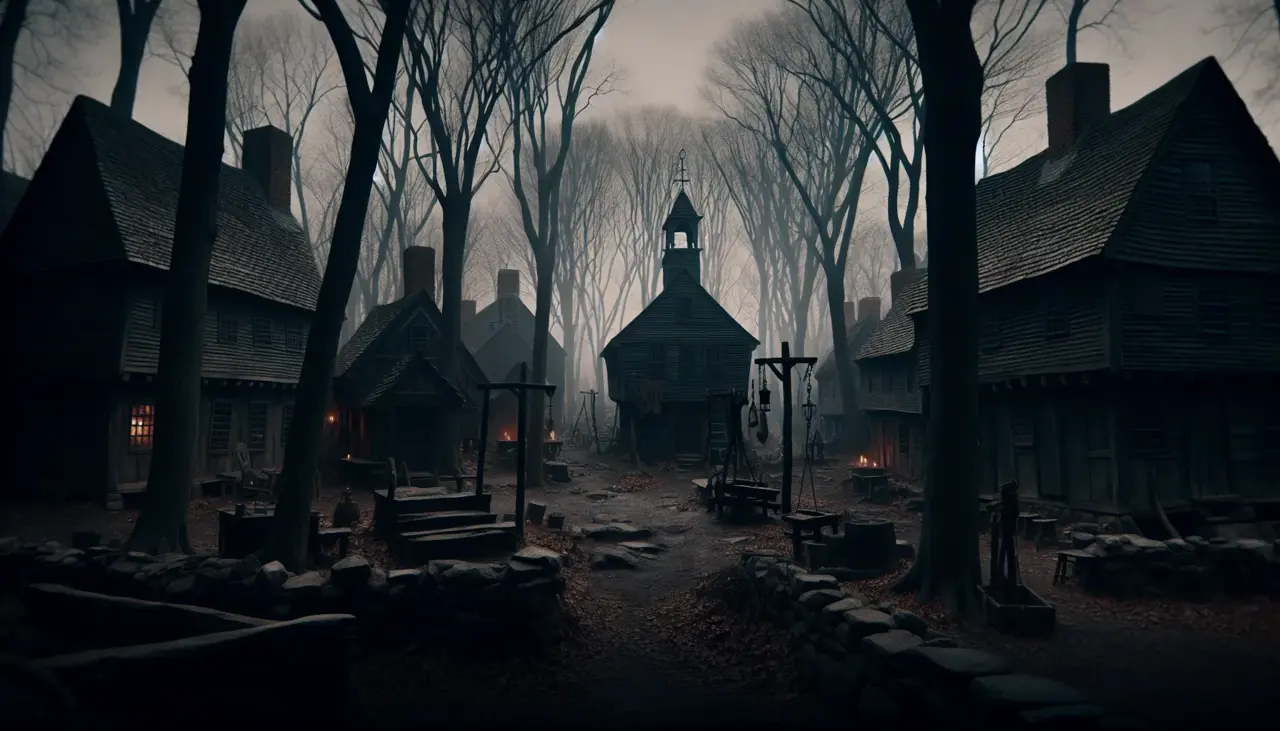
The Salem witch trials of 1692–1693 remain one of the most unsettling episodes in American history. They are often remembered as a moment of mass hysteria or irrational superstition, yet such explanations flatten a far more complex reality. Salem was not chaos erupting from ignorance alone. It was a system—religious, legal, and social—operating under extreme pressure and failing in predictable ways.
To understand Salem fully requires examining the conditions that made it possible, the mechanisms that sustained it, and the long shadow it cast afterward. The trials were not an anomaly. They were the outcome of ordinary institutions responding disastrously to fear, producing nineteen hangings (fourteen women and five men between June 10 and September 22, 1692, all at Proctor\u2019s Ledge on Gallows Hill), the pressing death of Giles Corey on September 19, 1692, at least five deaths in prison\u2014including Sarah Osborne and the infant Mercy Good\u2014and more than two hundred accusations. The legacy continues to resonate more than three centuries later.
Life Before the Trials
Puritan New England was a disciplined, structured society built on religious certainty and communal accountability. Daily life was governed by moral expectations that left little room for ambiguity. Church attendance was mandatory. Behavior was monitored by neighbors. Reputation determined social standing. Deviation from expected norms carried real risk. To understand how the witch trials emerged, one must first understand the daily realities of Puritan New England and the pressures that shaped colonial life.
This social environment created stability during ordinary times, but it also created vulnerability during crisis. Communities accustomed to moral explanation for all events lacked neutral categories for understanding misfortune. When unexplained suffering appeared—illness without clear cause, children displaying strange symptoms, livestock dying mysteriously—the culture demanded moral meaning. Someone must be responsible. Something must have gone wrong in the spiritual order.
The tight-knit nature of village life meant that longstanding disputes, economic tensions, and personal grievances simmered beneath the surface. Land was scarce and contested. Inheritance created conflict. Neighbors accumulated memories of past slights. These tensions would provide fuel when accusations began.
Religion and Moral Worldview
Puritan theology shaped how people understood the world around them. God was believed to act directly in human affairs, rewarding obedience with prosperity and punishing sin with suffering. The community existed under a sacred covenant; the moral failure of individuals could bring divine judgment upon everyone.
Within this framework, witchcraft was not mere superstition. It was treason against divine order—a pact with Satan that threatened the entire community’s relationship with God. The Devil was understood as an active presence, constantly seeking to corrupt the faithful and undermine the covenant. Vigilance against his influence was not paranoia; it was moral duty. The question of whether religion or power drove the trials reveals how deeply these forces were intertwined in Puritan society.
This theology did not make witch trials inevitable, but it created conditions where accusations could gain traction. When suffering appeared without obvious natural cause, spiritual explanation was not only available but expected. Inaction in the face of perceived satanic assault could be interpreted as complicity or weakness.
Fear Becomes Action
The trials began in early 1692 with reports of affliction in Salem Village. Young girls in the household of Reverend Samuel Parris displayed disturbing symptoms: convulsions, fits, screaming, claims of invisible torment. When medical examination failed to identify a cause, attention turned to supernatural explanation.
Under pressure from adults asking who was tormenting them, the afflicted girls began naming names. The first accused—Tituba, an enslaved Arawak woman from Barbados; Sarah Good, a homeless beggar; Sarah Osborne, an elderly widow who had stopped attending church—were precisely the kind of marginal figures communities had long associated with witchcraft. But the accusations soon expanded beyond the margins: Bridget Bishop, a tavern-owning widow of about sixty who had been previously charged with witchcraft in 1680, became the first person executed on June 10, 1692. Their arrests marked the beginning of a crisis that would consume the region for the next year.
Belief alone did not cause Salem. Communities throughout New England believed in witchcraft without conducting mass trials. The crisis escalated when belief was validated by authority, when courts accepted accusations as credible, and when legal machinery was created to process cases efficiently. Fear became dangerous only when it was transformed into institutional action.
Who Was Accused—and Why
More than two hundred people were accused of witchcraft during the Salem trials. Contrary to popular myth, these accusations were not random. Clear patterns emerge when examining the identities of the accused witches closely.
Women were disproportionately targeted, comprising roughly three-quarters of those accused. Female defendants were often economically vulnerable—widows without male protectors, unmarried women, those dependent on charity. Understanding why women were specifically targeted reveals the intersection of gender ideology, economic vulnerability, and social marginality that made certain individuals especially vulnerable. They were frequently socially isolated, lacking the strong family networks that might have provided protection. Many carried reputational baggage: histories of conflict with neighbors, sharp tongues, unconventional behavior.
Men were accused as well, often sharing similar characteristics of marginality or association with accused women. George Burroughs, a former minister with a controversial reputation, became one of the most prominent male victims. Giles Corey, an 81-year-old farmer, was accused after his wife Martha; his refusal to enter a plea led to his death by pressing\u2014two days of stones piled on his chest on September 19, 1692, reportedly responding to demands that he plead with only “more weight.” George Jacobs Sr., approximately eighty years old and walking with two canes, was hanged on August 19, 1692, after his own granddaughter Margaret testified against him. Rebecca Nurse, a 71-year-old church member with an unblemished reputation, was initially acquitted by the jury, but when the afflicted girls collapsed in dramatic fits at the verdict, the judges sent the jury back to reconsider; Nurse was hanged on July 19.
The accused were not random victims of indiscriminate panic. They were predictable targets shaped by social hierarchy, economic vulnerability, and existing reputation. The trials did not create new categories of suspicion; they activated old ones with lethal efficiency.
The Accusers and Credibility
The accusers included children, adolescents, and adults whose testimony drove the trials forward. Examining who the accusers really were reveals the complex mix of genuine distress, social pressure, and adult manipulation that characterized their involvement. Their claims carried weight not because they were objectively verifiable—spectral evidence by definition could not be independently confirmed—but because they fit existing beliefs about how witchcraft operated.
The core group of afflicted accusers displayed symptoms during examinations and trials that observers interpreted as evidence of ongoing supernatural attack. Their fits, screams, and claims of invisible assault created dramatic courtroom scenes that influenced judges and juries. Whether these performances were sincere, exaggerated, or fabricated remains debated, but their effect was undeniable.
Youth testimony was especially powerful. Children were assumed to be innocent, incapable of sophisticated deception. Questioning their claims risked appearing cruel or morally suspect. This cultural assumption, intended to protect the vulnerable, became a mechanism through which vulnerability was weaponized.
The Role of Children
Children played a central and troubling role in the Salem trials. They were among the earliest accusers, the most influential witnesses, and in some cases the accused themselves. Their distress was real—whatever its ultimate cause, the afflicted children were experiencing genuine symptoms that alarmed adults around them. A closer examination of children’s role in the witch trials shows how adult authority shaped and amplified youthful testimony.
But the interpretation of that distress was shaped by adults. Ministers and magistrates asked leading questions. Parents offered explanations consistent with existing beliefs. The legal system treated subjective childhood experience as objective evidence of specific individuals’ guilt.
The failure of Salem was not childhood imagination or youthful misbehavior. It was adult authority that transformed uncertain symptoms into certain accusations, that accepted children’s visions as courtroom evidence, and that created a system where young voices could condemn people to death.
Courts, Law, and Procedure
The Salem witch trials were conducted through formal legal systems, not mob violence. Magistrates issued arrest warrants. Preliminary examinations were held before witnesses. A special Court of Oyer and Terminer was established to handle witchcraft cases. Judges heard testimony, juries deliberated, and executions followed official sentencing. Understanding how the courts, evidence, and confessions actually worked reveals the systematic nature of the proceedings.
This legality is precisely what makes Salem so disturbing. The danger lay not in lawlessness but in how law functioned when belief replaced restraint. Procedures that appeared orderly produced catastrophic injustice. The courts followed their own rules—those rules simply failed to protect the innocent.
The legal system reflected and amplified the biases of the society it served. Character evidence substituted for material proof. Reputation determined credibility. The burden of proof effectively shifted to the accused, who were asked to demonstrate that they had not committed crimes that by definition left no physical evidence.
Spectral Evidence
The most destructive legal innovation of the Salem trials was the acceptance of spectral evidence—testimony that the accused had appeared in spirit form to torment victims. Accusers claimed to see specters visible only to themselves, attacking, threatening, and demanding allegiance to Satan.
Courts initially accepted this testimony because it aligned with prevailing theology about how the Devil operated through human agents. If witches made pacts with Satan, Satan could send their spirits to do harm. The afflicted were understood to possess special sensitivity to these attacks.
Once spectral evidence was admitted, innocence became virtually impossible to prove. The accused could not demonstrate that their spirits had not appeared somewhere. They could not produce witnesses to contradict claims about invisible events. Denial was easily reinterpreted as evidence of the Devil’s influence, since Satan would naturally encourage his servants to lie.
Some ministers warned that the Devil might assume the shape of innocent people, making spectral evidence unreliable. These warnings were initially ignored. Only when political authority intervened and prohibited such testimony did the trials collapse.
Confession and Coercion
Confession became central to the trials’ operation and expansion. Those who confessed to witchcraft were typically spared execution; those who maintained innocence faced death. This created powerful pressure to confess regardless of actual guilt.
Confessions served multiple functions within the system. They validated the accusers by confirming that witchcraft was real and widespread. They expanded the crisis by naming accomplices—confessors were pressured to identify others who had attended witch meetings or signed the Devil’s book. Each confession produced new names, new arrests, new opportunities for further confession.
The dynamic rewarded false admission and punished truthful denial. Those willing to lie survived; those who refused to bear false witness often died. This perverse incentive structure distorted the proceedings and guaranteed escalation.
Why the Trials Escalated
Each conviction reinforced the system’s legitimacy. If the courts were finding witches, then witches must exist. If witches existed, then accusations deserved serious treatment. The logic was self-reinforcing, and institutional momentum discouraged doubt.
Expressing skepticism about current cases implicitly questioned past convictions. Officials who had authorized executions had strong incentives to believe those executions were justified. Admitting error would have threatened reputations, institutional authority, and the moral framework that made the trials meaningful.
Fear, once embedded in legal procedure, became self-sustaining. The system generated its own evidence of necessity. The more people were accused, the larger the conspiracy appeared. The larger the conspiracy appeared, the more urgent prosecution became.
Why the Trials Ended
The trials did not end because belief in witchcraft suddenly disappeared or because the community achieved enlightenment. They ended when political authority intervened and changed the rules under which courts operated. The story of how and why the Salem trials finally ended reveals the crucial role of institutional intervention.
Governor William Phips, facing mounting criticism and accusations that had reached into prominent families including his own, dissolved the Court of Oyer and Terminer in October 1692. He prohibited further arrests based on spectral evidence and established a new Superior Court with stricter evidentiary standards.
Under these new standards, most remaining cases collapsed. Without spectral evidence, prosecutors could not sustain convictions. Of approximately fifty cases heard by the new court, nearly all resulted in acquittal. The machinery that had produced twenty executions proved incapable of functioning without unverifiable testimony.
Power—not reason—ended the crisis. The same institutional authority that had enabled the trials chose to disable them. This pattern is instructive: ending such crises requires political will and institutional change, not merely the gradual spread of skepticism.
Aftermath and Apology
Accountability for Salem came slowly and incompletely. The immediate aftermath was characterized by silence and discomfort rather than dramatic reckoning. Communities returned to ordinary life without formal confrontation of what had occurred. The long process of apologies, regret, and reparations reveals how societies struggle to confront their own failures.
Individual expressions of regret emerged over the following years. Judge Samuel Sewall publicly confessed his guilt in 1697. Twelve jurors signed a statement acknowledging error. Ann Putnam Jr., one of the most active accusers, issued a public apology in 1706.
Institutional acknowledgment came later still. In 1711, the Massachusetts General Court reversed the attainders of twenty-two of the convicted and authorized \u00a3578 12s in compensation to their families\u2014though some victims, including Bridget Bishop, were pointedly excluded from the reversal. It would take until 2001 for the Massachusetts legislature to formally exonerate the last five victims by name, finally clearing all those convicted in the Salem trials. These measures acknowledged that harm had been done but carefully avoided naming perpetrators or demanding individual accountability.
No judges or officials faced punishment. Responsibility was diffused across institutions and generations. The system apologized without dismantling its foundations or confronting the specific failures that had made the trials possible.
Myths and Misunderstandings
Over time, Salem became mythologized. Popular culture, tourism, and simplified storytelling transformed a complex legal tragedy into a collection of persistent myths: that the trials were mob violence rather than legal procedure; that everyone believed the accusations; that only ignorant people participated; that the accusers were simply lying; that Salem ended because people came to their senses. Examining the myths about Salem that refuse to die helps separate historical reality from popular fiction.
These myths obscure how ordinary systems failed. They create comfortable distance between Salem and the present by locating the trials safely in a primitive past populated by people fundamentally different from ourselves. They replace structural analysis with individual blame, institutional critique with moral distancing.
Understanding Salem accurately requires rejecting these comforting narratives and confronting the uncomfortable reality that the trials were produced by recognizable dynamics operating within familiar institutional frameworks.
Salem as Moral Panic
The trials exemplify what scholars call moral panic: a situation in which a perceived threat to social order is exaggerated, framed as urgent, and treated as requiring extraordinary response. The threat is typically portrayed as hidden, contagious, and existential—capable of spreading undetected and destroying the community from within. Understanding what Salem teaches us about moral panic illuminates patterns that recur throughout history.
Moral panics share common features across different historical periods: identification of a threatening group, claims that the threat is more widespread than it appears, demands for decisive action, characterization of skepticism as complicity, and suspension of normal safeguards in the name of protection.
Once panic becomes policy—once fear is embedded in legal procedure and institutional action—harm becomes routine. The machinery operates according to its own logic, producing outcomes that participants may not have intended but that follow predictably from the rules they established.
Why Salem Still Matters
Arthur Miller\u2019s 1953 play “The Crucible” cemented Salem\u2019s position as America\u2019s defining parable of persecution. Written as an allegory for McCarthyism and the House Un-American Activities Committee\u2019s loyalty hearings, the play drew explicit parallels between 1692 and 1950s anti-communist purges\u2014spectral evidence replaced by guilt by association, confession rewarded while principled refusal meant destruction. Miller himself was called before HUAC in 1956 and convicted of contempt of Congress for refusing to name names, a conviction later overturned on appeal. Salem endures in cultural memory because its underlying mechanisms remain recognizable. Fear framed as moral threat. Authority endorsing certainty over evidence. Law enforcing belief rather than restraining it. Social pressure silencing dissent. These dynamics did not disappear when the trials ended. They persist wherever human institutions operate under conditions of stress and moral urgency. Exploring why the Salem witch trials still matter today connects historical tragedy to contemporary relevance.
The trials warn against systems that reward certainty over humility, that treat subjective conviction as sufficient proof, that characterize doubt as disloyalty. They demonstrate that intelligence and education provide no immunity against institutional failure. They show how quickly compassion can become coercion when it is channeled through systems designed for prosecution rather than protection.
Salem’s relevance lies not in its specific content—few today believe in literal witchcraft—but in its structural patterns. Whenever communities face threats they cannot fully understand, the temptation arises to find someone responsible, to convert anxiety into accusation, to demand action that feels proportionate to fear. Salem shows where that path can lead.
The Enduring Lesson
The Salem witch trials were not caused by madness. They were not caused by ignorance. They were caused by certainty—moral certainty that felt righteous, institutional certainty that felt necessary, social certainty that discouraged the doubt that might have saved lives.
The participants believed they were protecting their community from genuine danger. Their sincerity did not prevent catastrophe. Their good intentions did not excuse the outcomes. Salem demonstrates that the feeling of moral righteousness provides no guarantee against moral failure.
Justice requires restraint, skepticism, and the courage to question systems even when fear demands action. It requires institutions designed to resist panic rather than amplify it, to protect the accused rather than assume their guilt, to distinguish between accusation and proof even when the accusers seem sympathetic and the threat seems urgent.
Salem’s legacy is not about witches. It is about how societies decide who is believed, who is protected, and who is sacrificed when fear takes control. It is about the fragility of justice under pressure and the ease with which ordinary systems can produce extraordinary harm.
Three centuries later, that warning remains as urgent as ever.
For more on this topic, see our complete guide to the Salem witch trials.