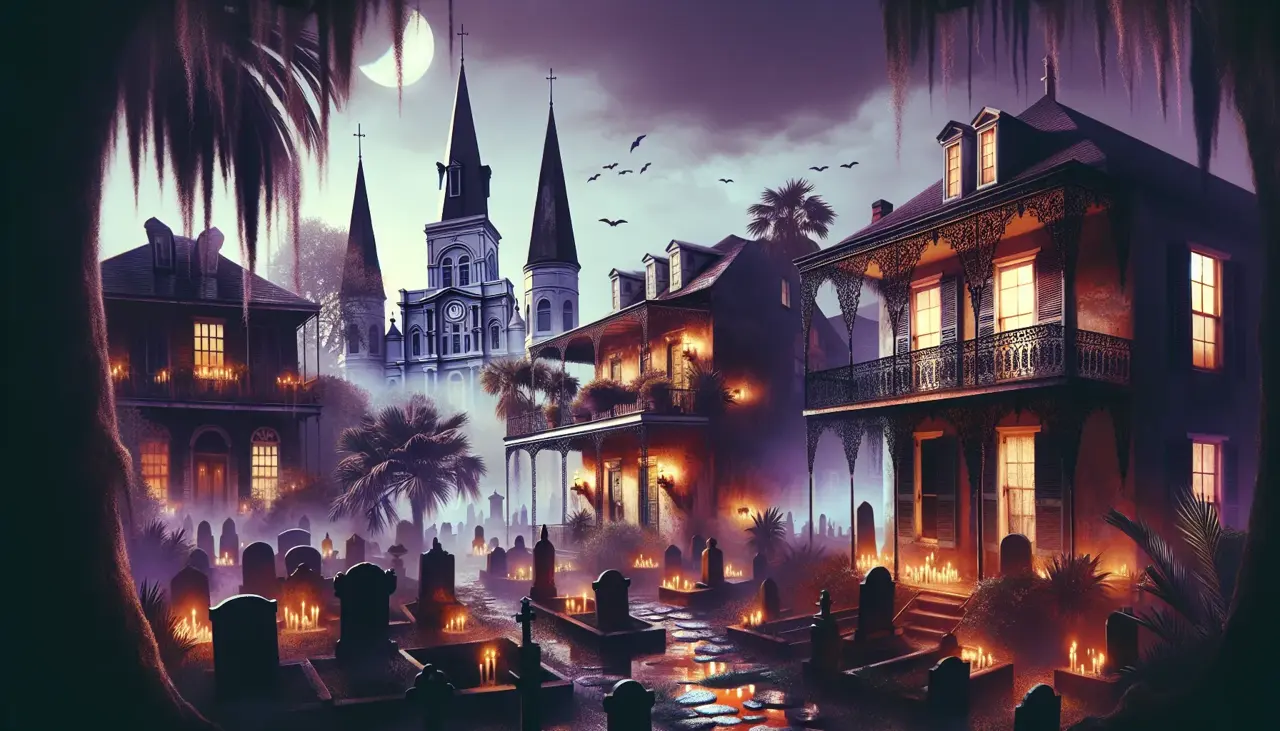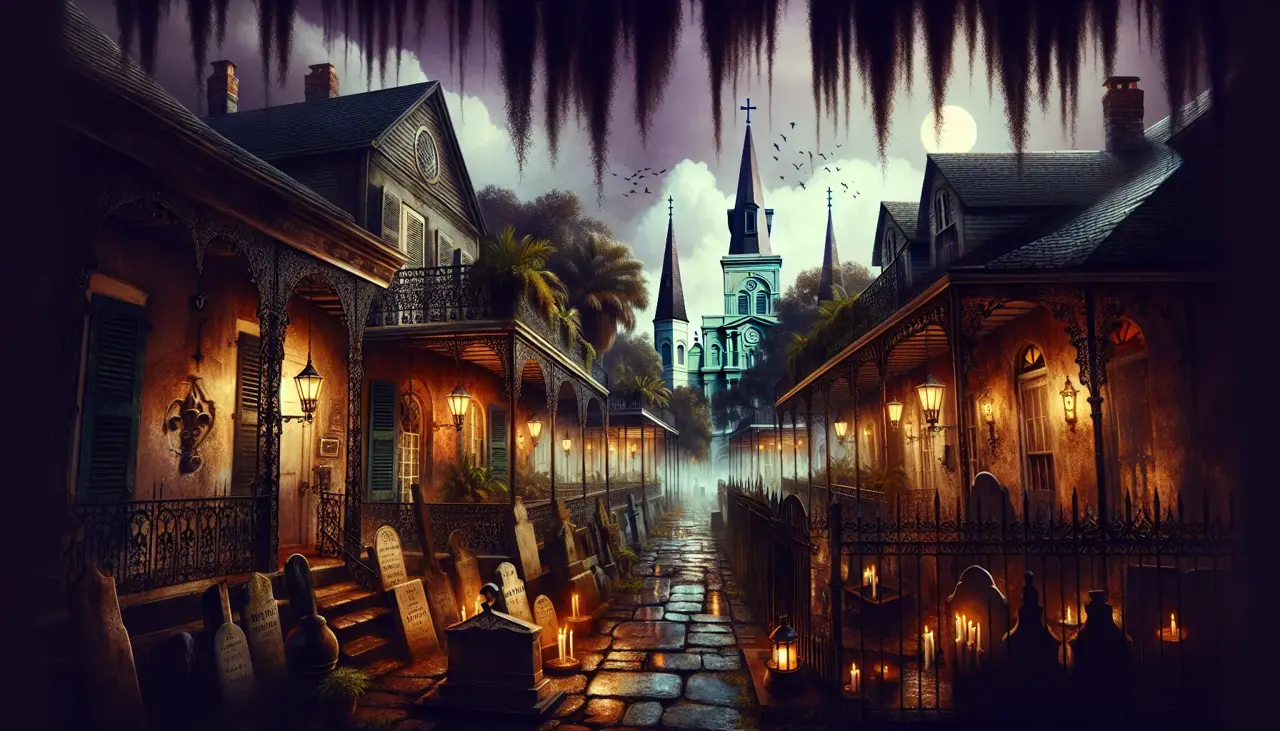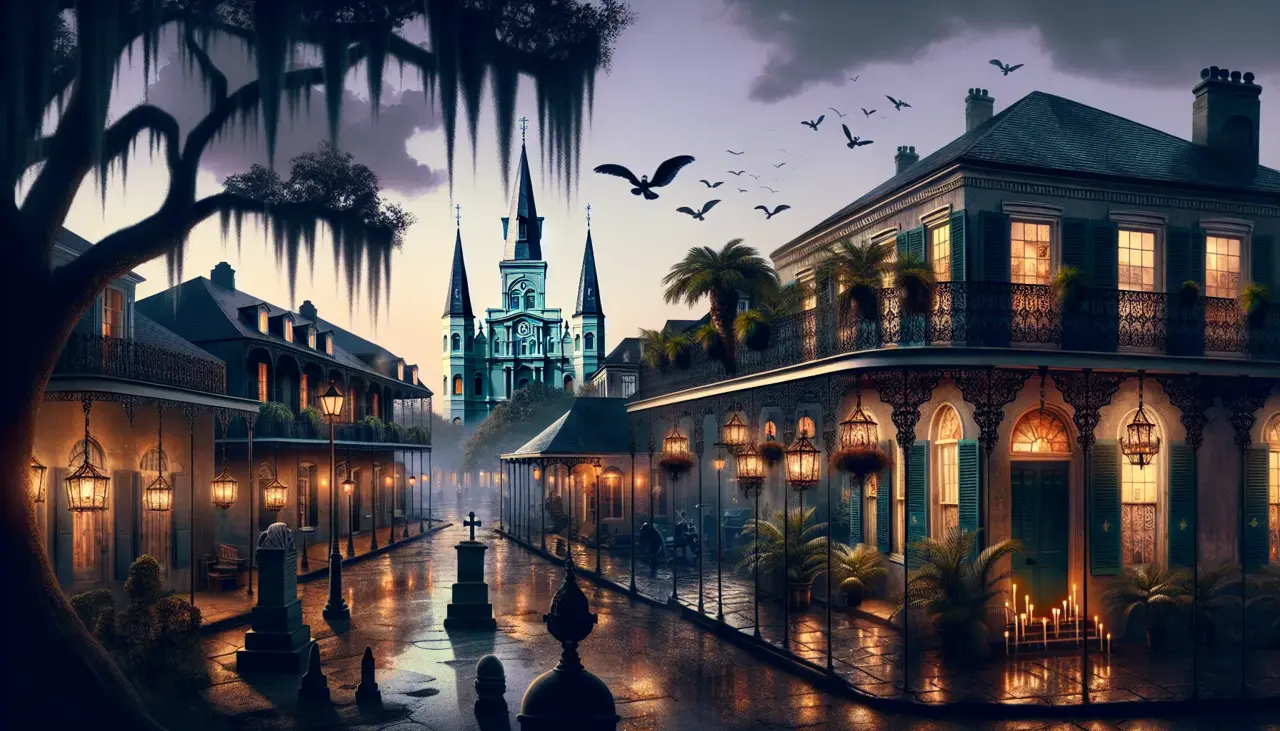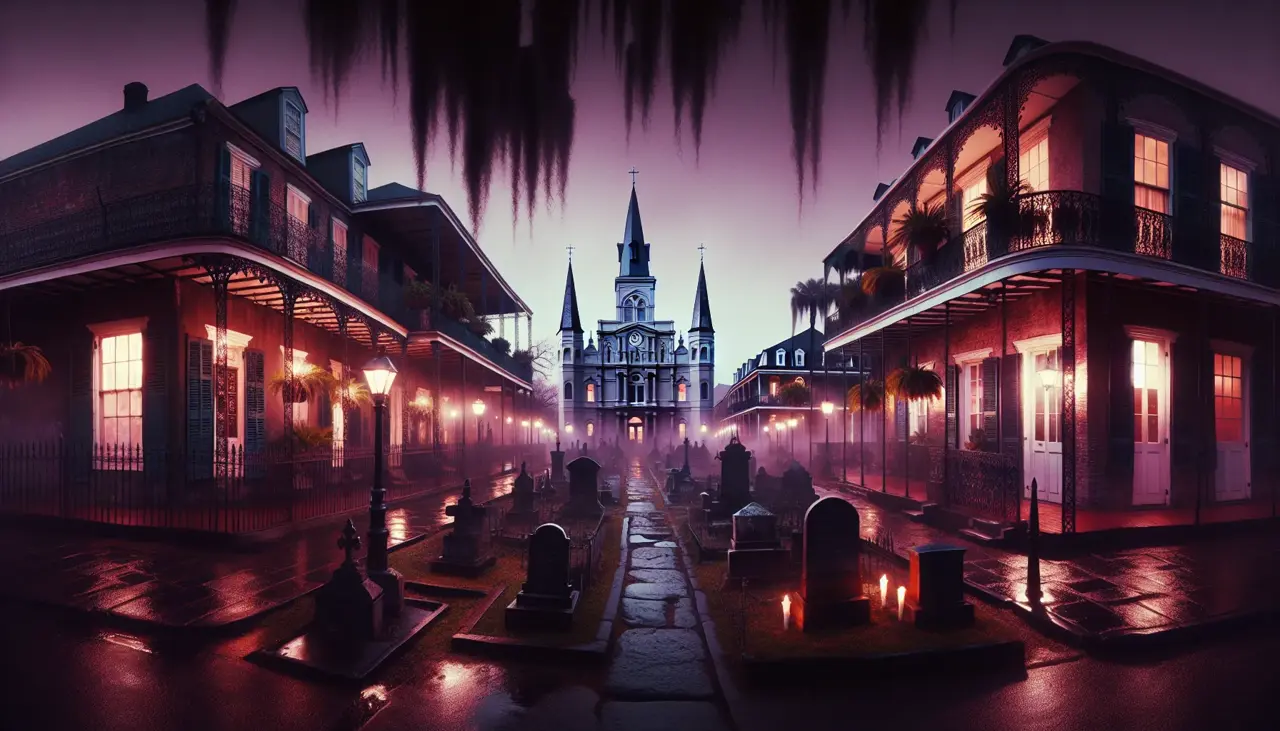
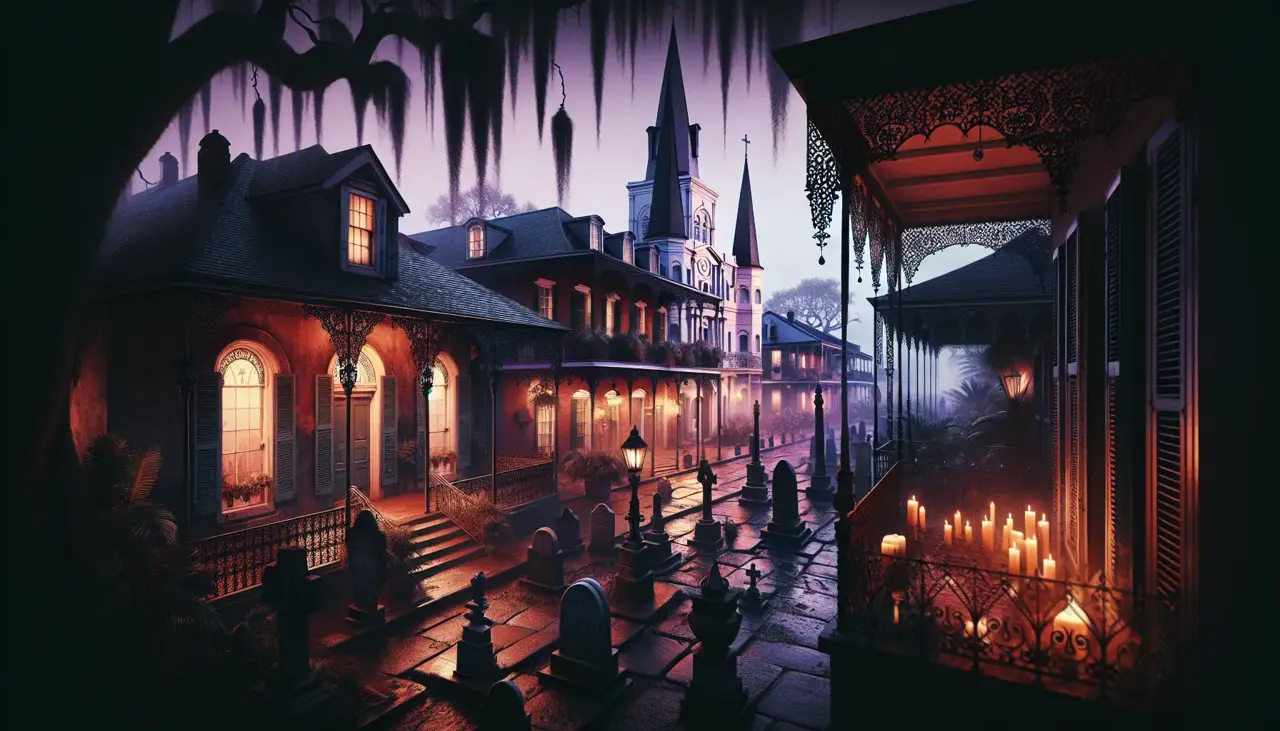
New Orleans is not merely haunted. It is saturated with the dead—their stories, their rituals, their refusal to be forgotten. No American city blends the supernatural into daily life as thoroughly as New Orleans, where voodoo altars share street corners with jazz clubs, where the dead are buried above ground because the ground itself rejects them, and where ghost tours are not novelty but navigation through layers of genuine history.
This is not a city that performs its darkness for tourists. The darkness is structural—woven into architecture, religion, commerce, and memory. Understanding the haunted history of New Orleans requires understanding how the city was built, who built it, what they believed, and what they suffered.
A City Built on Contested Ground
New Orleans was founded in 1718 by the French, on land that Indigenous peoples had used for thousands of years as a portage point between the Mississippi River and Lake Pontchartrain. The site was swampy, disease-ridden, and prone to flooding. It was also strategically invaluable.
The French ceded it to Spain in 1762, reclaimed it briefly, then sold the entire Louisiana Territory to the United States in 1803. Each transition brought new populations, new power structures, and new conflicts. The city absorbed French Catholicism, Spanish colonial administration, West African spiritual traditions, Caribbean influences, and American Protestant commerce—all layered on top of one another without any single culture fully displacing the others.
This layering is essential to understanding New Orleans. The city never resolved its contradictions. It held them in tension. That tension produced a culture unlike anything else in North America—and a relationship with death and the supernatural that remains unique.
The Roots of Voodoo in New Orleans
Voodoo arrived in New Orleans through enslaved West Africans and free people of color from Haiti and other Caribbean islands. It was not a single, unified religion but a family of practices drawing on Yoruba, Fon, and Kongo spiritual traditions, adapted under the pressures of slavery and Catholic colonialism. The full history of voodoo in New Orleans traces how these traditions evolved from African roots into a distinctly American spiritual practice.Catholic saints were mapped onto African spirits—not as disguise but as genuine syncretism. Practitioners saw no contradiction in attending Mass and performing voodoo rituals. The spiritual world was larger than any single tradition could contain.
Voodoo in New Orleans was never the caricature of Hollywood films—no zombies, no curses for hire, no sinister figures sticking pins in dolls. It was a community practice centered on healing, protection, spiritual communication, and justice. Understanding the distinction between voodoo and hoodoo is essential to separating authentic tradition from commercial myth.
Marie Laveau: Power Beyond the Myth
No figure embodies New Orleans voodoo more than Marie Laveau, the woman known as the Voodoo Queen. Born a free woman of color around 1801, Laveau operated at the intersection of spiritual authority, social power, and community service. She was a hairdresser to wealthy white women—a position that gave her access to the secrets and scandals of the city’s elite. She was also a healer, a counselor, and a spiritual leader who commanded respect across racial and class lines.
The full story of Marie Laveau reveals a woman far more complex than the mythologized figure of popular culture. Her power was real, grounded in community trust and practical knowledge rather than supernatural spectacle. Her legacy endures at St. Louis Cemetery No. 1, where visitors still leave offerings at a tomb associated with her name.
The Dead Above Ground
New Orleans buries its dead above ground. This is not merely tradition—it began as necessity. The city’s high water table meant that coffins buried conventionally would resurface during floods, floating through streets in a grim procession. Above-ground tombs solved this problem while creating one of the most visually striking burial landscapes in the world.
The city’s unique burial traditions produced the famous Cities of the Dead—walled cemetery complexes that resemble miniature neighborhoods, with family tombs arranged along narrow pathways. St. Louis Cemetery No. 1, the oldest extant cemetery in the city, dates to 1789 and contains the remains of some of New Orleans’ most prominent historical figures.
These cemeteries are not merely repositories for the dead. They are active sites of memory, ritual, and visitation. Voodoo practitioners, Catholic families, and curious visitors navigate the same narrow paths, each bringing their own relationship with mortality.
The LaLaurie Mansion: Cruelty Made Architecture
At 1140 Royal Street in the French Quarter stands the LaLaurie Mansion, arguably the most infamous haunted house in America. In 1834, a fire revealed that Madame Delphine LaLaurie had been torturing enslaved people in her attic—a discovery so horrifying that a mob formed and drove her from the city.
The true story of the LaLaurie Mansion is more disturbing than any ghost story because it requires no supernatural element. The horror was human, systematic, and conducted within the legal framework of slavery. LaLaurie was not an aberration. She was an extreme expression of a system that granted absolute power over human beings.
The mansion’s haunted reputation emerged almost immediately after the discovery. Reports of screams, apparitions, and unexplained phenomena have persisted for nearly two centuries. Whether one believes in ghosts, the LaLaurie Mansion forces a confrontation with historical evil that no amount of time has diminished.
French Quarter Ghosts
The French Quarter—the Vieux Carré—is the oldest neighborhood in New Orleans and the epicenter of its ghost stories. Within its compact grid of streets, nearly every building carries history measured in centuries and tragedy measured in lives.
The ghost stories of the French Quarter range from the well-documented to the apocryphal, but they share a common quality: they are anchored in specific buildings, specific events, and specific people. These are not generic hauntings. They are local, particular, and deeply connected to the history of the places where they occur.
The Sultan’s Palace, the Gardette-LePretre House, the Old Absinthe House, the Andrew Jackson Hotel—each carries its own narrative of death, betrayal, or suffering. The density of these stories within such a small area creates a cumulative effect that is difficult to dismiss entirely, even for skeptics.
Yellow Fever and Mass Death
Between 1817 and 1905, yellow fever killed over 40,000 people in New Orleans. The epidemic of 1853 alone killed nearly 8,000 in a city of 150,000—one in every nineteen residents, dead within a single summer. Bodies overwhelmed the cemeteries. Mass graves were dug. The stench of death was inescapable.
This scale of mortality shaped the city’s culture in ways that persist today. New Orleans developed an intimate, almost casual relationship with death that outsiders sometimes mistake for morbidity. Jazz funerals, second lines, Día de los Muertos celebrations, and All Saints’ Day tomb-cleaning traditions all reflect a culture that refuses to separate the living from the dead.
The ghost stories of New Orleans are not incidental to this history. They are an expression of it—a city processing centuries of mass death through narrative, ritual, and memory.
Pirates, Smugglers, and the Underworld
New Orleans was a port city in every sense—open to commerce, smuggling, piracy, and the moral ambiguity that accompanies all three. Jean Lafitte, the gentleman pirate, operated from the swamps south of the city, running a smuggling empire that traded in everything from stolen goods to enslaved people. His legend has been romanticized beyond recognition, but the historical Lafitte was a pragmatist who aided Andrew Jackson at the Battle of New Orleans in 1815 before disappearing into myth.
Lafitte’s ghost is said to haunt several locations in the French Quarter, including the blacksmith shop on Bourbon Street that bears his name. Like many New Orleans ghost stories, the Lafitte legend functions as a way of keeping uncomfortable history present—the city’s complicity in slavery, piracy, and exploitation wrapped in a narrative that is easier to tell than the truth.
The Supernatural Economy
New Orleans has commercialized its supernatural heritage more successfully than any other American city. Voodoo shops, ghost tours, haunted hotels, and occult museums form a significant part of the tourism economy. This commercialization is not entirely cynical—many practitioners and tour operators are deeply knowledgeable and genuinely connected to the traditions they present.
But the tension between authentic cultural practice and tourist spectacle is real. Voodoo is a living religion, not a theme park attraction. The dead whose stories fuel ghost tours were real people who suffered real fates. Understanding what to expect from New Orleans ghost tours helps visitors navigate this tension and engage with the city’s history respectfully.
Why New Orleans Haunts Differently
Most haunted cities have ghost stories. New Orleans has a ghost culture. The distinction matters. In other cities, hauntings are treated as anomalies—interruptions of normal reality. In New Orleans, the supernatural is woven into the normal. The dead are not absent. They are present in architecture, cuisine, music, religion, and daily conversation.
This is a city where funeral processions dance. Where the boundary between Catholic saints and African spirits was never firmly drawn. Where above-ground tombs line the streets like apartment buildings for the dead. Where the worst horrors—slavery, epidemic, exploitation—are preserved in the built environment rather than buried and forgotten.
New Orleans does not haunt because it is old. Many cities are older. It haunts because it remembers. The stories persist because the city refuses to let them fade—not out of morbidity, but out of a cultural understanding that the dead deserve attention, that history demands acknowledgment, and that some truths can only be told as ghost stories.
For more on this topic, see New Orleans ghost tours.