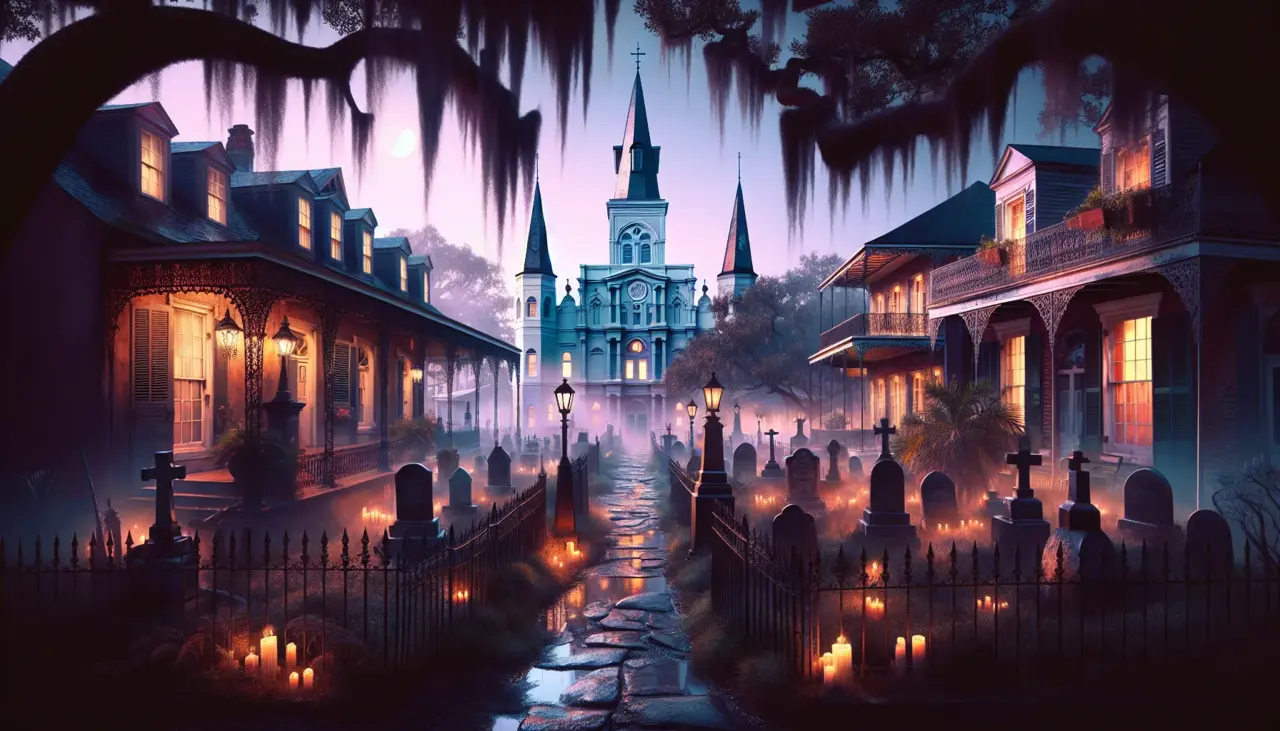
New Orleans contains more allegedly haunted locations per square mile than any other American city. This is not merely a tourism claim. The concentration reflects genuine history—centuries of epidemic disease, slavery, violence, and cultural practices that kept the dead present in daily life. The haunted reputation of New Orleans is built on real events in real buildings, many of which still stand and remain in active use.
What follows is not a comprehensive catalog but a guide to the most historically significant and well-documented haunted locations in the city. Each site carries its own history, its own reported phenomena, and its own connection to the broader haunted history of New Orleans.
The LaLaurie Mansion
Address: 1140 Royal Street, French Quarter The LaLaurie Mansion is the most infamous haunted house in New Orleans and arguably in the United States. On April 10, 1834, a fire at the residence of Madame Delphine LaLaurie (c. 1775–1849, born Delphine de McCarty) (c. 1775–1849), a wealthy Creole widow, led to the discovery of enslaved people who had been tortured in the attic—chained, mutilated, and starved. The discovery provoked a mob that ransacked the house, but LaLaurie escaped to France where she died in poverty.
The full story of the LaLaurie Mansion is more horrifying than any ghost story because its horrors were entirely human. The building has changed hands numerous times since 1834, and nearly every occupant has reported disturbances—screams from empty rooms, the sound of chains, apparitions in upper-floor windows. The house is privately owned and not open to the public, but it remains the centerpiece of virtually every ghost tour in the French Quarter.
St. Louis Cemetery No. 1
Address: 425 Basin Street
The oldest extant cemetery in New Orleans, officially established in 1789 (with some burials from 1781), St. Louis Cemetery No. 1 spans three acres and is a labyrinth of above-ground tombs that has been called the most haunted cemetery in America. Its history and legends include the tomb of Marie Laveau, where visitors still leave offerings and mark X’s in hope of granted wishes.
Reported phenomena include apparitions moving between tombs, the sensation of being touched by invisible hands, cold spots on hot days, and the figure of a tall man in a dark hat seen repeatedly near the cemetery’s center. Access is now restricted to guided tours, partly to preserve the deteriorating tombs and partly to manage the volume of visitors drawn by the cemetery’s reputation.
The Gardette-LePretre House (The Sultan’s Palace)
Address: 716 Dauphine Street, French Quarter
This elegant mansion carries one of the French Quarter’s most gruesome legends. According to tradition, a man claiming to be a Turkish sultan rented the Gardette-LePretre House in approximately 1862–1863 and filled it with a harem of approximately 12 women, servants, and opulent furnishings imported from the Ottoman Empire. One morning in 1862 or 1863, neighbors discovered everyone inside had been massacred—dismembered and buried in the courtyard beneath the flagstones. The sultan himself was reportedly buried alive at the estate.
Historical verification of this story is thin, but the building’s haunted reputation is robust. Residents and passersby have reported Middle Eastern music emanating from empty rooms, the scent of incense, and apparitions in period dress visible through the windows.
The Old Ursuline Convent
Address: 1100 Chartres Street, French QuarterThe Old Ursuline Convent, the oldest building in the Mississippi Valley (completed in 1752), located at 1100 Chartres Street in the French Quarter, carries legends involving vampires—the casket girls (filles à la cassette) who arrived from France between 1728 and 1751 carrying small cassettes of belongings. Legend holds that some caskets contained vampires, and that the convent’s sealed third-floor shutters keep them contained to this day, supposedly housing between 15 and 20 supernatural entities.
The vampire legend is almost certainly apocryphal, but the convent has a genuine history involving yellow fever nursing, wartime service, and centuries of religious life. Reported phenomena include lights in sealed upper rooms, shadowy figures on the balcony, and the sounds of footsteps in empty corridors.
The Hotel Monteleone
Address: 214 Royal Street, French Quarter
One of the grand historic hotels of New Orleans, the Hotel Monteleone has operated continuously since its opening in 1886 and spans an entire city block with over 600 rooms. It is one of the most haunted hotels in the South, having been investigated by numerous paranormal research groups and featured on multiple paranormal television programs.
The most commonly reported ghost is a young boy, believed to be the child of a former guest who died of yellow fever on the property. Guests have reported doors opening and closing, lights flickering, and the sensation of a small hand tugging at clothing. The hotel’s famous Carousel Bar—a revolving bar in the lobby—is said to be a particular hotspot for unexplained activity.
Lafitte’s Blacksmith Shop Bar
Address: 941 Bourbon Street, French Quarter
One of the oldest structures in the French Quarter, built in approximately 1722 during the French colonial period, this building operates today as a bar but carries the name and legend of Jean Lafitte (c. 1780–c. 1823), the pirate who allegedly used it as a front for his smuggling operations and privateering activities in the Gulf of Mexico. Whether Lafitte actually used this specific building is debated by historians, but the association has persisted for two centuries.
The bar is lit almost entirely by candlelight, creating an atmosphere that makes it easy to imagine ghosts in every corner. Reported phenomena include the apparition of a man in period clothing near the fireplace, objects moving on their own, and red eyes glowing in dark corners. Staff members have reported the sensation of being watched and unexplained cold drafts.
The Beauregard-Keyes House
Address: 1113 Chartres Street, French Quarter
This 1826 raised cottage served as the temporary residence of Confederate General Pierre Gustave Toutant Beauregard (1818–1893) (1818–1893) during the American Civil War and later as the home of novelist Frances Parkinson Keyes (1885–1970). The house’s haunted reputation centers on reports of Civil War soldiers in gray uniforms seen fighting in the courtyard and ballroom, apparently reenacting the Battle of New Orleans (January 8, 1815) that never took place at this location.
Other reported phenomena include piano music from empty rooms, the scent of roses without any flowers present, and the apparition of a woman in white on the second-floor gallery.
The Bourbon Orleans Hotel
Address: 717 Orleans Street, French Quarter
Built on the site of the Orleans Ballroom, where the quadroon balls of antebellum New Orleans took place between 1817 and 1850, this hotel carries the weight of particularly painful history. The quadroon balls were events where wealthy white men chose mixed-race women as mistresses in formalized arrangements called plaçage, a system unique to New Orleans. The ballroom later served as a convent for the Sisters of the Holy Family (1859–1880) and then as an orphanage.
Ghosts reported here include children playing in the hallways, a Confederate soldier on the sixth floor, a woman dancing alone in the ballroom, and nuns gliding through corridors. The hotel’s history encompasses slavery, exploitation, religious life, and childhood death—layers of suffering that the building seems unable to shed.
The Pharmacy Museum
Address: 514 Chartres Street, French Quarter
The New Orleans Pharmacy Museum occupies the building where America’s first licensed pharmacist, Louis Joseph Dufilho Jr. (1783–1821), practiced from 1816 until his death in the 1820s. A later occupant, Dr. Jean Étienne Dupas (dates unknown), was rumored to conduct experiments on enslaved people and unsuspecting patients in the rear laboratory, testing experimental medicines and performing surgeries of questionable medical necessity.
Visitors and staff have reported the apparition of a man in 19th-century medical attire, unexplained sounds of glass breaking in the courtyard, and the sensation of being grabbed or pushed in the rear garden.
Muriel’s Jackson Square
Address: 801 Chartres Street, French Quarter
This restaurant, housed in a building dating to 1718 and spanning two stories with a brick courtyard, maintains a table permanently set for its resident ghost—believed to be Pierre Antoine Lepardi Jourdan (dates unknown), a wealthy merchant who lost the building and his entire fortune in a single poker game and subsequently took his own life on the second floor in approximately 1830. Staff set a place with bread and wine each evening, and the table remains reserved throughout service.
Reported phenomena include glasses moving on their own, the sound of footsteps on the second floor after closing, and unexplained cold spots near the reserved table. The restaurant treats its ghost with humor and respect—an approach characteristic of New Orleans’ pragmatic relationship with its supernatural residents.
Visiting the Haunted City
New Orleans’ haunted locations are best experienced with context. Ghost tours provide historical narrative that transforms individual sites into a connected story of the city’s past. The ghost stories of the French Quarter are most compelling when understood not as isolated spooky tales but as expressions of the city’s layered, unresolved history.
For more on this topic, see New Orleans ghost tours.