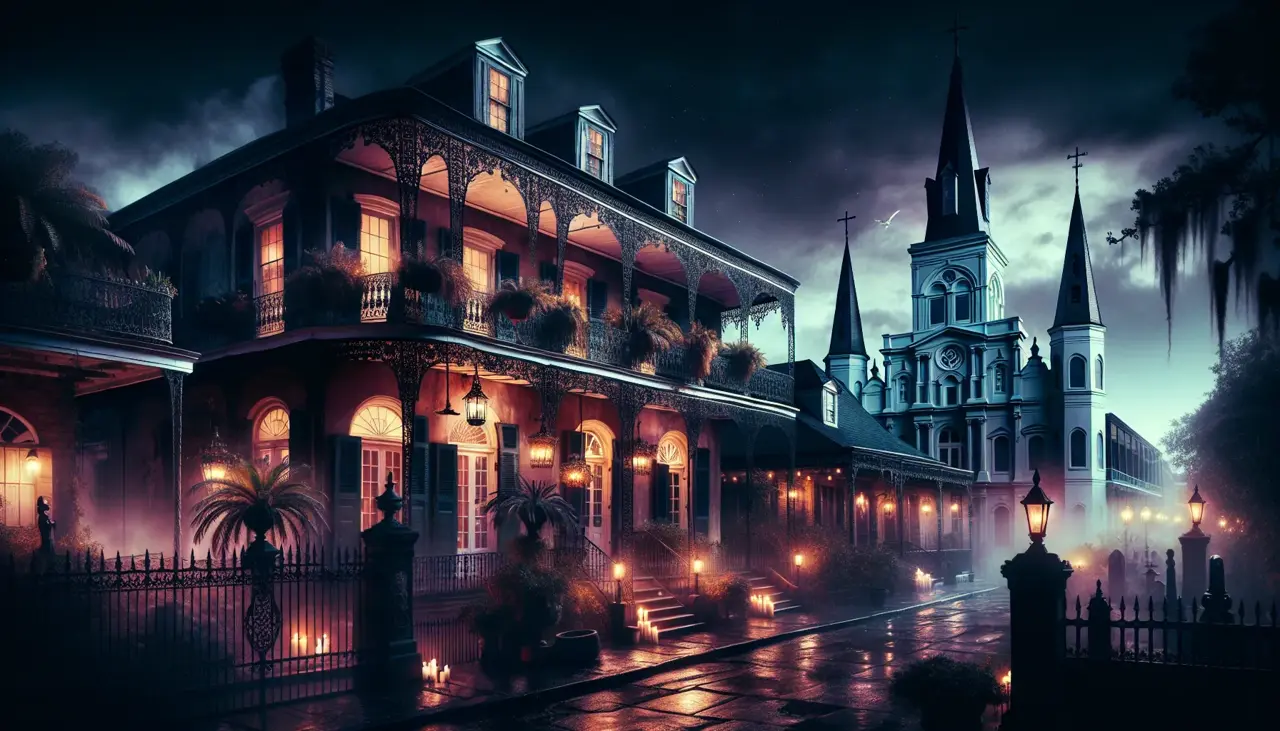
Voodoo in New Orleans is not what most people think it is. The word conjures images from horror films—dolls stuck with pins, zombies, curses whispered in candlelit rooms. The reality is a complex, living spiritual tradition with deep roots in West African religion, shaped by the catastrophe of the Atlantic slave trade, adapted under Catholic colonialism, and evolved into something distinctly American in the streets of New Orleans.
Understanding voodoo requires understanding its origins, its transformations, and the people who carried it across oceans and through centuries of oppression. New Orleans’ haunted history begins with these traditions and the communities that sustained them.
African Roots
The spiritual traditions that became New Orleans voodoo originated primarily among the Fon and Ewe peoples of present-day Benin and Togo (regions known as Dahomey and the Gold Coast in the colonial era), and among the Yoruba of present-day Nigeria (the historical Yoruba Empire, c. 1200-1896). These traditions centered on a supreme creator god and a pantheon of lesser spirits—called loa, lwa, or orisha depending on the tradition—who served as intermediaries between humans and the divine.
These spirits were not abstract theological concepts. They were present, active, and accessible through ritual, offering, and ceremony. Practitioners communicated with spirits through drumming, dancing, trance states, and sacrificial offerings. Spiritual authority was held by priests and priestesses who had undergone extensive training and initiation.
The traditions were oral, transmitted through practice rather than scripture. This oral nature proved essential to their survival. When enslaved people were stripped of material possessions, language, and family connections, they carried their spiritual knowledge with them.
The Middle Passage and Survival
The Atlantic slave trade transported millions of Africans to the Americas between the 16th and 19th centuries. The path itself—the Middle Passage—was an experience of systematic dehumanization designed to destroy cultural identity and spiritual connection. Enslaved people were separated from speakers of their own languages, stripped of personal belongings, and subjected to conditions intended to break will and memory.
Despite this, spiritual traditions survived. They survived because they were carried in the mind rather than in material form. Songs, rhythms, invocations, and ritual knowledge could not be confiscated. Enslaved people who arrived in the Caribbean and the American South brought with them the essential frameworks of their spiritual traditions, even when specific practices had to be adapted to new circumstances.
Caribbean Transformation
The Caribbean colonies—particularly Haiti (then Saint-Domingue)—became the crucible in which African spiritual traditions were transformed into the practices recognizable as voodoo. French colonial law, specifically the Code Noir issued by King Louis XIV in 1685 (a legal code governing slavery in French colonies across the Americas), required that enslaved people be baptized Catholic within eight days of arrival. Rather than abandoning their own traditions, enslaved Africans mapped Catholic saints onto African spirits.Saint Patrick, who drove the snakes from Ireland, became associated with Damballah, the serpent spirit. The Virgin Mary was mapped onto Erzulie Freda, the spirit of love and beauty. Saint Peter, who holds the keys to heaven, was identified with Papa Legba, the spirit who guards the crossroads between the human and spirit worlds.
This was not mere disguise. It was genuine syncretism—a creative theological act that recognized shared qualities between Catholic and African spiritual figures. The result was a new tradition that was neither purely African nor purely Catholic but authentically both.
The Haitian Revolution (1791-1804), which began as a slave uprising in Saint-Domingue and culminated in the establishment of the independent nation of Haiti in 1804, gave voodoo its most dramatic historical moment. The revolution’s opening ceremony at Bois Caïman (August 1791) is traditionally described as a voodoo ritual in which the spirits sanctioned the uprising against French colonial rule. Led by figures including Dutty Boukman and Henri Christophe, the revolution resulted in Haiti becoming the first black-led republic in the Western Hemisphere. Whether historically precise or mythologized, this event cemented the association between voodoo and resistance to oppression.
Arrival in New Orleans
Voodoo arrived in New Orleans through multiple channels beginning in the late 18th century. Enslaved Africans brought directly from West Africa via the Atlantic slave trade (which peaked for Louisiana in the 1720s-1740s) carried original traditions. Free people of color and enslaved people fleeing the Haitian Revolution (particularly between 1791-1804 and continuing through the 1810s) brought Caribbean-inflected practices to New Orleans, with significant migrations occurring in 1793-1797 and again in 1809-1810. The constant movement of people through New Orleans’ port ensured a continuous flow of spiritual knowledge and practice, making the city a syncretic hub by the early 1800s.
New Orleans was uniquely receptive. Unlike Protestant-dominated cities elsewhere in the American South, New Orleans was Catholic—a tradition that already included saints, relics, holy water, and ritual in ways that resonated with African spiritual practices. The city’s Code Noir, adopted from the French colonial version, mandated Catholic instruction for enslaved people but also inadvertently created spaces for African spiritual practice to continue under Catholic cover.
Congo Square—a public space where enslaved people were permitted to gather on Sundays—became the most visible site of African cultural expression in North America. The drumming, dancing, and singing that took place there were simultaneously entertainment, cultural preservation, and spiritual practice.
The Golden Age Under Marie Laveau
The mid-19th century marked the height of voodoo’s public visibility in New Orleans, largely due to Marie Laveau (1794-1881), the most renowned voodoo priestess of her era. Under her leadership from the 1820s through the 1870s, voodoo ceremonies became major public events. The annual St. John’s Eve celebration (June 23-24) on the shores of Lake Pontchartrain drew hundreds of participants from all races and social classes, with crowds reportedly numbering in the hundreds by the 1840s-1850s.
Laveau’s genius was in making voodoo both accessible and authoritative. She combined African spiritual elements with Catholic ritual, herbal medicine with theatrical ceremony, community service with strategic power. Her practice demonstrated that voodoo was not a marginal superstition but a legitimate spiritual tradition capable of operating at the center of urban life.
The period also saw the proliferation of voodoo practitioners throughout the city. Not all were as prominent as Laveau, but the tradition supported numerous healers, diviners, and spiritual advisors who served communities across racial and economic lines.
Suppression and Survival
After the Civil War ended in 1865, voodoo faced increasing pressure from both legal authorities and mainstream Protestant culture. As Jim Crow laws—a system of racial segregation laws that dominated the South from the 1880s onward—tightened racial restrictions, practices associated with Black culture were targeted for suppression. Newspapers sensationalized voodoo ceremonies, portraying them as dangerous, primitive, and threatening, particularly intensifying after the 1890s as the New Orleans press became increasingly hostile to Black spiritual traditions.
Police raids on voodoo gatherings became more frequent. Practitioners were arrested for “fortune telling” or “practicing medicine without a license.” The legal framework that had tolerated voodoo under French and Spanish colonial rule gave way to an American legal system that viewed it with suspicion and hostility.
Yet voodoo survived—pushed underground but not eliminated. It continued in private homes, in the back rooms of shops, and within tight-knit community networks. The tradition adapted, as it always had, to new pressures.
The Tourist Era
The 20th century brought a new challenge: commercialization. As New Orleans developed its tourism industry, voodoo became a selling point. Shops marketed mass-produced voodoo dolls and gris-gris bags. Tour operators incorporated voodoo stories into their narratives. Hollywood films cemented stereotypes that bore little resemblance to actual practice.
This commercialization was a double-edged sword. It kept voodoo visible in public consciousness but often reduced it to caricature. Authentic practitioners found themselves competing with novelty shops for cultural authority. The distinction between genuine spiritual practice and tourist entertainment blurred.
Voodoo Today
Contemporary New Orleans voodoo exists on a spectrum from fully traditional practice to cultural tourism. Serious practitioners maintain altars, perform rituals, and serve their communities as healers and spiritual advisors. Organizations like the New Orleans Voodoo Spiritual Temple work to educate the public about authentic practice and combat misconceptions.
The tradition continues to evolve, incorporating elements from other spiritual paths while maintaining its core identity as a syncretic religion rooted in African, Caribbean, and Catholic traditions. It remains a living faith, not a museum exhibit.
Understanding voodoo as a living tradition rather than a historical curiosity is essential to understanding New Orleans itself. The city’s culture—its music, its food, its attitude toward death and celebration—was shaped in part by the spiritual practices of the people who built it under conditions of extraordinary adversity.
For more on this topic, see New Orleans ghost tours.