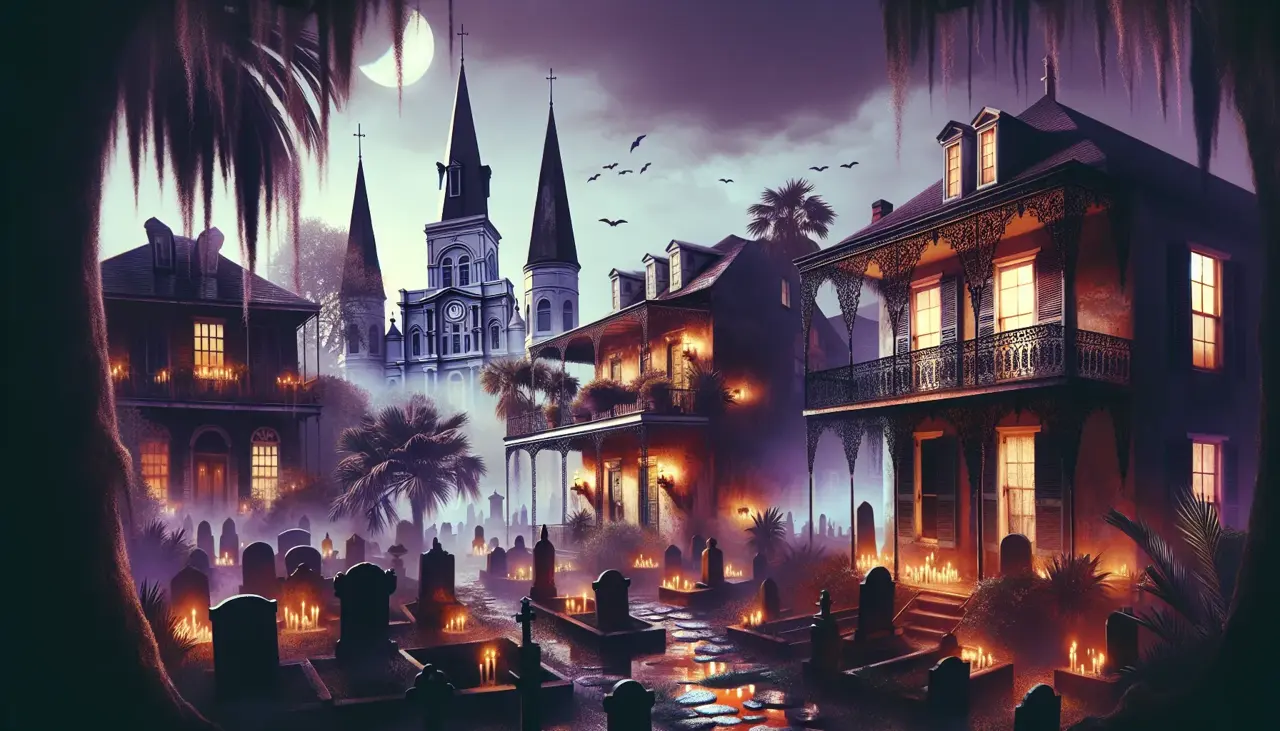
New Orleans ghost tours are among the most popular tourist activities in the city, drawing hundreds of thousands of visitors each year—estimates suggest over 500,000 annually—into the French Quarter’s narrow streets after dark for evening historical walks. But the quality, accuracy, and experience of these tours varies enormously—from rigorous historical walks led by knowledgeable guides to theatrical performances that prioritize entertainment over truth.
Knowing what to expect helps visitors choose tours that match their interests and engage with the city’s genuinely haunted history rather than a commercialized version of it.
What Most Tours Cover
The standard New Orleans ghost tour follows a roughly 90-minute to two-hour walking route (covering approximately 1 to 1.5 miles) through the French Quarter, stopping at buildings and locations associated with documented hauntings, historical tragedies, or supernatural legends. Most tours cover a core set of locations that have become canonical in the ghost tour industry:
The LaLaurie Mansion at 1140 Royal Street appears on virtually every ghost tour itinerary. Built in 1832, the mansion is where Madame Marie Delphine LaLaurie (1775-1849) tortured enslaved people in her attic during the 1830s—a story that is genuinely horrifying and extensively documented in historical records, making it one of the few ghost tour stops where the historical record is more disturbing than any embellishment.
Lafitte’s Blacksmith Shop Bar on Bourbon Street provides a stop associated with Jean Lafitte, the gentleman pirate. The Sultan’s Palace (the Gardette-LePretre House) offers a story of massacre that may or may not be historically accurate. The Beauregard-Keyes House, the Old Ursuline Convent, and the Andrew Jackson Hotel round out many standard itineraries.
Better tours also incorporate the city’s voodoo traditions, above-ground burial customs, and the broader historical context of slavery, epidemics, and colonial violence that produced the city’s haunted reputation.
Types of Tours Available
Ghost tours in New Orleans fall into several categories, and choosing the right type significantly affects the experience.Walking tours are the most common format, accounting for approximately 70% of ghost tour offerings. Groups of 15 to 30 people follow a licensed or unlicensed guide through the Quarter on foot, stopping at predetermined locations for narration. These range from excellent to terrible depending entirely on the guide’s training and knowledge. The best walking tours combine rigorous historical research with engaging storytelling and academic grounding. The worst rely on scripted performances, theatrical fake accents, and stories copied from other tours without verification or documentation.
Cemetery tours focus specifically on St. Louis Cemetery No. 1 (established 1789) or other historic burial grounds including St. Louis Cemetery No. 2 (established 1823) and St. Louis Cemetery No. 3 (established 1852). Since 2015, St. Louis Cemetery No. 1 requires a licensed tour guide for entry, which has generally improved the quality of cemetery tours by filtering out unlicensed operators and establishing professional standards. These tours emphasize New Orleans’ distinctive above-ground funerary architecture, Creole burial customs, and the historical figures interred within the walls.
Voodoo-focused tours explore the city’s spiritual traditions, visiting sites associated with Marie Laveau, Congo Square, and active voodoo temples. The quality of these tours depends heavily on the guide’s understanding of the distinction between voodoo and hoodoo and their willingness to present the traditions respectfully rather than sensationally.
Pub crawl ghost tours combine haunted history with bar stops—typically visiting three or four establishments along the route. These are social events more than educational ones, though some manage to deliver solid historical content between drinks.
Carriage tours offer a more leisurely option, covering the Quarter by horse-drawn carriage with narration from the driver. Coverage is broader but shallower, and the noise of the street can make it difficult to hear the guide.
What Makes a Good Tour
The difference between a good ghost tour and a bad one comes down to three factors: the guide’s historical knowledge, their storytelling ability, and their honesty about what is documented versus what is legend.
Good guides distinguish between verified history and local folklore. They say “the story goes” or “according to legend” when presenting unverified claims, and “historical records show” when presenting documented facts. They understand the historical context—slavery, yellow fever, colonial politics—that produced the city’s supernatural reputation. They answer questions with substance rather than deflection.
Good guides also respect the living traditions they discuss. Voodoo is a practiced religion, not a theme park attraction. The LaLaurie Mansion story involves real people who suffered real torture. The cemeteries contain the remains of actual families. A guide who treats these subjects with appropriate gravity delivers a better experience than one who plays them for cheap thrills.
Group size matters. Tours with more than 25 participants become difficult to manage on narrow Quarter streets. Guides must shout to be heard, stops become crowded, and the experience degrades for everyone. Smaller groups—particularly those capped at 15 or fewer—allow for better interaction and more intimate engagement with the material.
What to Watch Out For
Several red flags indicate a tour that prioritizes spectacle over substance. Be cautious of tours that promise guaranteed ghost sightings or paranormal encounters. No legitimate tour operator can guarantee supernatural activity. Tours that advertise EMF detectors, spirit boxes, or other paranormal investigation equipment as standard features are selling entertainment, not history.
Be wary of guides who cannot answer basic historical questions about the locations they visit. If a guide cannot tell you when the LaLaurie Mansion was built, who owned it before and after Madame LaLaurie, or what happened to it in the 20th century, they are reciting a script rather than drawing on actual knowledge.
Street barkers—people standing at corners in the Quarter selling tour tickets—sometimes represent legitimate companies but often work on commission for whoever will pay them. Booking directly through a tour company’s website or through verified review platforms provides more reliable quality assurance.
When to Go
Most ghost tours depart between 7:00 PM and 9:00 PM local time, with the later departures (9:00 PM or after) offering darker streets and enhanced atmospheric conditions for storytelling. October is peak season, with tours booking out well in advance around Halloween (October 31), particularly in the week leading up to All Saints’ Day (November 1). Summer tours (June-August) contend with heat, humidity, and temperatures often exceeding 90 degrees Fahrenheit, conditions that can make a two-hour walking tour uncomfortable.
Weather in New Orleans is unpredictable. Rain does not typically cancel tours, but thunderstorms may cause delays or rescheduling. Comfortable walking shoes are essential—the Quarter’s sidewalks are uneven, and the route covers roughly a mile of walking with frequent stops.
Beyond the French Quarter
The French Quarter dominates New Orleans’ ghost tour market, but the city’s haunted history extends well beyond the Vieux Carré. The Garden District, the Tremé neighborhood, and the Bywater all contain sites with documented supernatural histories. Some tour companies offer routes through these neighborhoods, providing a less crowded and sometimes more historically nuanced experience.French Quarter ghost stories are the most commercially developed, but they represent only a fraction of the city’s supernatural landscape. Visitors with more than one evening to spare benefit from exploring beyond the Quarter’s boundaries.
Making the Most of It
The best approach to a New Orleans ghost tour is to treat it as a starting point rather than a complete experience. A good tour introduces locations, stories, and historical contexts that reward further exploration. After a tour visits the LaLaurie Mansion, a curious visitor can research the documented history. After hearing about Marie Laveau, a visitor can visit the New Orleans Historic Voodoo Museum or attend a voodoo ceremony open to the public.
New Orleans’ haunted history is not a product to be consumed in two hours. It is a landscape to be explored—one that reveals more the deeper you go. The best ghost tours understand this and position themselves as guides to a larger world rather than self-contained entertainment packages.
The dead of New Orleans have been telling their stories for three centuries. A good tour helps you listen.
For more on this topic, see New Orleans ghost tours.