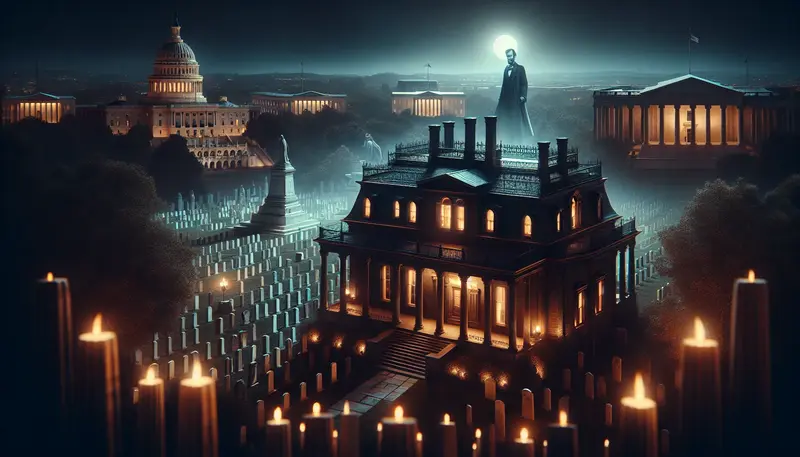
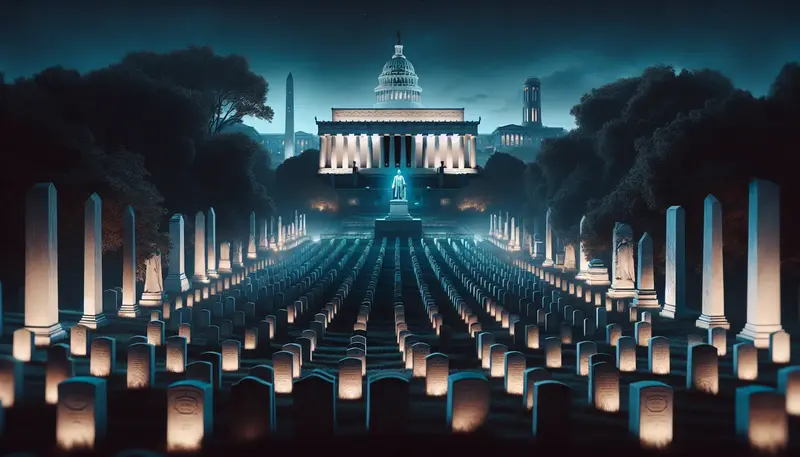
Arlington National Cemetery holds 400,000 graves across 639 acres. Guards, staff, and visitors have reported encounters they cannot explain.
This article is part of our comprehensive Washington DC ghost tours guide. Whether you're planning a visit or researching from afar, these stories reveal a side of Washington DC most visitors never see.
History and Context: How Arlington Became America's Sacred Ground
Can a family estate seized in wartime become one of the nation's most sacred and, paradoxically, most haunted places? The answer begins with facts: Arlington National Cemetery formally opened on May 13, 1864, when the U.S. government began burying Union dead on the grounds of Arlington House, the former estate of George Washington Parke Custis and home to General Robert Edward Lee, who resigned his U.S. Army commission on April 20, 1861, to join the Confederacy.
Arlington House was built between 1802 and 1818 by Custis, the adopted grandson of George Washington, and designed by English architect George Hadfield (second architect of the U.S. Capitol). Its imposing Greek Revival portico features eight massive Doric columns, each 23 feet tall, visible from across the Potomac. The Lees occupied the house until 1861; the estate was seized under the Revenue Act of 1861 for $92.07 in unpaid property taxes—Mary Anna Custis Lee sent a cousin to pay, but authorities required payment in person—and sold at public auction on January 11, 1864, to the U.S. government for $26,800, and federal authorities quickly saw the high ground across the Potomac as an ideal burial site during the American Civil War. Within months, the property had transformed from family home to national cemetery. That transition is central to the cemetery's aura: graves layered across lawns that were once domestic space add a human intimacy to the monumental setting.
Specific elements of the cemetery give it an especially grave resonance. The Tomb of the Unknown Soldier was first dedicated on November 11, 1921, to honor an unidentified American soldier from World War I; the present marble sarcophagus—designed by architect Lorimer Rich and sculpted by Thomas Hudson Jones from a single block of Colorado Yule marble—was completed in 1932. The site is also the final resting place of prominent figures such as President John F. Kennedy, whose gravesite with its Eternal Flame was dedicated on November 25, 1963, just days after his assassination on November 22, 1963. The cemetery is administered by the U.S. Army, and the 3d U.S. Infantry Regiment, "The Old Guard," carries out ceremonial duties there.
Arlington occupies roughly 639 acres in Arlington County, Virginia, just across the Potomac River from Washington, D.C. The main visitor entrance is at 1 Memorial Avenue, Arlington, VA 22211. That proximity to the capital, the concentration of the nation's war dead—more than 400,000 interments—and the high-profile graves all contribute to a landscape where history and memory press close together. Those elements are why reports of the supernatural tend to concentrate here: grief, ceremony, and high symbolic meaning create fertile ground for stories of restless presences and strange occurrences.
Common Legends and the Places They Haunt
The folklore of Arlington National Cemetery clusters around a few iconic features: Arlington House, the Confederate Memorial, the Tomb of the Unknown Soldier, Section 60, and the Kennedy gravesite. Each place carries its own stories, often traceable to a historical flashpoint. The Confederate Memorial—unveiled in 1914 by the United Daughters of the Confederacy and located at Arlington's northwestern edge—anchors tales about Civil War soldiers returning to patrol the grounds, while Arlington House, as the Lee family home, is tied to persistent stories about a spectral figure seen on its porch or in its windows. For related history, see our the u.s. capitol building.
The Tomb of the Unknown Soldier is at the center of one of the cemetery's most persistent sets of reports. Personnel associated with the Sentinel program—members of the 3d U.S. Infantry Regiment who stand guard at the tomb—have long reported sensations of an unseen presence, the feeling of being watched, and the sound of soft footsteps when no one else is present. Those experiences echo the ritual seriousness of the tomb itself, where silence, precision, and vigil combine into an atmosphere that many describe as both solemn and uncanny.
Section 60 — a newer part of the cemetery where many service members from Iraq and Afghanistan have been interred — has in recent decades accrued its own contemporary folklore. Located in the northwest portion of the cemetery and mapped in the cemetery's public directory, Section 60 serves as an informal pilgrimage site for families of recent war dead. Visitors and informal guides report hearing whispered conversations near fresh graves, or seeing a figure in modern combat gear moving between headstones. The proximity of burial to present time may intensify the psychological resonance of these reports; grief and memory press more acutely when the dead have been absent only months or years rather than decades or centuries. The Kennedy gravesite, with its Eternal Flame and frequent visitors, has also produced reports of lights behaving oddly at night and a sense of warmth or presence beyond normal expectations. Because Arlington functions as a public, working cemetery, these stories circulate among visitors, staff, veterans, and local historians, and they often gain traction precisely because the sites are so well known and so loaded with national meaning.
Notable Eyewitness Accounts and Their Context
Reported experiences at Arlington range from subtle sensations to dramatic visual sightings. A commonly cited class of reports comes from cemetery staff and military sentinels whose livelihoods situate them in the most solemn parts of the grounds. For example, a former Tomb Sentinel (speaking on background and identified only by rank in several oral histories) described occasions when he and fellow sentinels heard pacing and low voices near the tomb late at night while the area was officially closed to the public. The sentinels emphasized that such occurrences were rare, always reported through official channels, and treated with a combination of respect and procedural calm.
Another recurring account comes from tour guides and veterans who walk the grounds after sunset. Guides have reported seeing a lone figure in a dark overcoat near Arlington House who vanishes when approached; these sightings are often framed by the guide as an emotional echo of the home's wartime history. A veteran visitor described, in a recorded interview for a local oral-history archive, feeling an inexplicable chill while standing at the edge of Section 60 on November 11, 2007 — Veterans Day — followed by a faint scent of cordite and a whisper of an indistinct name. The veteran requested anonymity but allowed the account to be archived, underscoring a pattern: people connected to the cemetery by service or work account for a disproportionate share of reports. For related history, see our the georgetown exorcist house: the true.
In a different vein, there are documented instances where camera equipment has recorded anomalies. At certain times of year—often in late autumn or winter—visitors have reported that digital photos taken near the Tomb of the Unknown Soldier or the Kennedy gravesite show unexpected light flares or small, translucent shapes that do not appear in the raw scene. Photographers and staff tend to treat such evidence cautiously: lighting in marble-lined spaces, long exposures, and lens artifacts are plausible natural explanations, and staffers with technical training commonly point out those possibilities. Nevertheless, these reports remain part of the cemetery's oral record because they are tied to specific places and dates and because the witnesses frequently include people with prolonged familiarity with the site.
Hotspots, Exact Locations, and Practical Details
Arlington National Cemetery's geography channels most folklore into a handful of hotspot locations that modern visitors should know by name. The primary address is 1 Memorial Avenue, Arlington, VA 22211; within the grounds, certain sections recur in stories. Arlington House (the Robert E. Lee Memorial) sits on a prominent ridge and is often referenced in reports of spectral figures seen on the porch or in windows. The Confederate Memorial, near Memorial Drive NW, is another locus of Civil War–era stories. The Tomb of the Unknown Soldier is centrally located and highly visible; visitors can find it at the marble esplanade near the ceremonial grounds.
Section 60, located in the northwest portion of the cemetery, has become a modern focal point for stories about recent-war veterans. It is mapped in the cemetery's public directory and is frequently referenced by dates of internment, which gives visitors an anchor for contextualizing reports. The Kennedy gravesite, situated close to the Arlington House hillside and at the terminus of a sloping lawn, is a major pilgrimage spot; it is marked by its plaza, the Eternal Flame, and the Eternal Flame—designed by architect John Carl Warnecke and first lit by Jacqueline Kennedy during the funeral on November 25, 1963—and a simple flat granite headstone
For those interested in specific coordinates or plot locations, the cemetery maintains an online gravesite locator and provides maps at the visitor center near 1 Memorial Avenue. Visitors should keep in mind that many of the reported experiences occur after dark or during hours when the cemetery is closed—trespassing is not only illegal but disrespectful. Official tours and daytime visits are the proper channels for learning about the cemetery's history and its stories, and those channels also allow visitors to ask staff about documented incidents and oral-history reports. These practical details ground legend in place: Arlington's ghost stories are tethered to identifiable plots and monuments, which is one reason they continue to circulate with specificity. For related history, see our most haunted places in washington dc:.
How Military Tradition and Cemetery Staff Treat Unusual Events
The response to reports of strange phenomena at Arlington is shaped by two institutional realities: a military culture that prioritizes order and ritual, and a cemetery administration that must balance access with respect. The 3d U.S. Infantry Regiment ("The Old Guard") has a formal, storied role at Arlington; its sentinels guard the Tomb of the Unknown Soldier with an exacting protocol that leaves little room for informal behavior. When sentinels or other personnel report anomalies—sounds, sensations, or unexpected movements—the first response is administrative: incidents are documented, reviewed by superiors, and, when necessary, forwarded to the cemetery's public affairs office.
Arlington's staff, including groundskeepers and rangers, generally treat such reports under same chain-of-command expectations that apply to other unusual workplace occurrences. In practice that means a report might generate a log entry and, depending on the nature of the account, a cursory investigation. Staff interviews make clear that most reports have mundane explanations—wildlife, soil settling, reflective light, and the acoustic oddities of marble and open lawn. That said, there is an institutional culture of respect: ceremonial units and cemetery employees routinely emphasize the dignity of the site and discourage sensationalizing. The National Cemetery Administration and the Department of the Army have no official doctrine on the supernatural, but both organizations expect personnel to prioritize protocol, respect, and safety.
Those institutional reactions affect what becomes public. Most of the cemetery's more dramatic stories leak through oral histories, tour-guide lore, and veterans' testimonials rather than formal reports. For researchers and interested members of the public, that pattern offers an important caveat: many of the most vivid accounts come from people whose roles make them insiders—rangers, sentinels, groundskeepers—so while the accounts may be earnest, they rarely carry the kind of documentation a formal investigative agency would produce. That mixture of official restraint and grassroots storytelling is part of why Arlington remains both a place of national ritual and a magnet for ghost stories.
Interpretation, Responsibility, and Respectful Engagement
Arlington's reputation as a locus of the supernatural must be read through the dual lenses of history and folklore. The cemetery is an active, consecrated burial ground and a federal site of remembrance; that status requires visitors and storytellers to act with restraint and respect. From an interpretive standpoint, many reported paranormal occurrences can be framed as expressions of communal memory: grief and ceremony linger as social energies, and those energies often produce stories that help communities process loss. Folklorists call such stories "memory narratives"—they are not merely claims about apparitions but ways of negotiating the past.
Responsible engagement with Arlington's stories means a few practical things. First, visitors should use the cemetery's official hours and access points (main entrance: 1 Memorial Avenue, Arlington, VA 22211), comply with regulations against trespassing, and avoid grave-site disturbance. Second, researchers and tour operators should not amplify sensational claims without acknowledging plausible natural explanations—acoustic phenomena, lighting artifacts, and human expectation are common causes of reported anomalies. Third, storytellers should center the families and veterans connected to the site; ghost stories should never eclipse the human lives represented by the headstones.
From an SEO and public-facing perspective, the cemetery's folklore ties directly into searches for ghost and haunted, but the stories are most useful when they illuminate history rather than replace it. Arlington's haunting, if it exists, is less a catalog of frightful encounters than a reflection of a place where sacrifice, ceremony, and collective memory meet. That combination produces narratives that can be told with curiosity, historical detail, and, above all, respect for the living and the dead. Tour guides, historians, and visitors who keep those priorities will treat Arlington not as a spectacle but as a solemn landscape whose stories—paranormal or otherwise—help explain why the nation returns there again and again.