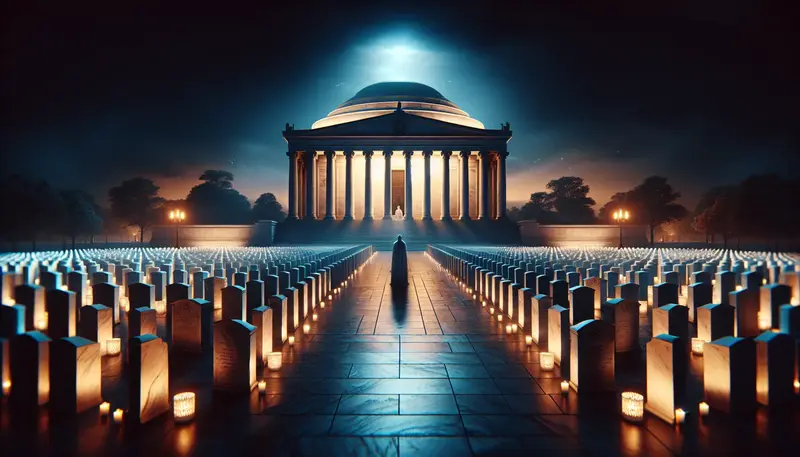
Lincoln's ghost has been seen by presidents, first ladies, and heads of state. He's the most reported — but far from the only — White House ghost.
This article is part of our comprehensive Washington DC ghost tours guide. Whether you're planning a visit or researching from afar, these stories reveal a side of Washington DC most visitors never see.
Is the White House really haunted? A short question about 1600 Pennsylvania Avenue
?Has the building at 1600 Pennsylvania Avenue NW, Washington, D.C., ever hosted a spirit who refuses to leave? The question has been asked by journalists, historians, staffers, and visitors for more than a century. The White House is both a working executive mansion and a living museum; its walls store decisions, celebrations, grief, and routine human drama. That combination makes it fertile ground for ghost stories that connect a tangible past with a living present.
Why the White House invites stories
The White House was completed in 1800 and has been expanded, renovated, and refurnished repeatedly—most notably after the British burned it in 1814 and during the major reconstruction under President Harry S. Truman in 1948–1952. Every renovation layered new materials over old, and each presidency added artifacts, portraits, and personal tragedies. The result is a building dense with associations: presidential births, funerals, illnesses, and historic crises. People who work in or visit the mansion often carry strong emotional responses to those associations, which helps explain why reports of unusual sensations or apparitions persist.
How reports are framed
Reports about White House hauntings are usually framed in three ways: eyewitness testimony from staff or dignitaries, archived anecdotes in newspapers or memoirs, and folklore that grows through repetition. The presence of documented facts—such as Abraham Lincoln’s assassination on April 14, 1865, and the many high-profile deaths and tragedies that followed—gives those stories a historical anchor. At the same time, the federal government does not maintain an official registry of paranormal events, so researchers rely on oral history, contemporary press coverage, and the memoirs of people who lived or worked at the mansion.
For local SEO and context, these tales are often cataloged under tags like ghost and haunted, reflecting both the city’s deep history and its appetite for stories that link place, memory, and mystery.
Abraham Lincoln’s spirit: the most persistent White House apparition
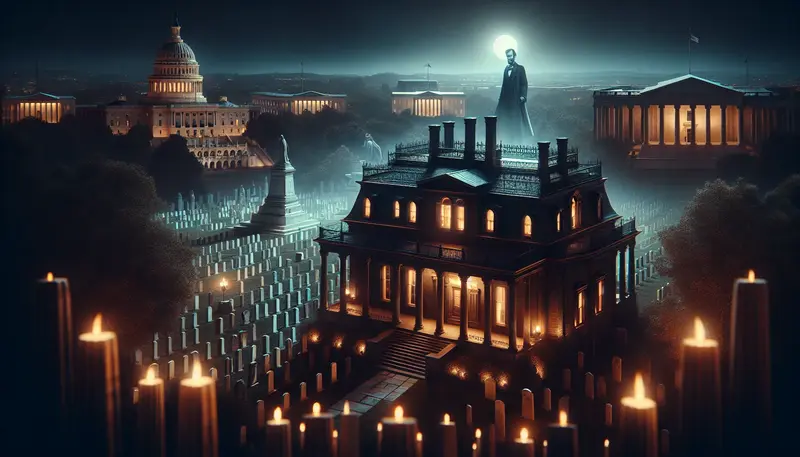
Has Abraham Lincoln ever been seen standing where he once stood? Accounts naming the 16th president as a White House apparition are the best-known of the mansion’s ghost stories. Abraham Lincoln (1809–1865) lived and worked in the White House from 1861 until his assassination in Ford’s Theatre on April 14, 1865. Over the ensuing decades, multiple people have reported seeing a tall, gaunt man in a frock coat and stovepipe hat who matches period descriptions of Lincoln.
Notable reported sightings
One frequently cited account involves Queen Wilhelmina of the Netherlands. Contemporary press reports from the early 20th century record that she stayed in the White House and later told interviewers she had seen a figure she believed to be Lincoln standing in a window looking out over Lafayette Park. The queen’s visits to the United States and to the White House occurred several times; the best-known sighting attributed to her is usually placed in the 1910s–1920s era in news columns and memoir compilations.
Another often-cited name is Sir Winston Churchill. Biographers and White House anecdotal compilations report that Churchill, during a visit with President Franklin D. Roosevelt in the early 1940s, allegedly saw Lincoln in the White House and was startled enough to mention it to Roosevelt. While the exact date and primary source for Churchill’s remark are debated among historians, the story has been preserved in numerous retellings and print collections of White House lore.
How serious are these claims?
Those who research presidential folklore treat these claims carefully. The accounts are often mediated—reported secondhand in newspapers, memoirs, or interviews—so historians emphasize the importance of context and caution. Still, multiple witnesses across different eras reporting the same figure in the same rooms produces a pattern that keeps Lincoln’s presence central to the White House haunted narrative. Whether read as cultural memory, misperception, or unexplained phenomena, the Lincoln stories remain the best documented of the mansion’s spectral traditions. For related history, see our arlington cemetery.
Other reported apparitions and named witnesses through the years
Which other figures are said to haunt the White House? Aside from Abraham Lincoln, a number of presidents, first ladies, and early American icons have been connected to unexplained encounters. Names and dates vary between accounts, but common candidates include Dolley Madison, Andrew Jackson, and Abigail Adams. Those stories range from gentle presences to emotional impressions tied to grief or longing.
Reported experiences with named witnesses
One frequently published anecdote names First Lady Grace Coolidge (1879–1957). In the 1920s, Grace Coolidge’s social calendar and popularity made her remarks newsworthy; multiple columns attributed to that era mention that she and other socialites found a sense of Lincoln’s presence in the upstairs suite that later became known as the Lincoln Bedroom. These versions are typically framed as impressions rather than startling confrontations—sensing a chill, a presence, or an unease in a room directly associated with the Civil War president.
A more dramatic account appears in period reporting about White House staff. A maid and a plumber who worked at 1600 Pennsylvania Avenue have been quoted in oral-history compilations as saying they found doors opening on their own and unexplained footsteps on the second floor late at night. These are often anonymous for privacy, but several newspaper features from the early 20th century and later include staff testimony without always naming the individual. Where names do appear—such as in memoirs of housekeepers or presidential aides—those narratives strengthen the pattern of repeated reports across decades.
Folklore versus documentation
Historians and folklorists distinguish between documentation (e.g., dated newspaper stories, signed memoirs) and oral tradition (stories told among staff). Both are valuable: documentation allows verification, while oral tradition shows how stories circulate and evolve. Researchers advising tours and publications like CursedTours.com emphasize both the verifiable facts and the social function of the tales: they reveal how Americans remember presidents, anniversaries, and crises tied to this specific address, 1600 Pennsylvania Avenue NW.
Where the apparitions are seen most often: rooms, corridors, and addresses
Which rooms in the White House are most commonly labeled haunted? Reports cluster around the Lincoln Bedroom, the Yellow Oval Room, the Blue Room, and the second-floor guest suite. Each space carries a historical association that helps explain why observers expect or report unusual experiences there.
Key locations and why they matter
Lincoln Bedroom (second-floor northwest corner of the Executive Residence): This room bears Lincoln’s name because it contains Lincoln-era furniture and was used by him as a sitting room and office on some occasions. The Lincoln Bedroom is the primary locus for Lincoln sightings. Witnesses often describe seeing a tall figure in a dark coat or experiencing sudden drops in temperature. For related history, see our the u.s. capitol building.
Blue Room (first floor, state rooms suite): The Blue Room has hosted numerous receptions, funerals, and official gatherings. Because it has been the scene of high emotion, visitors occasionally report sensing a presence or hearing music when no band is present. The room’s eastern windows look over the Ellipse and the Washington Monument sightline, adding to its symbolic weight.
East and West Wings, corridors, and service spaces: White House staff—housekeepers, Secret Service agents, and maintenance crews—have reported footsteps, a sense of being followed, and doors closing on their own. These reports often come from specific addresses within the White House complex (for example, staff quarters adjacent to the Executive Residence), but for security reasons, personnel accounts are sometimes vague about exact rooms or times.
How location shapes perception
Architectural features—narrow staircases, long corridors, and a mix of modern and historic materials—can create shadows, drafts, and acoustical oddities. Many researchers point to drafts around older sash windows and to HVAC fluctuations as natural explanations for sudden chills. Still, the emotional resonance of particular rooms—especially those tied to known tragedies or significant events—means that observers bring expectations that influence what they experience at 1600 Pennsylvania Avenue NW.
Investigations, evidence, and institutional responses
Has the White House ever been scientifically investigated for ghosts? The short answer is: not in any publicly verifiable way. No federal agency has produced a peer-reviewed study concluding that paranormal activity occurs at the Executive Mansion, and White House policy does not support formal paranormal research in a manner comparable to archaeological or structural studies.
What investigators have done
Journalists, television producers, historians, and private investigators have each taken their turn. Television specials and tabloid journalists sometimes gain access to the public rooms, but such visits are constrained by Secret Service security and by the need to avoid disrupting official functions. Private investigators have occasionally interviewed former staff for print articles or books, and folklorists have compiled oral histories. Much of the “evidence” consists of witness testimony, ambiguous photographs, and anecdotal EVP (electronic voice phenomenon) recordings made by enthusiasts.
Official and practical constraints
The White House is an active workplace and a secure federal building. Secret Service policy and the White House Historical Association govern what researchers can and cannot do onsite. For example, large-scale instrumentation, overnight stays by outside investigators, or the installation of equipment for months at a time would require permissions that are rarely granted. That practical reality explains why the evidence for hauntings is primarily testimonial rather than experimental. For related history, see our the georgetown exorcist house: the true.
How skeptics and historians interpret the evidence
Skeptical historians point to natural explanations—fatigue, suggestion, air currents, building acoustics, and the power of expectation. They also note that many of the most famous anecdotes are mediated through decades of retelling and that primary-source documentation is often thin. That said, historians value the stories as cultural artifacts: they reveal how Americans process leadership, grief, and national memory. For those interested in the empirical question of paranormal activity, the lack of controlled, replicable studies means the matter remains unsettled.
Ghost stories, public memory, and the role of tours
Why do these stories matter beyond a late-night conversation? Ghost stories tied to the White House perform a cultural function: they help the public relate to history in human terms. By pointing to a figure like Abraham Lincoln in the context of a living building, the tales bridge national myth and everyday experience. They turn a large, sometimes remote institution into something approachable and emotionally resonant.
Tour narratives and educational value
Guides, writers, and tour companies—especially ones focused on haunted history, like CursedTours.com—treat White House ghost stories as part history and part folklore. Responsible guides separate verifiable fact (dates, documented deaths, architectural changes) from anecdote. They help visitors understand what is documented (for instance, Lincoln’s assassination on April 14, 1865, and the 1814 burning of the mansion) while presenting the folklore surrounding those events. This balanced approach respects both evidence and the human desire to connect personally to the past.
Balancing skepticism and storytelling
Stories about the ghost and the haunted reputation of the White House persist because they are emotionally compelling and often rooted in the right historical soil. A careful storyteller will note which accounts come from named witnesses—such as Queen Wilhelmina and the many staffers whose anonymous accounts appear in oral histories—and which are widely retold folklore. That clarity helps listeners and readers decide how to weigh each claim.
What visitors and readers should take away
Ghost stories of the White House are not just sensational tidbits; they are part of how the public remembers and humanizes its leaders. Whether a visitor believes in apparitions or not, the tales prompt questions about grief, leadership, and memory—and they invite people to consider how buildings become repositories of the past. For those compiling tours or researching the mansion’s past, the best practice is to present stories with verifiable context, careful sourcing, and respectful skepticism—letting history and folklore speak together rather than against each other.