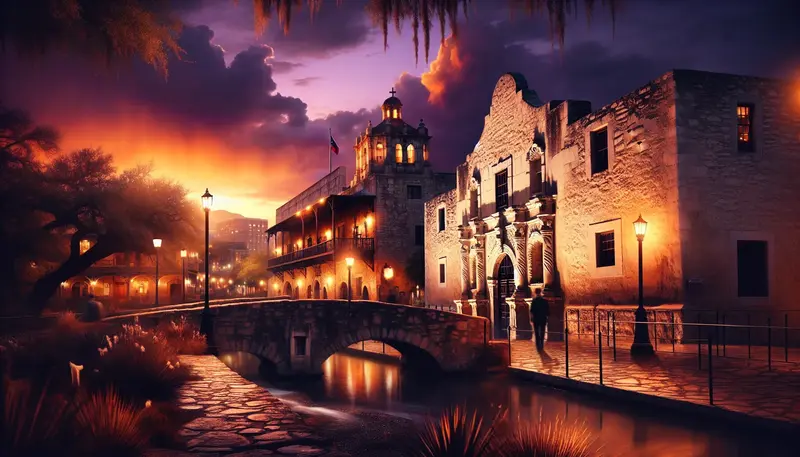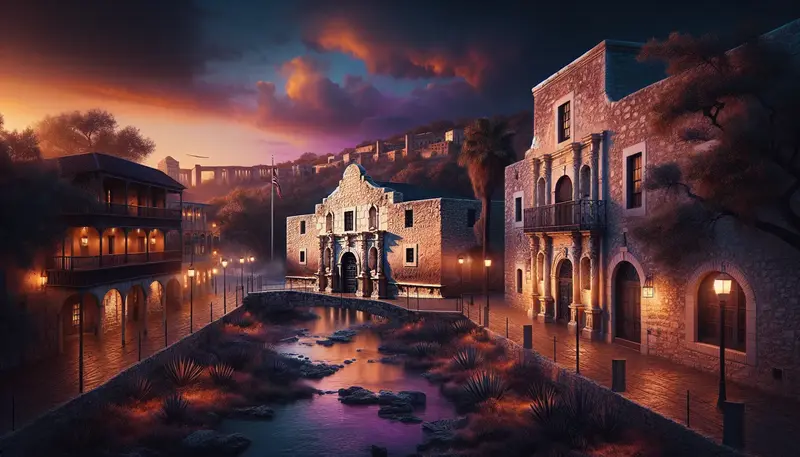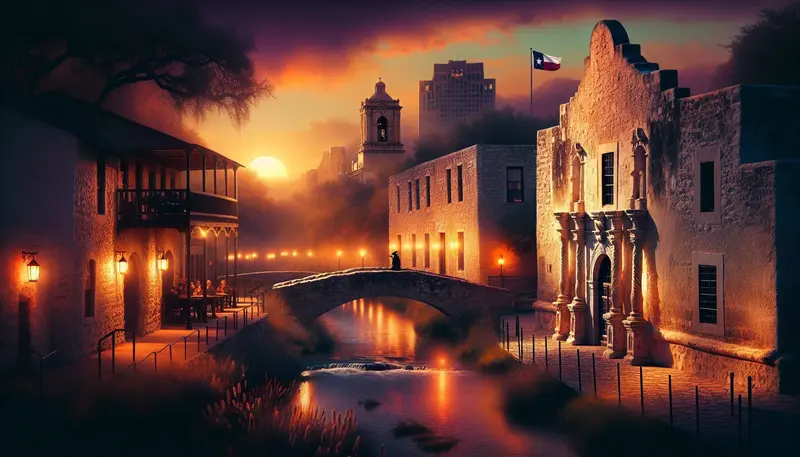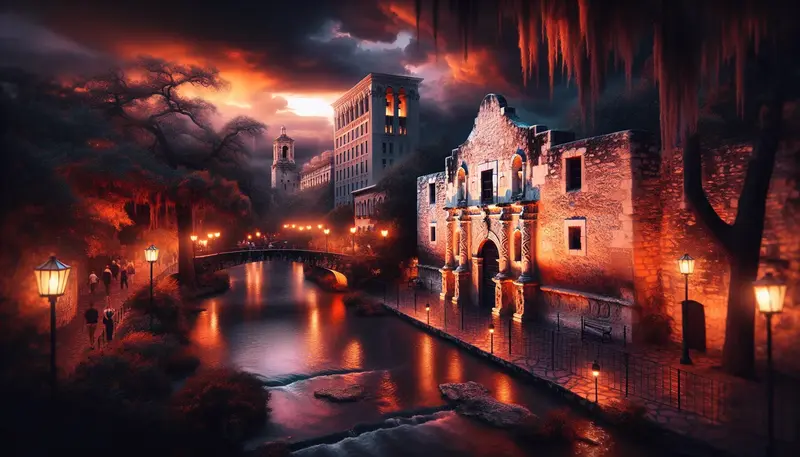
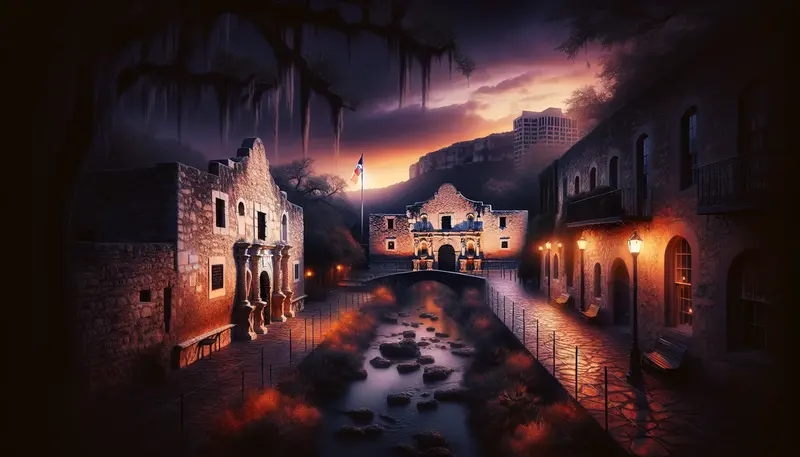
All 189 Texan defenders died at the Alamo in 1836. Mexican soldiers reported apparitions within days. Nearly 200 years later, the sightings continue.
This article is part of our comprehensive San Antonio ghost tours guide. Whether you're planning a visit or researching from afar, these stories reveal a side of San Antonio most visitors never see.
Why the Alamo Feels Unfinished
?Why does the mission-turned-fortress at 300 Alamo Plaza, San Antonio, TX 78205, still feel like a place where time paused on March 6, 1836?
The Battle of the Alamo — fought between February 23 and March 6, 1836 — left an outsized imprint on local memory and national myth. Within days of the battle, after General Santa Ana ordered the mission church burned, Mexican soldiers reportedly encountered six ghostly figures carrying flaming swords, described as “diablos”, that allegedly barred entry to the chapel before guards fled in terror. Commanders and defenders such as William B. Travis, James Bowie, and Davy Crockett are etched into history for their stand against General Antonio López de Santa Anna’s forces. That concentrated trauma, combined with the Alamo’s continuous public use, renovation, and reinterpretation, creates an atmosphere that some interpret as spectral activity. Historians point to the sheer violence and the symbolic status of the site as reasons why stories of lingering presences proliferate.
Local guides and archivists often frame reports with a careful balance of documented history and folklore. The Alamo has been part of San Antonio’s urban fabric for nearly two centuries, and its status as a shrine—alongside repeated construction and reburial of artifacts—leaves many visitors and staff unsettled. The violence of the battle itself—with casualties burned, thrown into the San Antonio River, and buried in mass graves—created layers of trauma that some researchers argue contribute to the site’s strong psychic impressions. Reports described over decades feature recurring motifs: cold spots in the chapel, phantom footsteps along the Long Barrack, and the sensation that the battle has not entirely ended. Those reports fuel the Alamo’s place in lists of San Antonio ghost attractions and explain why it frequently appears in discussions of San Antonio haunted sites.
In presenting these accounts, local historians and custodians tend to avoid sensational language. The aim is to document what people report while situating those experiences within a deep, verifiable historical record: dates, names, and actions that are not in dispute. That approach maintains credibility while also acknowledging that the past here is unusually present-sensitive, both emotionally and physically.
Reported Apparitions and Where They're Seen
?What kinds of faces or forms are most often reported by people who say they’ve seen something at the Alamo?
Apparitions at the Alamo are most commonly reported in three areas: the chapel, the Long Barrack (the elongated stone structure adjacent to the chapel), and the north gate area facing Alamo Plaza. Additionally, witnesses at Alamo Plaza itself report sightings of a spectral woman walking across the plaza, believed to be one of two women struck by lightning in the 1700s, with some accounts specifying the apparition as the woman who was killed in that incident. Witnesses describe figures in period clothing—sometimes identified as Texian defenders in 1836 militia dress or as Mexican soldiers in darker uniforms. One frequent motif is a solitary man in a greyish coat, described by several night watch personnel as moving along the chapel corridor without making sound. Another recurring report involves a pale female figure seen near the Long Barrack doorways or along the perimeter gardens; the figure often vanishes when approached.
Serious accounts typically come from staff, volunteers, reenactors, and routine patrol personnel rather than from casual tourists alone. Staff at nearby hotels have also reported guests witnessing grotesque apparitions emerging from the Alamo's walls and restless spirits walking atop the building's structures, adding corroborating testimony from independent observers outside the site itself. For example, multiple night attendants over the years have independently reported seeing a uniformed figure pause at the chapel threshold, then dissolve into the shadows—always without altering the physical environment. Other reports come from members of historical reenactment groups, who sometimes note a strong whiff of gunpowder or tobacco in locations where no recent firing or smoking occurred. These olfactory phenomena are particularly significant because they correspond to the sensory environment of the 1836 battle, when musket fire and period-appropriate tobacco use would have saturated the compound. Those sensory elements—sight and smell together—give many reports a specificity that moves them beyond vague impressions.
While most apparitions are described without aggressive intent, the presence of uniformed figures and period clothing ties witnesses’ experiences directly back to the documented moment of the 1836 battle. That connection is why so many local chroniclers treat these stories with sober interest: they appear to re-enact not only a human figure but also a historical role. For related history, see our the menger hotel: san antonio's grand.
Voices, Footsteps, and Residual Sounds
?How often do people hear sounds tied to the battle, and where are those sounds most commonly reported?
Auditory phenomena are among the most frequently reported Alamo experiences. Accounts range from isolated footsteps echoing across polished floors after hours to the distant and sudden impression of commands, musket discharges, or shouted cries. These sounds are commonly reported in the Long Barrack corridors and around the chapel nave—places where stone surfaces and narrow passageways can carry and amplify noise in odd ways. Several staff members have reported hearing muffled military commands or the cadence of marching when the grounds were otherwise empty, often describing the experience as a “residual” replay of the conflict rather than a directed communication.
One consistent set of reports involves the sensation of an unseen presence passing close by: footsteps on the gravel outside the north gate, a scraping along wooden thresholds, or light tappings that correspond to the old timber frames in the Long Barrack. In a number of accounts, groups of visitors at night have reported simultaneous experiences—sudden cold, footstep sounds, and at least one instance of coordinated whispers that several people described as calling a name. Those multi-sensor episodes are often the most compelling to investigators because they produce correlated testimony rather than single, isolated impressions.
Investigators approach these claims with careful documentation: timestamps, environmental notes (temperature, humidity, crowds), and repeat interviews. Acoustic anomalies in a structure of limestone and heavy wooden beams are well known to architects and acousticians, but the persistence of similar auditory themes across decades keeps the Alamo’s sound-based reports part of San Antonio’s haunted narrative.
Historical Context: Why Spirits Might Linger
?What historical factors make the Alamo a focal point for ghost stories and persistent memory?
The Alamo’s history supplies the raw material for many haunting narratives. In February–March 1836, roughly 180–250 Texian defenders held the mission against several thousand Mexican troops; the defenders were killed when Santa Anna’s forces stormed the complex on March 6. The battle’s brutality and the defenders’ high-profile deaths, followed by the Alamo’s decades-long evolution—from mission to military post, to civic structure, to memorial shrine—produce overlapping layers of trauma and reverence. Those layers are fertile ground for stories of residual phenomena: memories replaying where they once occurred.
Physical interventions over the decades have also shaped how people experience the site. Buildings were modified, walls rebuilt, and objects moved numerous times during the 19th and 20th centuries. Archaeological digs and preservation efforts have exposed burial layers, artifacts, and skeletons at various times, which can heighten a collective sense that the past has not been fully laid to rest. The Alamo’s role as a sanctified, contested symbol in Texas identity amplifies these feelings; a site that functions as a shrine will naturally attract narratives that treat it as a living repository of feeling and memory. For related history, see our most haunted places in san antonio:.
Historians note that the Alamo’s continuing public role—daily tours, ceremonies, and civic gatherings—intensifies the interplay between past and present. That blending of roles means that both emotional resonance and material history contribute to why people report uncanny experiences here, making the Alamo one of the most frequently cited San Antonio ghost locales.
Skeptical Perspectives and Natural Explanations
?Which natural or psychological explanations best account for reported phenomena at the Alamo?
Responsible investigation requires balancing witness testimony with known natural causes. Several plausible non-supernatural factors can produce or magnify the kinds of experiences described at the Alamo. Acoustic reflections in stone and wood can turn a distant vehicle, conversation, or maintenance noise into something that sounds like footsteps or marching. Rapid temperature changes between the shaded interior and sunlit exterior can create localized cold spots or condensation that people interpret as “cold breath.” Old buildings commonly produce settling noises, creaks, and groans that, in a charged setting, read as footsteps or distant shouts.
Expectation and suggestion also have an outsized effect at a site famous for its ghosts. Visitors who arrive primed by guidebooks, signage, or prior story-listening are more likely to notice ambiguous stimuli and interpret them according to the legend. Group dynamics—where one person reports an experience and others in the group adopt the same interpretation—contribute to clusters of similar accounts.
At the same time, investigators often find sensory reports that resist straightforward debunking: simultaneous, independent accounts of the same sound by unrelated witnesses; electromagnetic field readings associated with unexplained sensations in a room; or replicated experiences by trained observers. These instances usually invite closer acoustic, structural, and contextual analysis rather than immediate acceptance of a paranormal hypothesis. The prudent approach is to treat each claim as data: document carefully, test for environmental causes, and only then consider less conventional explanations.
Visiting the Alamo: Where to Look and What to Expect
?What should visitors who are curious about the Alamo’s ghost stories pay attention to, and how should they set expectations?
Visitors interested in the Alamo’s haunted reputation should plan around the site’s operational realities. The Alamo is a functioning historic mission and museum at 300 Alamo Plaza, San Antonio, TX 78205, with strict public hours, curated exhibits, and an emphasis on preservation. Access to many of the places associated with reports—like the Long Barrack corridors and certain interior zones—may be limited during daytime operations. After-hours access is tightly controlled and generally restricted to staff, special events, and documented research visits.
For those observing the Alamo’s paranormal lore from the outside, the most frequently reported locations are the chapel interior (where many feel a concentrated stillness), the Long Barrack passageways (where footsteps and echoes are commonly reported), and the north gate facing Alamo Plaza (where some witnesses describe the sensation of being watched or followed). Visitors should approach these stories with both curiosity and respect: historical markers and artifacts are fragile, and the site functions as both a memorial and a public space.
Local tour operators and historians recommend simple precautions for anyone investigating claims: record times, note crowd levels, photograph or log environmental conditions, and, if possible, obtain corroborating testimony from independent witnesses. San Antonio's haunted landscape extends beyond the Alamo to include other Spanish colonial missions with their own documented dark pasts. Such documentation helps distinguish between ordinary environmental effects and repeatable anomalies. Whether or not one believes in the supernatural, the Alamo remains a powerful locus of San Antonio haunted memory—where history, myth, and human perception meet at the edge of a battle that many still say has not entirely ended.