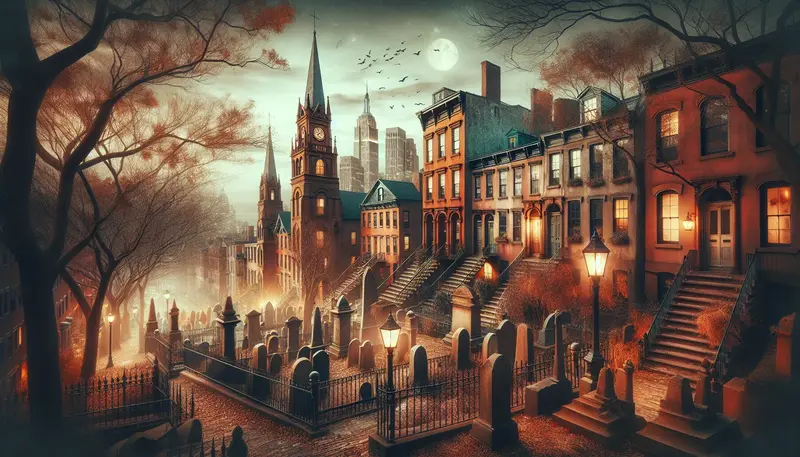
Four centuries of history have left New York with ghost stories in every borough — from colonial-era taverns to Gilded Age mansions.
This article is part of our comprehensive New York ghost tours guide. Whether you're planning a visit or researching from afar, these stories reveal a side of New York most visitors never see.
Manhattan — Island of Firsts and Phantom Footsteps
Have you ever felt a chill in the exact spot where history turned a corner?
Manhattan is the place where New York City ghost lore is richest, because so many foundational events happened here. You’ll find houses, mansions, hotels, and churches whose histories date back to the 18th and 19th centuries; many of those sites have layered stories that visitors and staff continue to report. The Morris-Jumel Mansion (160 Jumel Terrace) served as George Washington’s temporary headquarters in September 1776, and tour guides and visitors routinely describe a strong presence attributed to Eliza Jumel, the 19th-century owner. You should expect creaks, cold spots, and the occasional sense of being watched in the mansion’s upstairs rooms, where staff say light fixtures sometimes behave oddly during quiet hours.
Notable Sites and Reported Experiences
The Merchant’s House Museum at 29 East 4th Street is one of the best-documented “haunted” homes in Manhattan. The house was continuously occupied by the Tredwell family from 1835 until 1933; docents and longtime staff report recurrent phenomena: unexplained scents of pipe tobacco and perfume, footsteps on the upper floors when the building is closed, and a frequently felt cold spot near the parlor stair. These reports have been collected over decades by museum volunteers and published recollections by past curators. You can study the provenance of objects and the Tredwell family records if you want to tie folklore to verifiable facts.
The Dakota (1 West 72nd Street) and the Chelsea Hotel (222 West 23rd Street) occupy a different corner of Manhattan’s haunted reputation—24/7 urban intensity, tragic deaths, and famous residents. John Lennon’s murder on December 8, 1980, just outside the Dakota, is a verifiable historical trauma that feeds later reports of lingering grief-like energy in the building’s corridors. Staff and some long-term residents have told reporters they occasionally feel an otherworldly stillness or hear footsteps when the lobby is empty. At the Chelsea, which housed writers and musicians for more than a century, visitors have reported hearing the sound of a piano from an empty room or seeing a figure in period dress on stairways; such accounts are common in oral histories collected by neighborhood historians.
How you approach Manhattan’s haunted spots matters: many operate as museums or private residences, and you should respect opening hours, photography rules, and staff directions. If you’re trying to understand whether a particular sensation is historical residue or modern mechanics, examine the documented architectural changes (gas to electric lighting, added plumbing, and HVAC) and the written records that tie a building to known events—those will help you separate folklore from physical causes while still honoring the stories people share about New York City haunted places.
Brooklyn — Brownstones, Battlefields, and Restless Cemeteries
Which corners of Brooklyn feel like they remember their past more than others?
Brooklyn’s haunted reputation is less about single iconic buildings and more about landscapes: cemeteries, battlefields, and rowhouse neighborhoods where immigrants’ lives and sudden deaths left dense human stories. Green-Wood Cemetery (500 25th Street, Brooklyn, New York 11204), founded on June 30, 1838, is a 478-acre landscape of memorial sculpture, rolling hills, and reported nighttime apparitions featuring over 600,000 graves. Visitors and caretakers have reported phantom carriages, disembodied voices, and the sensation of being followed along the Ladies’ Walk. These accounts tend to come from long-term groundskeepers and historical society volunteers who work overnight or during quiet early mornings.
Battlefield Memory and Domestic Hauntings
Brooklyn Heights and Fort Greene preserve Revolutionary and Civil War memories. The old lines of battle and the presence of 19th-century hospitals near the waterfront are often invoked when locals report strange sounds or sudden temperature drops. In brownstone neighborhoods, residents sometimes report recurring dreams tied to a particular house’s former occupants. One particularly persistent story centers on an 1840s house in Cobble Hill where the family ledger shows a child’s death in 1847; current owners have reported nursery sounds and the smell of baby powder when no child lives there. In such cases, you should check municipal death and census records to confirm dates and names—this helps you distinguish oral tradition from documented history. For related history, see our greenwich village ghosts: new york's most.
Brooklyn Navy Yard and the industrial stretches along the East River have their own spectral tales: workers report tools moving without explanation and the sense of a presence at shift change. A helpful approach for you is to pair reported experiences with site histories—when did the yard operate, which firms worked there, and what accidents were documented? Doing so lets you treat Brooklyn’s ghost lore with respectful skepticism: you honor what people say while checking the archival record.
Green-Wood and other public cemeteries welcome daytime visits and historical tours; at night, however, many are closed for safety and preservation reasons. If you want to see the places that inspired Brooklyn’s stories, plan daytime research visits, ask staff about oral histories, and consult burial records to link anecdote to fact. You’ll find that the combination of memorial architecture and immigrant histories produces some of New York City’s most persistent haunted narratives.
The Bronx — Old Hospitals, Parks, and Graveyard Whispers
Do parks and institutional ruins in the Bronx carry a different kind of haunting than Manhattan’s parlors?
The Bronx’s haunted places often center on institutions—hospitals, asylums, and large public works—that served thousands and sometimes saw traumatic deaths. Woodlawn Cemetery (517 East 233rd Street, Bronx, New York 10466) opened on July 20, 1863, across 400 acres and is notable both for its scale and for stories of quiet figures moving among mausoleums at dusk, with over 300,000 interments recorded. You’ll also hear accounts tied to now-demolished facilities such as the old Bronx County Hospital and to clifftop sites in Pelham Bay Park where people report sudden chills and the occasional apparition of figures in period dress.
Hospital Sites and Recorded Events
Some of the Bronx’s most persistent tales come from hospital history: overcrowding during epidemics, makeshift wards in the 19th and early 20th centuries, and the emotional weight of mass illness. Families and former staff have told local reporters and oral-history interviewers about sounds—soft singing, a rumble of carts at night—and about rooms that feel markedly colder despite functioning heating systems. If you want to check these stories, look for municipal health records and newspaper reports from the dates when epidemics or mass casualty events occurred; those primary sources help you match anecdote to documented stressors.
Historic houses like Wave Hill (4900 Independence Avenue) have their own softer hauntings: gardeners and visitors sometimes sense a presence near the Rhododendron Walk in the early morning. Wave Hill’s archives include letters, photographs, and staff logs that can help you see whether a reported sensation aligns with real incidents—deaths, land transfers, or storms—that might have left an emotional imprint on community memory. For related history, see our the morris-jumel mansion: manhattan's most haunted.
When you visit Bronx sites, bring solid footwear and a research mindset. Parks and cemeteries are best explored in daylight; institutional ruins are often unsafe and private property. Respect for preservation and for living neighbors will make your inquiry into The Bronx haunted places both responsible and rewarding.
Queens — Country Houses, Rail Yards, and Unquiet Shores
Would you expect the borough most associated with airports and suburbs to be quietly haunted?
Queens contains surprising pockets of old New York: colonial-era manor houses, immigrant neighborhoods with layered histories, and the vast industrial reaches of the rail yards. King Manor Museum (150-03 Jamaica Avenue, Jamaica, Queens, New York 11432), the former home of Founding Father Rufus King (1755–1820), is a good example. The Federal-style mansion was built circa 1765 and expanded in the early 19th century and houses a museum with archival material; guides and visitors sometimes report footsteps on the upstairs landing when no one is there. Such reports are typically recorded by local historical societies and may coincide with donors’ or caretakers’ recollections preserved in institutional logs.
Industrial Nightmares and Waterfront Echoes
Areas around the waterfront—Jamaica Bay, the Rockaways, and parts of the East River shoreline—generate stories about shipwrecked sailors and lost ferries. Workers and fishermen have reported lantern-like lights moving across dark water and the sense of a figure at the prow of an unseen boat. Queens’ industrial history—gunpowder works, coastal shipping lanes, and transport accidents—creates plausible contexts for these accounts. If you want to test a story, search maritime accident records and 19th-century newspaper archives for named incidents; those records often reveal dates and names that anchor oral reports to reality.
Rikers Island, administratively part of the city and located between the Bronx and Queens, has its own weight of lore tied to incarceration, riots, and deaths. Former corrections staff and journalists have described an atmosphere of lingering harm in certain housing areas; many such accounts can be found in investigative reporting and books about penal history. When you read these reports, pay attention to dates—prison riots and reform eras are documented events that provide context for why a place might be remembered as haunted.
Queens encourages you to pair field visits with archival research at borough historical societies. Doing so helps you treat reports about Queens haunted locations with sensitivity to both the human suffering that created them and the documentary record that preserves their memory. For related history, see our new york's abandoned subway stations.
Staten Island — Forts, Farms, and Seafaring Spirits
How do you approach a place where sea air and 18th-century politics meet modern suburbia?
Staten Island is often the most overlooked borough for ghost stories, but it’s home to some of the city’s oldest structures and battle-scarred sites. The Conference House at 298 Satterlee Street, Tottenville, Staten Island (New York 10307) is one of the most grounded examples: the Colonial-era structure built circa 1680 hosted the September 11, 1776 Staten Island Peace Conference, an abortive attempt to negotiate a cessation of hostilities between British General William Howe and American delegates Benjamin Franklin, John Adams, and Edward Rutledge. Because a major historical event took place there, you’ll find guided histories and repeated folklore about spectral figures and muffled conversation heard in empty rooms. Park staff and local historians report odd acoustic phenomena and footsteps when the house is otherwise quiet.
Fortifications and Maritime Memory
Fort Wadsworth (on the Narrows, Staten Island, New York 10305) is a multi-era installation with fortifications built between 1779 and the 1890s, including Battery Weed (completed 1861) and Fort Tompkinsburg (1862–1863), serving through the Civil War. Rangers and volunteers have reported seeing a figure in a Civil War-era uniform along the ramparts and hearing the distant clang of a bell at times when no bell is rung. The area’s long military history—redoubts, ordnance stores, and coastal defenses—provides a verifiable backdrop for such accounts. Military logs, garrison rosters, and engineering plans in the National Archives can give you dates and names when you want to connect an apparition story to historical personnel and events.
Staten Island’s rural past is preserved at places like the Richmond Town Historic Complex, where farm buildings and family cemeteries make stories of household spirits and unquiet farmhouses plausible. Local archives often hold probate records and farm inventories that document life-and-death cycles at those properties—primary sources you should consult if you plan to reconcile folklore with the record. Remember that many anecdotes stem from custodians and volunteers who work odd hours; their reports tend to be consistent over time, making them valuable even when names are withheld for privacy.
When you visit Staten Island haunted sites, treat them as living history: many are on preserved property with staff who can point you to archival material. That way, you honor both the folklore and the historical facts that give these stories their weight.
Citywide Patterns, Practical Tips, and Respectful Research
What should you keep in mind when you’re chasing a New York City haunted story?
Across boroughs you’ll see recurring patterns: sites connected to sudden deaths (hospitals, prisons, battlefields), buildings with long continuous occupancy (brownstones, almshouses), and memorial landscapes (cemeteries and parks). These patterns matter because they point toward why certain places accumulate narratives of presence and why witnesses—staff, volunteers, longtime residents—often report similar sensations: colder temperatures, footsteps, smells tied to past inhabitants. Your role as an investigator or curious visitor is to pair respect for those stories with a habit of checking archival records, newspapers, and municipal documentation to ground anecdotes in verifiable fact.
Quick Reference: Notable Sites and Addresses
| Site | Address | Borough | Why Visit / Notes |
|---|---|---|---|
| Merchant’s House Museum | 29 East 4th Street | Manhattan | Well-documented domestic haunt; check museum hours and docent histories |
| Morris-Jumel Mansion | 160 Jumel Terrace | Manhattan | Washington’s 1776 headquarters; strong Eliza Jumel folklore |
| Green-Wood Cemetery | 500 25th Street | Brooklyn | Historic cemetery with memorial architecture and reported apparitions |
| Woodlawn Cemetery | 517 East 233rd Street | The Bronx | Large Victorian cemetery; good daytime research site |
| King Manor Museum | 150-03 Jamaica Avenue | Queens | 18th–19th-century house with archival records and local lore |
| Conference House | 298 Satterlee Street | Staten Island | Site of 1776 peace talks; documented history complements folklore |
Practical, Ethical, and Legal Considerations
You should always respect opening hours and private property. Many of the best-preserved haunted sites are museums, churches, or private residences; trespassing is illegal and harms the very places you want to understand. If you’re conducting research, consult primary sources—census returns, death certificates, newspaper archives, and municipal records—to corroborate oral accounts. Treat witness testimony with respectful skepticism: ask who reported it, when it happened, and whether multiple independent observers described the same event. That method keeps your inquiry honest and rooted in both humane concern and historical evidence.
Finally, if you want to read more about New York City haunted lore, look for local historical-society publications and well-researched guidebooks. Primary sources and institutional archives anchor stories so that your curiosity becomes a responsible exploration of how memory, trauma, and urban change shape the city’s spectral reputation.