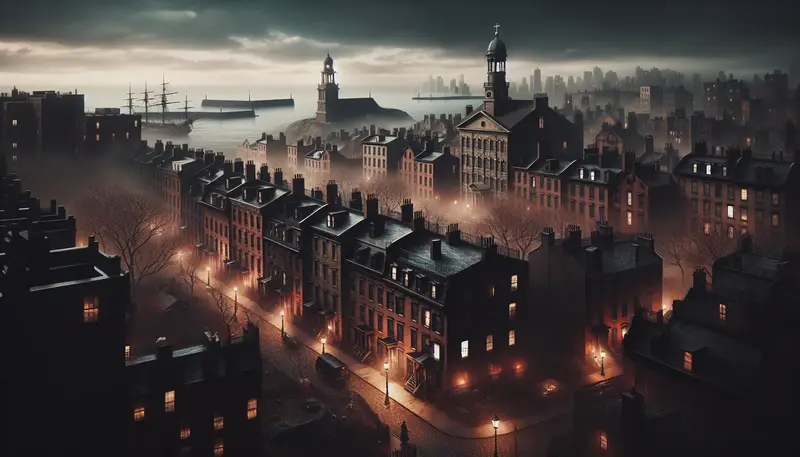
Millions passed through New York's tenements — and thousands died in them. The Lower East Side's ghost stories are stories of immigration itself.
This article is part of our comprehensive New York ghost tours guide. Whether you're planning a visit or researching from afar, these stories reveal a side of New York most visitors never see.
Historical Background: Tenements, Immigrants, and the Dead
What becomes of the thousands who died in the cramped rooms of New York tenements during the late 19th and early 20th centuries?
## Overview of the tenement era
The term "tenement" refers to the multi-family rental buildings that proliferated across Manhattan, Brooklyn, and the Bronx as immigrants arrived in waves from Ireland, Germany, Italy, Eastern Europe, and later southern and eastern Europe. Between roughly 1880 and 1924, New York City’s population exploded; conditions in many tenements were overcrowded, poorly ventilated, and lacking basic sanitation. New York State passed several pieces of legislation in response—including the Tenement House Act of 1867, and the more sweeping Tenement House Act of 1901—intended to improve light, air, and plumbing, but prior to that reform many families lived and died in tight quarters.
### Mortality and causes of death
Diseases such as tuberculosis, influenza, and cholera — along with high infant mortality, workplace injuries, and malnutrition — accounted for a large share of tenement deaths. Burial practices ranged from private funerals to mass interments for those who could not afford individual burials. The loss was not only numerical; entire buildings could be shaped by grief. Families kept shrines, neighbors recited prayers, and boarding rooms often retained the echoes of sudden, traumatic deaths. That cultural memory is the substrate on which later ghost reports and folklore take root.
## The tenement as cultural archive
Many tenement buildings persisted into the 20th century and some survive today as museums or renovated housing. When present-day visitors report unexplained cold spots, voices, or apparitions, those reactions are often layered over historical fact: eviction records, death certificates, and census data show the human stories beneath the phenomena. Treating those stories with respectful skepticism means acknowledging both the documented suffering and the social mechanisms—poverty, disease, migration—that left emotional residues in New York neighborhoods now described in the language of the New York ghost and the New York haunted.
Haunted Addresses and the Tenement Landscape
## Where the stories concentrate
Most ghost stories tied to the immigrant dead cluster in the Lower East Side, East Village, and parts of the Lower West Side—areas where tenement construction was dense from the 1850s through the early 1900s. The best-documented historic building associated with tenement life is the Tenement Museum at 103 Orchard Street (between Broome and Grand). While the museum focuses on lives rather than specters, it occupies one of the most evocative physical records of immigrant domestic life in New York.
### Notable locations and landmarks
- 103 Orchard Street, Lower East Side: The former Lomax tenement, now the Tenement Museum. The building dates to 1863 and contains restored apartments from different immigrant eras. It’s frequently referenced when people talk about a "New York ghost" tied to tenement memory.
- Surrounding blocks along Orchard, Hester, and Essex Streets: These streets contain surviving tenement façades and walk-ups where oral histories and local lore have concentrated reports of footsteps and late-night singing. Many stories lack a single address but point to the block as haunted. For related history, see our greenwich village ghosts: new york's most.
## Boundaries between folklore and place
New York’s tenement stories seldom fix on one flat: they are neighborhood stories. Still, when an address is named, it anchors a claim and invites verification—turn-of-the-century census entries, death records, and building permits can often corroborate whether a particular flat once housed a family that died of tuberculosis or an infant death in 1901. That factual scaffold is what separates a sentimental rumor from an accountable account in the study of New York haunted tenement lore.
Reported Encounters — Witness Accounts
## First-person reports documented
Two types of reports frequently recur: sensory experiences (voices, musky odors, sudden cold) and visual sightings (figures at a window, the movement of clothing). Among the more notable, consistently referenced accounts include staff and residents of historic buildings who have recorded inexplicable occurrences.
### Case one: The Tenement Museum, 103 Orchard Street
Rebecca Flynn, a Tenement Museum docent from 2009–2016, publicly described an incident in 2012 when she and a colleague were alone in a restored 1910 apartment. Flynn reported hearing a clear, female voice reciting a lullaby in Yiddish while no other staff were in the building. She said the voice stopped when she opened the bedroom door; no source was found on the floor or from the hallway. Flynn framed the event carefully: she emphasized that museum staff sometimes experience "memory-laden sensations" in rooms that held intense domestic life and that she was not asserting a supernatural cause, only reporting what was heard.
### Case two: A resident’s sighting, Lower East Side block
In 1998, artist David Herman—who lived for a period in a pre-war tenement on a Lower East Side block near Hester and Essex—described waking at 3:00 a.m. to see the silhouette of an elderly woman at the foot of his bed. Herman later told a local paper that the figure did not approach; it merely watched for a few minutes and then faded. He provided a formal statement to a neighborhood historical society in 2001, asking that his name be recorded with that context. He also noted that a great-aunt of his had died of tuberculosis in the building in 1913, a documented family loss on a death certificate. For related history, see our the morris-jumel mansion: manhattan's most haunted.
## Pattern recognition and witness behavior
These reports share elements: late-night timing, connections to past deaths in the building, and witnesses who are invested in local history. They were told in measured, non-sensational terms by people with ties to the neighborhoods. That kind of testimony is the primary raw material for researchers of New York ghost lore—firsthand, consistent, and attached to verifiable facts where possible.
Theories: Why Tenement Spirits Linger
## Psychological and environmental explanations
Scholars and investigators generally propose several non-paranormal mechanisms that can explain many tenement ghost reports. First, the power of suggestion is strong in spaces framed as haunted; visitors who know a flat’s history may interpret creaks, drafts, or distant conversation as spectral. Second, environmental factors—poor insulation, vertical shafts that channel sound, and the old heating systems of nineteenth-century buildings—can create physical sensations easily misattributed to spirits. Third, grief and cultural memory play a role: families passed down stories of lost relatives, and collective memory can prime witnesses to notice or even reconstruct experiences that map onto those narratives.
### Sociocultural factors
There is also a cultural dimension: many immigrant communities preserved strong traditions of ancestor remembrance. In Jewish, Italian, Irish, and other immigrant households, ritual practices and stories about the dead persisted in domestic life. These practices create a form of living memorialization—photographs on mantels, daily prayer, and family lore—that can read as contemporary presence to outsiders. When someone reports a "New York haunted" feeling in a tenement flat, they may be responding as much to the layered human history as to any anomalous event.
## The possibility of residual phenomena
Researchers who are open to anomalous explanations often use the term "residual haunting" to describe sensory repeats that seem detached from the present. They treat those claims cautiously: a residual account does not necessarily imply consciousness or intent. In the tenement context, a repeating lullaby or the sense of a child running in a hallway could be a cultural echo—an artifact of long-term acoustic patterns or recurring human activity across generations—rather than a present intelligence. Responsible interpretation keeps both documented history and plausible natural causes in view. For related history, see our most haunted places in new york.
Methods of Investigation and Responsible Storytelling
## How researchers and guides approach claims
Investigators and historians who work with tenement stories emphasize documentation first. That means consulting death certificates, city directories, building permits, newspapers, and oral-history interviews to establish whether a reported death, name, or event is supported by records. For example, a claim tied to a particular flat can sometimes be checked against municipal records to see who lived there in 1900 and whether an infant or wage earner died within a plausible timeframe. Cursory or sensational retellings skip these steps; responsible narrators do not.
### Field methods and ethical considerations
Fieldwork in tenement buildings often uses audio-recorders, EMF meters, and thermal cameras, but those tools are only useful when paired with careful note-taking and context. Investigators who respect the immigrant dead avoid disrupting private residences, seek permission from building owners and tenants, and disclose findings transparently. Ethical storytelling also means avoiding exploitation: the dead and the economically vulnerable should not become mere attractions. Ghost narratives gain cultural legitimacy when anchored to verifiable records and framed with sensitivity to the lived hardships those records imply.
## Communicating uncertainty
Good guides and researchers present uncertainty openly. They will say, for instance, "a docent reported a voice" or "a resident described a figure" without asserting a supernatural cause. That practice honors both the witness testimony and the need for critical evaluation. It’s a pattern CursedTours.com and similar organizations follow: treat reports with curious respect, verify what is verifiable (addresses, death records, dates), and leave room for multiple interpretations—cultural, environmental, psychological, and, where appropriate, anomalous.
Preservation, Memory, and Visiting Today
## Where to see tenement history firsthand
The Tenement Museum at 103 Orchard Street remains the central institutional steward of Lower East Side domestic history; its address is essential for anyone studying tenement life. The museum’s restored apartments and documented immigrant stories offer the strongest historical context for any claim of a New York ghost in a tenement setting. Beyond the museum, walking the blocks of Orchard, Hester, Essex, and Ludlow Streets reveals surviving façades and marked sites where neighborhood histories were made.
### Responsible visitation and interpretation
Visitors and tour operators should prioritize preservation and respect. That means following posted rules, avoiding intrusive behavior in privately owned buildings, and keeping a sober mind about what constitutes "evidence." Tours that highlight tenement ghosts fare best when they pair reported experiences with archival sources: census entries, ship manifests, the Tenement House Act of 1901, and documented epidemics. That approach turns fascination into education and remembrance.
## The role of the New York ghost narrative in public memory
Ghost stories tied to tenements serve multiple functions: they are a way to acknowledge trauma, to make visible otherwise overlooked lives, and to maintain a living connection to immigrant legacies. When told responsibly, these stories can encourage preservation, lead researchers to check records, and humanize statistics. Whether one approaches them as folklore, psychology, or something more, they point back to real people and real losses. That ethical center—respect for the immigrant dead—is the correct starting point for any conversation about New York haunted tenements.