The South's Haunted Battlegrounds
The American South bore the heaviest burden of the Civil War. Most major battles were fought on Southern soil, most of the physical destruction fell on Southern cities and farms, and the war's aftermath reshaped Southern society in ways that reverberate to this day. It should come as no surprise, then, that the South holds more Civil War ghost stories per square mile than any other region in the country. These aren't gentle hauntings — they carry the intensity of a conflict that killed more Americans than every other war combined.
This article is part of our Gettysburg Civil War collection.
From the mist-shrouded hills of Virginia to the moss-draped plantations of Louisiana, the paranormal legacy of the Civil War is woven into the Southern landscape as tightly as the history itself. The stories persist because the land remembers, and because the communities built on these battlefields have never fully separated from the events that defined them.
Chickamauga Battlefield — Georgia
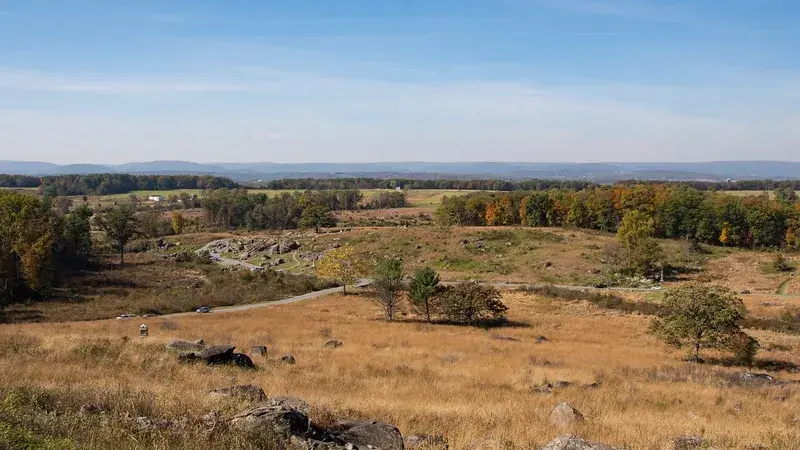
Chickamauga, fought September 19–20, 1863, was the bloodiest two-day battle of the entire war and the most significant Union defeat in the Western Theater. Over 34,000 casualties in the dense forests of northwest Georgia turned the battlefield into what one survivor called "a slaughterhouse in the woods." The fighting was so close-quartered and so chaotic that units frequently fired into their own men in the smoke-choked timber.
The Chickamauga battlefield ” now part of Chickamauga and Chattanooga National Military Park, established August 19, 1890, as the first federally protected Civil War battlefield in the United States ” has generated paranormal reports since the 1880s. The most persistent account involves "Old Green Eyes," a figure described as having glowing green eyes and a pale, almost luminous face, seen moving through the woods at night—most often near Snodgrass Hill, where some of the heaviest fighting occurred. One tradition holds the entity is a soldier decapitated by a cannonball, searching for his body; another claims the presence predates the Civil War entirely, tracing to Cherokee folklore about spirits in the Chickamauga Creek valley. Witnesses have reported the apparition for over a century, with descriptions remaining remarkably consistent across generations. Park rangers, local police, and visitors have all filed reports, and the sightings cluster around the areas of heaviest fighting along the Lafayette Road and in the Brotherton Cabin area.
Beyond Old Green Eyes, visitors report hearing drums, gunfire, and what sounds like large groups of men moving through the forest — sounds that stop abruptly when the listener tries to identify a source. The fog that frequently settles over the battlefield at dawn and dusk adds a visual element that makes the already dense atmosphere almost unbearably heavy.
Antietam Battlefield — Maryland
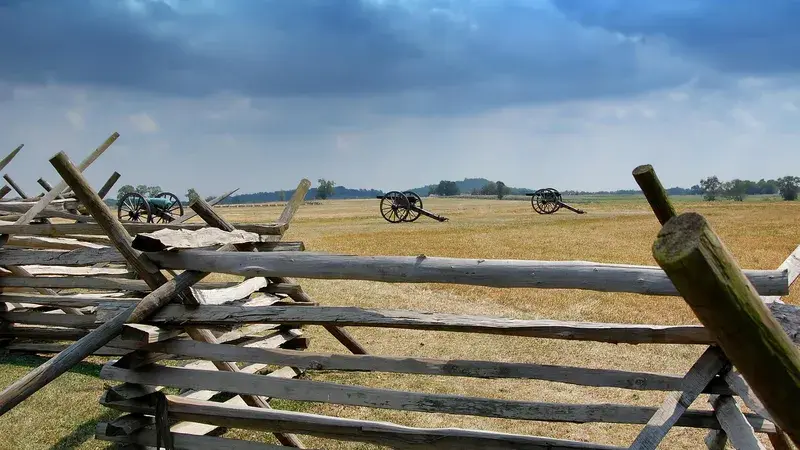
Technically border-state territory, Antietam sits just north of the Mason-Dixon Line but is so deeply embedded in Southern military history that no list of Civil War ghost stories can exclude it. September 17, 1862 remains the single bloodiest day in American military history — over 23,000 casualties in roughly twelve hours of fighting across cornfields, sunken roads, and a stone bridge that became a killing ground.
The Sunken Road — known ever after as "Bloody Lane" — is the battlefield's most active paranormal location. Confederate soldiers used the eroded farm lane as a natural trench until Union forces gained a position on the ridge above and fired directly down into the packed ranks. The dead lay so thick in the lane that survivors said you could walk its length without touching the ground. Today, visitors report smelling gunpowder, hearing gunfire and screaming, and seeing apparitions of soldiers lying in the road — particularly on foggy mornings near the anniversary.
Burnside Bridge, where Union forces under General Ambrose Burnside took hours to cross a narrow stone span defended by a handful of Georgian sharpshooters, produces its own category of reports. Blue lights have been photographed hovering over the water, and voices described as singing in unison have been heard from the bridge at night by visitors and park staff alike. For related history, see our the battle of gettysburg: a complete.
The Mercer House — Savannah, Georgia
Savannah's Mercer-Williams House, made famous by the book "Midnight in the Garden of Good and Evil," carries a Civil War haunting that predates its more recent notoriety. General Hugh Mercer, for whom the house was designed, fought for the Confederacy and was wounded at the Battle of the Wilderness. Though Mercer never actually lived in the completed house, Confederate soldiers reportedly used the unfinished structure during the war.
Residents and visitors have reported a range of phenomena including phantom footsteps on the upper floors, cold spots concentrated in specific rooms, and the feeling of being watched from empty doorways. The house's location on Monterey Square — one of Savannah's famously haunted squares — places it within a larger web of paranormal activity that tour guides attribute to the city's layered history of war, disease, and violent death.
The Myrtles Plantation — St. Francisville, Louisiana
The Myrtles Plantation is often cited as one of the most haunted buildings in America, and while much of its paranormal reputation stems from antebellum-era slavery and alleged poisonings, the Civil War added its own layer of tragedy to the property. Union soldiers occupied the plantation during their push through Louisiana, and the property saw violence during and after the occupation. The intersection of plantation-era brutality and wartime destruction created a site with multiple overlapping histories of suffering.
Guests at the Myrtles — which operates as a bed and breakfast — report a catalogue of experiences: a woman in a green turban seen on the veranda, piano music playing from an empty room, children's handprints appearing on mirrors that were just cleaned, and a Confederate soldier seen on the grounds near dusk. The property's Spanish moss-draped oaks and raised galleries create an atmosphere that requires zero embellishment to feel genuinely unsettling.
Fort Monroe — Hampton, Virginia
Fort Monroe—designated a National Monument by President Obama on November 1, 2011—occupies a unique position in Civil War history. The massive stone fortification on the Virginia coast remained in Union hands throughout the entire war — a Federal stronghold in the heart of the Confederacy. It served as the point of entry for escaped slaves seeking freedom under General Benjamin Butler's landmark "contraband" decision of May 24, 1861, and after the war, Confederate President Jefferson Davis was imprisoned there from May 22, 1865, to May 13, 1867—initially shackled in leg irons in a casemate cell lit around the clock by a lamp and guarded by sentries.
The fort's paranormal activity centers on the casemate where Davis was confined. Visitors and military personnel stationed at the fort have reported seeing a gaunt, bearded figure in nineteenth-century clothing in and around the casemate, along with unexplained cold spots, doors that open and close on their own, and a persistent feeling of despair that visitors describe as hitting them physically when they enter the confined space. The "White Lady of Fort Monroe" — sometimes identified as the wife of a Civil War-era officer — is another recurring apparition, reportedly seen walking the ramparts at night.
Why the South's Ghost Stories Endure
The concentration of Civil War ghost stories in the South reflects simple mathematics — more battles, more casualties, more destruction occurred here than anywhere else. But there's a cultural dimension as well. The South has maintained a relationship with Civil War memory that is more personal, more contested, and more emotionally charged than the North's. The war isn't ancient history in much of the South — it's a living presence that shapes identity, politics, and community in ways that outsiders sometimes struggle to comprehend.
That emotional investment keeps the ghost stories alive not just as entertainment but as a form of collective memory. When a tour guide in Savannah describes hearing Confederate soldiers marching through a square at midnight, or when a Gettysburg resident reports seeing campfires on the battlefield that vanish when approached, they're participating in a tradition of storytelling that processes historical trauma through the language of the supernatural. The ghosts are metaphor and mystery in equal measure — and in the American South, they're not going anywhere.