Two Minutes That Redefined a Nation
Abraham Lincoln spoke for roughly two minutes on November 19, 1863, at the dedication ceremony beginning at approximately 2:00 PM. The 272 words he delivered at the dedication of the Soldiers' National Cemetery at Gettysburg in Adams County, Pennsylvania constitute the most famous speech in American history — and arguably the most consequential. In the time it took the audience to settle into attentive silence, Lincoln had reframed the entire meaning of the Civil War, redefined the purpose of the American experiment, and established a vocabulary of democratic aspiration that every subsequent generation has drawn upon.
This article is part of our Gettysburg Civil War collection.
The speech almost didn't matter at the time. Lincoln wasn't even the featured speaker that day. Edward Everett, the former Secretary of State (serving 1852-1853) and the most celebrated orator of the era, delivered a two-hour address that covered the Battle of Gettysburg (July 1-3, 1863) in exhaustive military detail. Lincoln's "few appropriate remarks" — his own characterization — were an afterthought on the printed program. Several newspapers dismissed them the following day. The Harrisburg Patriot and Union called the speech "silly remarks" and suggested Lincoln should be embarrassed.
The Road to Gettysburg
By November 1863, Lincoln was carrying burdens that would have broken most people. The war was in its third year with no clear end in sight. Casualties had reached numbers that horrified a nation unaccustomed to industrial-scale killing. Lincoln's own son William Wallace "Willie" Lincoln had died in the White House on February 20, 1862, plunging President Abraham Lincoln and his wife Mary Todd Lincoln into grief so severe that Mary never fully recovered. Political opposition was fierce — Copperhead Democrats openly called for a negotiated peace that would preserve slavery, and Lincoln's own party contained factions that considered him too cautious and others that considered him a tyrant.
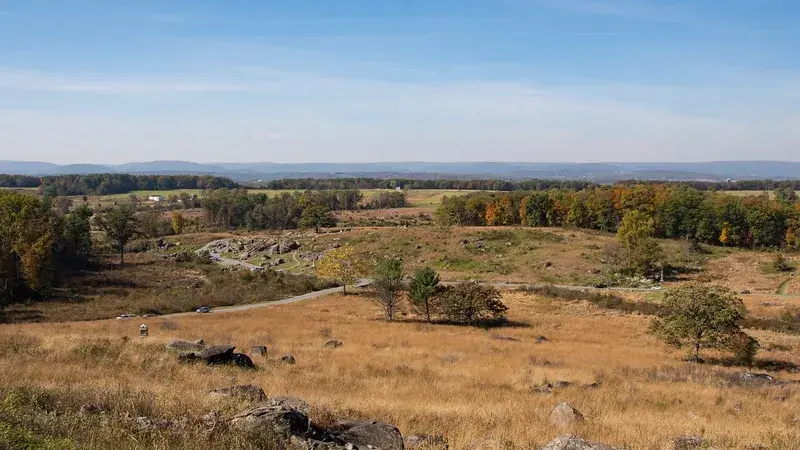
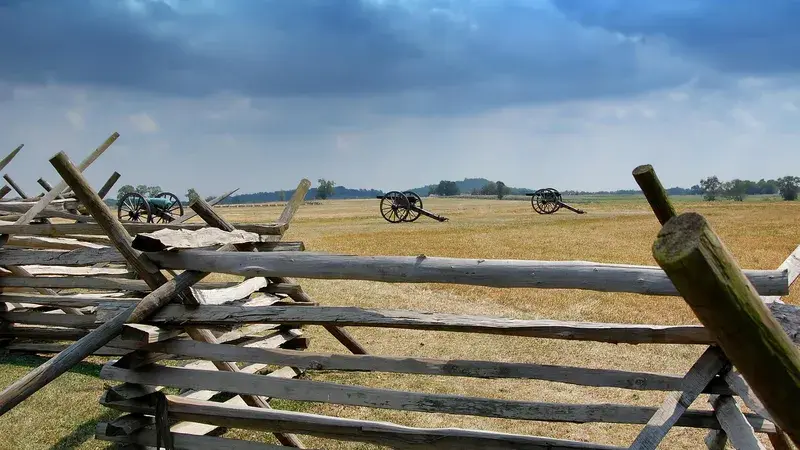
The dedication of the Soldiers' National Cemetery offered Lincoln an opportunity to address the nation at a moment of raw vulnerability. The battlefield at Gettysburg was still scarred from the three days of fighting in July 1863, four months earlier. Shallow graves dotted the landscape of Adams County, and the reburial process that the new cemetery was meant to facilitate was still in its early stages, with only about 3,500 Union soldiers ultimately interred there. The smell of death lingered. This wasn't an abstract occasion — the audience included parents who had traveled to Gettysburg to search for their sons' remains.
What Lincoln Actually Said
The speech opens with what has become the most recognizable sentence in American civic language: "Four score and seven years ago our fathers brought forth on this continent, a new nation, conceived in Liberty, and dedicated to the proposition that all men are created equal." That sentence does something radical that most listeners then and now don't fully register — it dates the nation's founding to 1776 and the Declaration of Independence, not to 1787 and the Constitution.
The distinction matters enormously. The Constitution, as ratified, protected slavery through multiple provisions including the three-fifths clause and the fugitive slave clause. The Declaration of Independence proclaimed universal equality as the nation's foundational principle. By anchoring his argument to 1776 (the year of the Declaration of Independence) rather than 1787 (the year the Constitution was drafted), Lincoln was making a constitutional argument through a rhetorical backdoor — asserting that the nation's truest commitment was to equality, and that the Constitution was a flawed attempt to implement that commitment rather than the final word on it.
The speech's central passage shifts from the past to the present: "Now we are engaged in a great civil war, testing whether that nation, or any nation so conceived and so dedicated, can long endure." Lincoln frames the war not as a conflict over tariffs, states' rights, or even slavery in isolation, but as an existential test of whether democratic self-government is viable. If the Confederacy succeeded in breaking away, it would prove that any faction dissatisfied with an election result could simply leave — and democracy as a concept would be discredited worldwide.
The closing movement turns from the dead to the living: "It is rather for us to be here dedicated to the great task remaining before us." Lincoln refuses to claim that the cemetery dedication provides closure. Instead, he argues that the dead have created an obligation the living must fulfill — to ensure "that government of the people, by the people, for the people, shall not perish from the earth." The final phrase, which Lincoln adapted from various earlier sources including Massachusetts statesman Daniel Webster (1782-1852) and abolitionist minister Theodore Parker (1810-1860), has become the standard definition of democracy itself.
The Speech's Immediate Reception
Contemporary reactions were sharply divided along political lines, which should sound familiar. Republican-aligned newspapers praised the speech effusively. The Springfield Republican called it "a perfect gem." The Chicago Tribune declared that the dedicatory remarks "will live among the annals of man." Democratic papers were dismissive or hostile — the Chicago Times called the speech an insult to the memory of the dead.
Edward Everett recognized what had happened immediately. The day after the ceremony, he wrote to Lincoln: "I should be glad if I could flatter myself that I came as near to the central idea of the occasion, in two hours, as you did in two minutes." Lincoln replied graciously, but he also understood what he had accomplished. He told a friend he was satisfied with the speech — high praise from a man who was his own harshest critic. For related history, see our civil war ghost stories of the.
Why 272 Words Outlasted 2 Hours
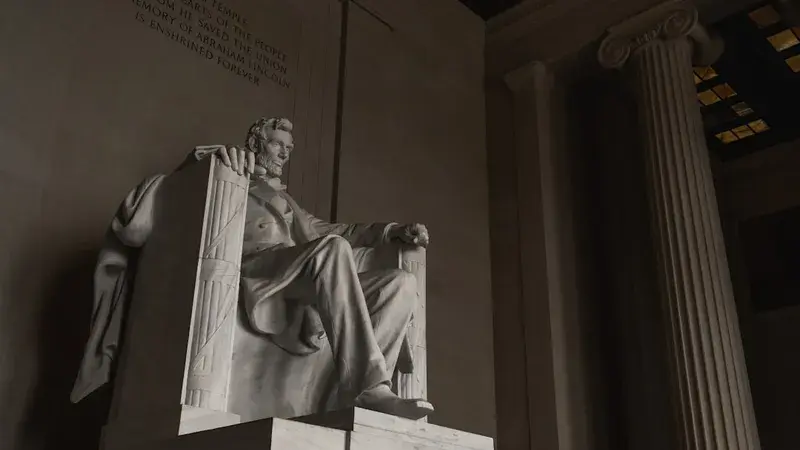
Everett's two-hour oration is a fine piece of classical rhetoric that virtually no one reads today. Lincoln's two-minute address is carved in marble on the National Mall. The difference comes down to what each speech attempted. Everett described the battle. Lincoln described what the battle meant — not just for the men who fought it, but for the idea of self-government itself.
The speech's power also derives from its radical compression. Every word carries weight because there are so few of them. Lincoln stripped away oratorical decoration, classical allusions, and the extended metaphors that characterized formal speechmaking in the nineteenth century. What remained was something closer to poetry than prose — rhythmic, precise, and emotionally devastating in its simplicity.
The structure itself is a model of persuasive architecture: past (the founding), present (the war), future (the obligation). Lincoln moves from abstraction to concrete reality to moral imperative in three paragraphs. No wasted motion, no unnecessary qualification. It reads like something that emerged fully formed, though Lincoln worked on it carefully over several days and likely revised the text right up until delivery.
The Legacy Beyond the Words
The Gettysburg Address did more than memorialize the dead or rally the living. It permanently altered how Americans understand their own founding documents. Before Gettysburg, the phrase "all men are created equal" was understood by many as a statement about political rights among white men. After Gettysburg, Lincoln had attached it to a war fought to end slavery — and in doing so, he began the interpretive work that would eventually connect the Declaration's promise to the Fourteenth Amendment's guarantee of equal protection under law.
Every significant American rights movement since — women's suffrage, labor rights, the civil rights movement, marriage equality — has drawn on the language and logic Lincoln deployed at Gettysburg. On August 28, 1963, exactly 100 years after the Gettysburg Address, Martin Luther King Jr. opened his "I Have a Dream" speech with a deliberate echo: "Five score years ago, a great American, in whose symbolic shadow we stand today, signed the Emancipation Proclamation." The callback was intentional and unmistakable.
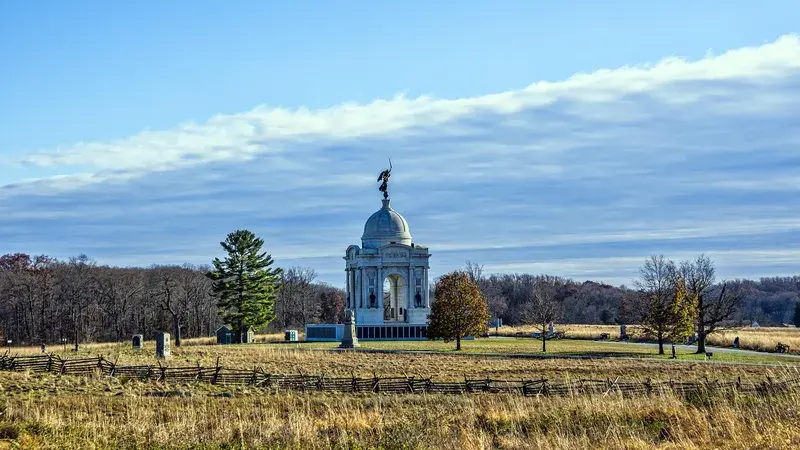
The field where Lincoln spoke is quiet now. The Soldiers' National Cemetery holds exactly 3,512 Union dead in concentric semicircles, their headstones small and uniform, facing the spot where Lincoln stood on November 19, 1863. Visitors often remark on how small the space feels — how close the graves are to the road, how modest the monument is compared to the speech's outsized legacy. But that modesty is the point. Lincoln didn't come to Gettysburg to celebrate a victory. He came to insist that the dead demanded something from the living — and 160 years later, that demand hasn't expired.