The Most Famous Failed Attack in American Military History
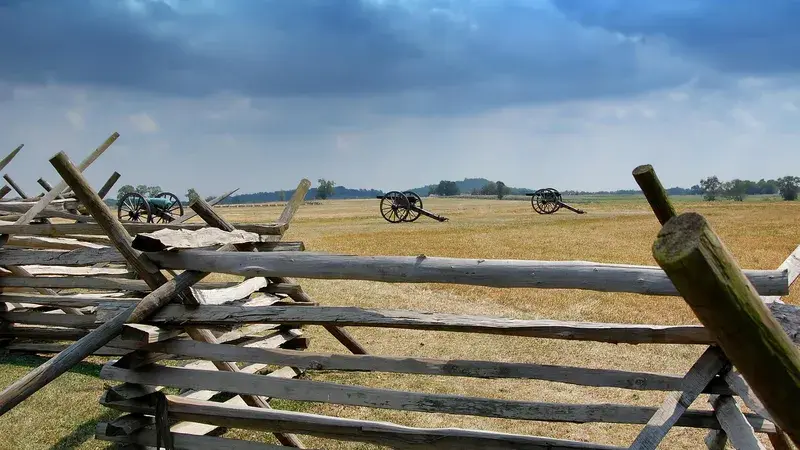
Shortly after 3:00 PM on July 3, 1863, approximately 12,500 Confederate soldiers stepped out of the tree line on Seminary Ridge and began walking across three-quarters of a mile of open farmland toward the center of the Union line on Cemetery Ridge. What followed over the next fifty minutes has been called the High Water Mark of the Confederacy — the moment when the Southern cause reached its greatest territorial advance and was thrown back with losses so catastrophic that the Army of Northern Virginia never fully recovered. Pickett's Charge remains the single most analyzed infantry assault in American military history, studied in war colleges worldwide as a textbook example of frontal attack against a prepared defensive position.
This article is part of our Gettysburg Civil War collection.
The Decision to Attack
Robert E. Lee's decision to order the charge remains the most debated command decision of the entire Civil War. After two days of fighting at Gettysburg, Lee had attacked both Union flanks without breaking the line. On the morning of July 3, he turned his attention to the center — the section of Cemetery Ridge near a small copse of trees that would become the assault's target point.
Lieutenant General James Longstreet, Lee's senior corps commander and the man responsible for executing the attack, objected with an urgency that bordered on insubordination. Longstreet had argued since the battle's first day for a flanking maneuver rather than a direct assault. When Lee outlined his plan for a frontal attack across open ground against entrenched infantry supported by massed artillery, Longstreet reportedly replied, "General, I have been a soldier all my life. It is my opinion that no fifteen thousand men ever arrayed for battle can take that position."
Lee overruled him. The commanding general believed that the attacks on July 2 had weakened the Union center, that a massive artillery bombardment could suppress the Federal guns on Cemetery Ridge, and that a concentrated infantry assault would crack the line. He was wrong on all three counts.
The Bombardment
The attack opened with the largest artillery bombardment of the Civil War. Beginning around 1:00 PM, over 150 Confederate cannons opened fire simultaneously on Cemetery Ridge in a barrage intended to destroy the Union artillery and drive the infantry from their positions. The noise was heard in Pittsburgh, 150 miles away. The ground shook so violently that soldiers on both sides described feeling seasick.
The bombardment looked and sounded apocalyptic, but it largely failed in its purpose. Confederate gunners, blinded by their own smoke, overshot the ridge. Most rounds sailed over the crest and detonated in the rear areas — damaging supply wagons, killing horses, and terrifying support troops but leaving the Union infantry along the stone wall relatively unscathed. Union artillery chief General Henry Hunt ordered his batteries to cease fire, partly to conserve ammunition and partly to create the impression that the bombardment had succeeded. The deception worked. Confederate artillery commander Colonel Edward Porter Alexander sent a message to Longstreet reporting that the Union guns appeared to be silenced and urging an immediate advance.
The Advance Begins
The assault force comprised troops from three divisions — George Pickett's Virginians, Johnston Pettigrew's North Carolinians, and Isaac Trimble's mixed brigade — though history has assigned Pickett's name to the entire operation. The men formed up along a front roughly a mile wide in the tree line on Seminary Ridge, dressed their lines with parade-ground precision, and at the command, stepped forward into the open. For related history, see our civil war ghost stories of the.
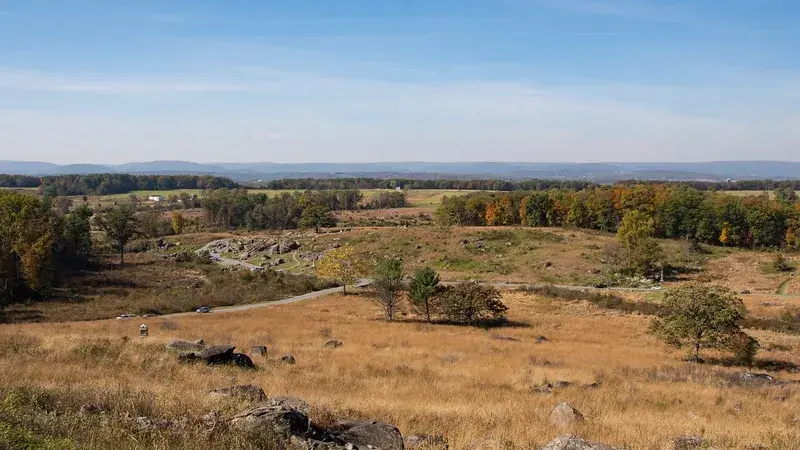
The distance they needed to cover — roughly 1,400 yards from the tree line to the stone wall on Cemetery Ridge — was an eternity under fire. The ground was not flat. The troops descended into a shallow valley, crossed the Emmitsburg Road with its post-and-rail fences that broke up formations, and then climbed the gradual slope toward the ridge. Every step of that advance was visible to the Union defenders above them.
For the first several hundred yards, the advance proceeded in eerie quiet. Union artillery had ceased fire during the bombardment's final minutes, and the Confederate guns had exhausted their ammunition. Soldiers on both sides later described an almost supernatural silence as the long gray lines moved forward through the trampled wheat and grass.
Into the Storm
The silence ended when Union artillery reopened at roughly 700 yards. Solid shot tore lanes through the advancing formations. As the range closed, the guns switched to shell, then to canister — tin cans packed with iron balls that turned cannons into enormous shotguns. Each discharge blasted holes in the Confederate ranks that the survivors closed by stepping inward and continuing forward.
At the Emmitsburg Road, the post-and-rail fences created a bottleneck that stalled the advance under concentrated fire. Men climbed over the rails, took casualties while straddling the top, and reformed on the far side with their units increasingly disordered. Union infantry along the stone wall opened with massed rifle fire at roughly 200 yards — a range at which trained soldiers with rifled muskets could hardly miss. The effect was staggering. Entire companies dissolved in seconds.
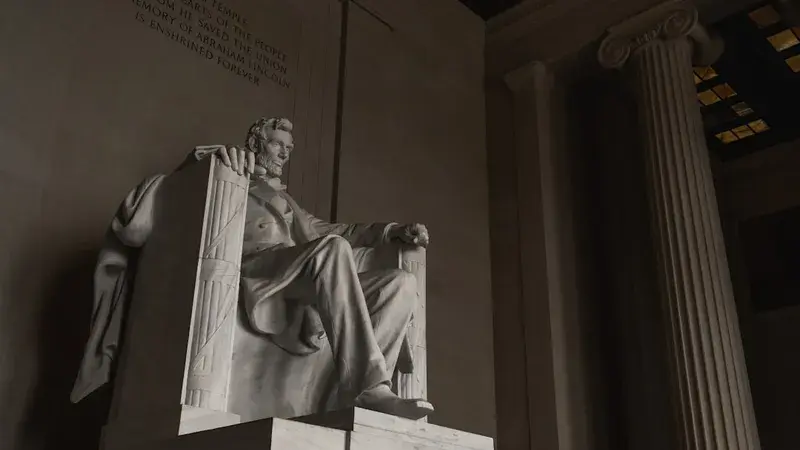
On the Confederate left, Pettigrew's and Trimble's brigades took murderous flanking fire from Union troops on Cemetery Hill and broke. Whole regiments turned and ran — not from cowardice, but from the mathematical impossibility of continuing forward into fire that was killing them faster than they could advance. On the right, Pickett's Virginians pressed on, angling toward the copse of trees that served as their guide point. For related history, see our the gettysburg address and lincoln's lasting.
The High Water Mark
A few hundred Confederates — led by Brigadier General Lewis Armistead, who placed his hat on his sword tip so his men could find him in the smoke — actually reached the stone wall and briefly crossed it. Armistead's men surged over the wall near a right-angle bend known afterward as "The Angle," temporarily capturing two Union cannons and engaging Federal soldiers in hand-to-hand combat. Armistead fell mortally wounded with his hand on a cannon barrel.
The breakthrough lasted minutes. Union reinforcements converged from both sides, pouring fire into the narrow salient from three directions. The Confederates who had crossed the wall were killed, wounded, or captured almost to a man. The survivors who hadn't reached the wall began streaming back across the field, now under fire from the same artillery that had savaged their advance.
The retreat was as terrible as the advance. Men stumbled back across the same open ground, passing through their own wounded and dead, while Union artillery resumed firing into the retreating mass. Some units maintained cohesion; others dissolved into crowds of individuals seeking any cover the ground offered. By the time the survivors reached Seminary Ridge, the assault force had suffered casualties approaching fifty percent.
The Cost and the Meaning
Pickett's division alone lost roughly 2,650 of 5,500 men — a casualty rate of nearly fifty percent in under an hour. All three of Pickett's brigade commanders were killed or wounded. All thirteen of his regimental commanders were killed or wounded. Pickett himself, who had remained behind the advancing lines on Lee's orders, was devastated. When Lee asked him to prepare his division for a possible counterattack, Pickett reportedly replied, "General Lee, I have no division."
Lee rode out to meet the shattered survivors as they staggered back to Seminary Ridge. Witnesses reported him saying, "It is all my fault. It is I who have lost this fight, and you must help me out of it the best way you can." The admission was remarkable — Lee almost never acknowledged error publicly — and reflected the magnitude of what had just happened.
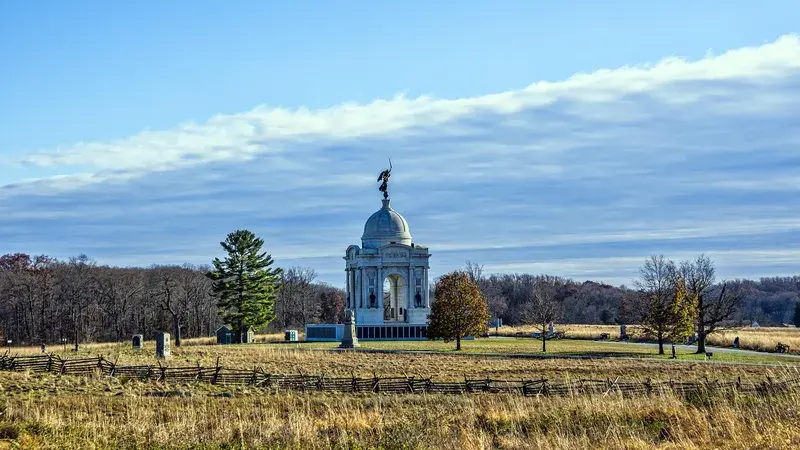
Pickett's Charge didn't end the war. Lee retreated to Virginia and fought for nearly two more years. But the charge ended any realistic hope of Confederate victory through offensive action. The Army of Northern Virginia would never again attempt a major invasion of the North, and the initiative shifted permanently to the Union. The copse of trees on Cemetery Ridge — unremarkable in itself, just a small stand of timber on a gentle hillside — became the most symbolically loaded piece of ground on the continent. The stone wall still stands. The field is still open. And walking it from tree line to ridge, measuring the distance with your own steps, remains the most visceral way to understand what those men attempted and what it cost them.