Where History and Hauntings Merge
Gettysburg holds a distinction no other American battlefield can match — it is both the most studied military engagement in the nation's history and the most frequently reported site of paranormal activity. Over 50,000 casualties in three days of fighting (July 1-3, 1863) on the fields of Adams County, Pennsylvania, left an imprint on this landscape that visitors, residents, and researchers have been documenting for over 160 years. The ghost stories of Gettysburg aren't vague campfire tales. They're specific, recurring, and reported by people who often came to the battlefield with no interest in the paranormal whatsoever.
This article is part of our Gettysburg Civil War collection.
The sheer concentration of violent death in such a compact area gives Gettysburg a quality that's difficult to describe to anyone who hasn't walked the fields at dusk. The terrain itself seems to hold the memory of what happened here — and if the reports are to be believed, it plays those memories back with startling frequency.
Devil's Den and the Wheatfield
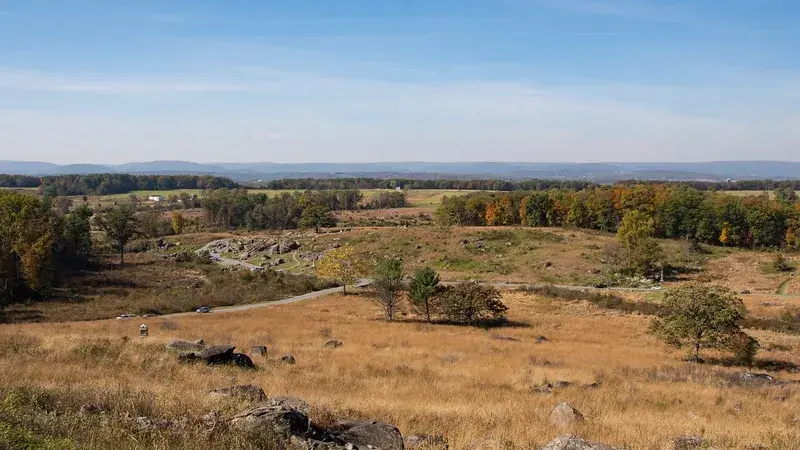
The boulder-strewn hillside of Devil's Den saw some of the most savage fighting on July 2, 1863, the battle's second day. Confederate sharpshooters situated between the massive rocks and picked off Union soldiers on nearby Little Round Top with devastating accuracy. The terrain is located in the southern portion of the Gettysburg battlefield in Adams County, Pennsylvania. The area changed hands multiple times in close-quarters combat where men fought with bayonets, rifle butts, and bare hands among the narrow passages between boulders.
Today, Devil's Den is the single most active paranormal location on the battlefield. Visitors report camera and phone malfunctions with remarkable consistency — batteries drain instantly, photos come out blurred or show unexplained light anomalies, and video equipment captures audio that wasn't audible in person. The most common sighting involves a disheveled man in ragged clothing, often described as barefoot, who appears among the boulders and sometimes speaks to visitors before vanishing. Multiple witnesses have described the same figure independently, using nearly identical details.
The adjacent Wheatfield, located just south of Devil's Den, where roughly 4,000 men fell in a space smaller than a city block, produces reports of phantom sounds — gunfire, screaming, the clash of metal — that seem to rise from the ground itself. Park rangers stationed nearby have logged these reports for decades and note that they peak around the anniversary of the battle in early July.
The Sachs Covered Bridge
The Sachs Covered Bridge, a wooden structure built in 1854 and spanning Marsh Creek, served as a crossing point for both armies during the battle and its aftermath. Confederate soldiers retreated across it on July 4 and 5, 1863, following General Robert E. Lee's failed invasion, and three Confederate soldiers were reportedly hanged from its beams for desertion during Lee's withdrawal. For related history, see our the battle of gettysburg: a complete.
The bridge has been a paranormal hotspot for generations. Visitors report seeing figures in Civil War-era clothing walking across the bridge or standing at its entrance, only to disappear when approached. Cold spots — areas where the temperature drops dramatically without any draft or ventilation to explain it — are reported with unusual frequency inside the covered structure. Photographers regularly capture orbs, mist formations, and what some interpret as transparent human figures in images taken inside and around the bridge.
In 1996, a devastating flood severely damaged the Sachs Covered Bridge, and it was painstakingly restored in 1997 using original materials and period techniques to preserve its historic integrity. Paranormal investigators who studied the bridge before and after the restoration reported that the activity, if anything, intensified following the rebuild — an observation that challenges the common assumption that renovations disrupt spiritual energy.
The Farnsworth House
The Farnsworth House, a brick structure located at 401 Baltimore Street in downtown Gettysburg, served as a Confederate sharpshooter's nest during the Battle of Gettysburg (July 1-3, 1863). Over 100 bullet holes remain visible in the south wall — evidence of the intense Union fire directed at the snipers inside. At least one Confederate soldier died in the garret, and the building reportedly served as a field hospital in the battle's aftermath.
Now operating as an inn and restaurant, the Farnsworth House embraces its haunted reputation. Guests staying in the upper rooms report being woken by heavy footsteps, doors opening and closing on their own, and the distinct smell of cigar smoke in rooms where no one has smoked. The garret where the sharpshooter died is considered the most active area — visitors on guided tours have reported feeling pressure on their chests, sudden difficulty breathing, and an overwhelming sense of being watched from the darkened corners of the low-ceilinged space.
Seminary Ridge and the Lutheran Theological Seminary
The Lutheran Theological Seminary building — its distinctive cupola served as an observation post for both armies — sits on Seminary Ridge where fierce fighting erupted on July 1, 1863, the first day of the Battle of Gettysburg. The building and surrounding grounds served as a hospital after the fighting moved south, and the seminary's floors were reportedly stacked with wounded and dying soldiers for weeks after the battle ended on July 3, 1863. For related history, see our the gettysburg address and lincoln's lasting.
The building now houses the Seminary Ridge Museum. Staff members and visitors report doors opening on their own, footsteps on empty floors above them, and what several witnesses have described as moaning or crying coming from the upper stories when the building is confirmed empty. The cupola, accessible to visitors, is a particular hotspot — the confined space seems to amplify whatever energy is present, and visitors frequently report feeling dizzy, disoriented, or emotionally overwhelmed in ways they can't attribute to the climb or the height.
Pennsylvania Hall at Gettysburg College
Gettysburg College's Pennsylvania Hall, built in 1837 and located at 300 North Washington Street on the college campus, served as a hospital and signal station during the Battle of Gettysburg from July 1-3, 1863. The building's basement and first floor housed hundreds of wounded soldiers, and amputations were performed on tables in what had been classrooms weeks earlier. The college estimates that over 700 soldiers passed through the building during and immediately after the three-day battle.
Students and faculty have reported strange occurrences in Pennsylvania Hall for over a century. The most well-known account involves two college administrators who entered the building's elevator late one evening and reported that when the doors opened in the basement, they saw not the modern corridor but a Civil War-era hospital scene — bloodied soldiers on the floor, surgeons working by lantern light, the smell of blood and chloroform hanging in the air. The doors closed and reopened to the normal basement. Both administrators filed independent reports describing the same scene in matching detail.
Whether or not that particular account survives scrutiny, the volume of reports from Pennsylvania Hall is difficult to dismiss entirely. Maintenance staff have documented equipment malfunctions, temperature anomalies, and unexplained sounds in the building's lower levels for decades.
What Makes Gettysburg Different
Haunted battlefields exist across the world, but Gettysburg generates a volume and consistency of paranormal reports that sets it apart. Several factors likely contribute. The extreme concentration of death — more casualties in three days than in any other battle on the continent — created conditions that paranormal researchers consider optimal for residual energy. The battlefield's remarkable preservation means the physical environment closely resembles what soldiers experienced in 1863, a factor that some researchers believe facilitates recurring manifestations.
The town's embrace of its haunted identity also plays a role. Gettysburg hosts dozens of ghost tour companies, several paranormal research organizations, and an annual series of investigation events that draw thousands of participants. This culture of investigation means that experiences which might go unreported at other locations are documented, discussed, and added to a growing body of evidence that — whatever you make of it — represents one of the most extensive collections of paranormal testimony associated with any single location in the world.
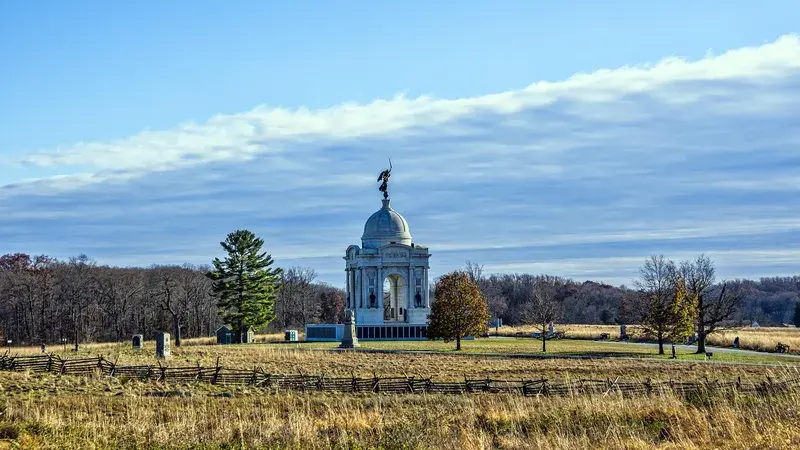
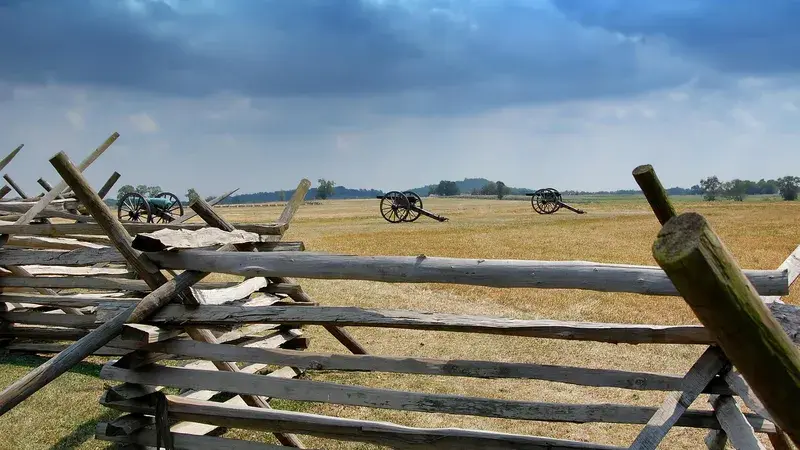
Walking the battlefield at dusk, with the monuments casting long shadows across fields where the grass still grows impossibly green, even the most skeptical visitors tend to grow quiet. Something about this place commands a respect that goes beyond historical appreciation. The soldiers who fought here left something behind — their stories, their suffering, and perhaps something else entirely.