The line between wrecking and piracy in Key West was never as clear as the federal court wanted it to be. For much of the 19th century, the island operated in a gray zone where salvage, smuggling, and outright theft overlapped. Pirates left their mark on the landscape—literally, in the form of a hanging tree still visible today at Captain Tony's Saloon—and their legacy shaped Key West's culture of rebellion and self-reliance in ways the town still embodies.
This article is part of our comprehensive Key West ghost tours guide, where we explore the haunted sites and darker chapters of Bone Island's maritime history.
Geographic Destiny: The Florida Keys as Pirate Stronghold
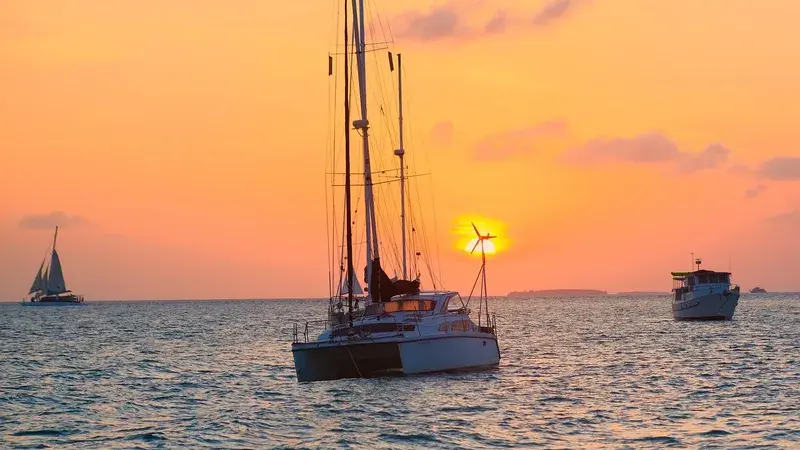
Key West's pirate era was not accident or anomaly. It was geography. The island sits at the southernmost point of Florida, directly in the path of two of the world's richest shipping lanes. The Straits of Florida—the narrow passage between the Keys and the Bahamas—funneled virtually every merchant vessel traveling between the Caribbean and the Gulf of Mexico. Spanish treasure fleets carrying gold, silver, and gems from Mexico, Peru, and Colombia passed through these waters with predictable regularity. The Gulf Stream's powerful current pushed disabled ships toward the reefs surrounding the Keys, creating opportunities for both legitimate salvage and predatory piracy.
The geography offered perfect concealment as well. The mangrove islands, shallow waters, and labyrinthine channels of the lower Keys provided ideal hiding places for pirates seeking refuge from naval patrols. A ship's crew familiar with the waters could disappear into the mangroves and reefs where deeper-draft vessels could not follow. Key West itself, though larger and more exposed than other islands in the chain, still offered access to supplies, repair facilities, and a degree of anonymity in a bustling port town where no one asked too many questions about a ship's origins or cargo.
Black Caesar and the Golden Age of Piracy
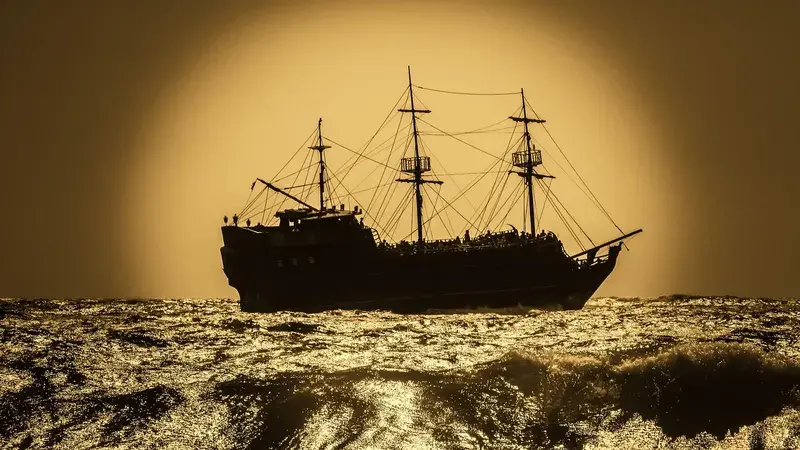
The most legendary name in Key West pirate history is Black Caesar (also known as Blackbeard in some accounts, though this is disputed), a figure whose origins blur myth and documented history. According to accounts that survive in maritime folklore, Caesar was an African who had been enslaved and later escaped captivity. Some sources place him operating as a pirate beginning around 1700-1720, though exact dates remain disputed among maritime historians. What is documented is that pirate operations in the Straits of Florida intensified during the Golden Age of Piracy (roughly 1650-1730), when privateers and outright pirates from Spain, England, France, and other nations all competed for control of Atlantic and Caribbean shipping.
Caesar reportedly established a base on one of the mangrove islands near Key West—some sources reference Caesar Rock or Caesar Creek as locations tied to his name—and used the natural cover of the dense mangrove forests as a fortress. Unlike the theatrical villains of pirate legend, Caesar was known for operational skill and a degree of strategic thinking. He targeted specific merchant vessels carrying high-value cargo and maintained enough discretion to avoid annihilation by naval forces for an extended period. The legend of Black Caesar persisted long after his presumed death, making him a symbol of resistance and maritime independence in the Key West imagination.
By the early 1800s, piracy in the Caribbean had declined as European navies strengthened their patrols, but the profitability of maritime lawlessness in the Keys remained high enough to attract organized operations. Spanish, British, and American vessels all engaged in smuggling, privateering, and outright piracy along the Florida coast during the War of 1812 and afterward.
Commodore David Porter's Mosquito Fleet and the Anti-Piracy Campaign
By 1823, piracy had become a significant enough problem that the U.S. Navy established a dedicated anti-piracy squadron based in Key West. The man tasked with commanding this force was Commodore David Porter (1780-1843), a decorated naval officer with a reputation for aggressive tactics and previous combat experience in the War of 1812. Porter's operation, officially called the West Indian Squadron but informally known as the "Mosquito Fleet" because of its small, shallow-draft vessels, represented a technological and strategic innovation in naval warfare.
Porter's fleet consisted primarily of approximately twelve schooners and forty barges rather than large warships, totaling roughly 1,000 officers and men. These shallow-draft vessels could navigate the narrow channels, reefs, and mangrove passages where pirates typically hid and operated. The squadron was based at Key West, giving it rapid-response capability for engagements throughout the Straits of Florida and the lower Keys. Between 1823 and 1826, Porter's fleet conducted multiple operations against pirate vessels and suspected pirates, with varying degrees of success.
One of Porter's most significant engagements occurred in October 1825 when his squadron captured the pirate schooner Panda off the coast of Florida, a major victory that boosted the squadron's reputation. Another early success was the suppression of pirate strongholds on the small islands surrounding Key West, particularly in 1824 and 1825. However, Porter's tenure was not without controversy. Yellow fever, endemic to the region, killed more of his men than pirates did. Approximately 50 sailors and officers died from disease during his command, a toll that made the campaign nearly as deadly as any armed conflict.
Porter's aggressive tactics also extended beyond piracy suppression. In November 1824, acting without direct authorization from Washington, Porter ordered an attack on the Spanish colonial port of Fajardo, Puerto Rico (located on the eastern coast), believing it to be harboring pirates and contraband smugglers. The raid violated Spanish sovereignty and exceeded his official orders. Porter was eventually court-martialed for exceeding his authority, and though he was not convicted, the incident marked the beginning of the end of his command. He left Key West in 1826, though the anti-piracy squadron continued operation for years afterward. By the 1830s, organized piracy in the Keys had been substantially reduced, though smuggling and small-scale maritime crime persisted. For related history, see our captain tony's saloon: key west's most.
The Wrecking Industry: Legitimacy and the Gray Zone
As organized piracy declined, a different but related maritime enterprise filled the void: wrecking. Key West's position on one of the world's most dangerous shipping corridors meant that wrecks were not rare occurrences. Spanish and British ships, merchant vessels, and slavers regularly ran aground on the reefs surrounding the island. Rather than plundering these wrecks through piracy, Key West residents pioneered a supposedly legitimate salvage industry.
The federal government established a wrecking court in Key West to regulate salvage operations and determine the division of salvage proceeds. Wreckers needed licenses to operate legally. In theory, this system turned maritime disaster into honest commerce. Salvage operations could be lucrative—a single large wreck might yield thousands of dollars in cargo and ship materials, with salvagers typically receiving fifty percent of the value.
But the system's legitimacy was questionable in practice. The temptations were obvious: when legitimate wrecks produced insufficient revenue, some wreckers were accused of deliberately causing wrecks. This involved moving channel markers to mislead ship captains, extinguishing lighthouse lamps to obscure the coastline, or displaying false lights to lure vessels onto the rocks. The federal government dispatched investigators and auditors periodically to investigate these accusations, but convictions were rare.
The reason was structural: the judge of the wrecking court, the wreckers themselves, and the auctioneers who sold salvaged cargo all lived in the same small town and frequented the same establishments. The judge might drink at the same tavern as the wrecker whose license he was supposed to be regulating. The auctioneer might be related by marriage to the salvage operation under investigation. In this environment, convicting a wrecker of deliberate wrecking was socially and economically difficult, even when evidence was compelling. The wrecking industry thrived in this gray zone, making Key West prosperous and attracting settlers, while the distinction between legitimacy and piracy remained deliberately obscure.
The Hanging Tree: Justice at 428 Greene Street
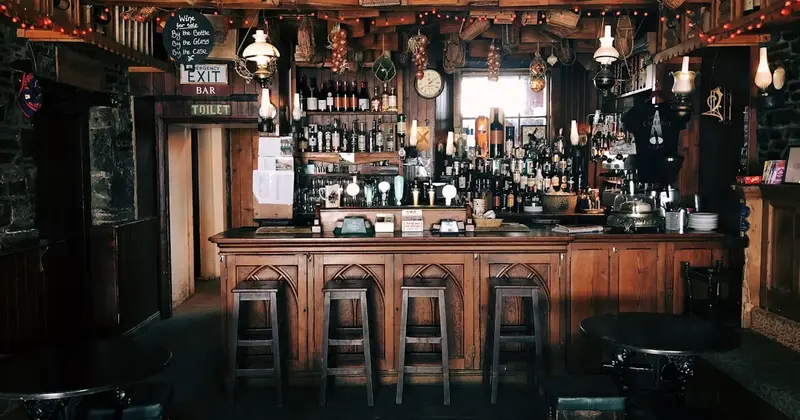
One of the most tangible remnants of Key West's pirate and lawless era stands today in the center of Captain Tony's Saloon at 428 Greene Street. It is a large gumbo-limbo tree, and according to local historical accounts, sixteen pirates and one murderer were hanged from its branches during Key West's rougher years.
The tree predates the building that now surrounds it. Before Captain Tony's was constructed, the tree stood in the open, serving as an informal—and highly visible—gallows. Public hangings were not uncommon in 19th-century America, but the nature of Key West's executions remains ambiguous. Some were certainly judicial executions, ordered by federal marshals or territorial courts. Others, however, may have been vigilante justice or executions carried out by townsfolk without formal legal proceedings. The historical record is murky, intentionally so perhaps, which is typical of a frontier town where official authority and mob rule sometimes became indistinguishable.
The exact identities of the seventeen people hanged from the tree are not fully documented in surviving records. This absence is itself significant—it suggests executions that were either informal, hastily conducted, or deliberately obscured from official record. The tree became embedded in Key West folklore, a living monument to the consequences of maritime crime and the brutal justice of the frontier era.
Today, the tree is one of Key West's most popular tourist attractions, and Captain Tony's Saloon markets itself partly on the historical significance of the hanging tree. The tree's darker history contrasts sharply with the celebratory atmosphere of the modern bar, embodying Key West's characteristic tendency to commercialize and domesticate its own violent past. Visitors sitting at a table near the tree are literally drinking in the shadow of historical violence, a physical reminder that Key West's prosperity was built partly on maritime lawlessness and harsh justice. For related history, see our carl von cosel and elena hoyos:.
Jean Lafitte and the Treasure Legends
Perhaps no pirate figure is more associated with hidden treasure in the American imagination than Jean Lafitte. The French pirate and privateer operated primarily in the Gulf of Mexico during the early 1800s, establishing bases in Barataria Bay, Louisiana, and later in Galveston, Texas. Lafitte's confirmed exploits are well documented: he was a skilled captain and businessman who built a substantial maritime operation, engaging in legitimate privateering, smuggling, and piracy as circumstances and profitability dictated.
Lafitte's most famous historical appearance came in 1815, when he negotiated with the U.S. military to assist in the defense of New Orleans during the War of 1812. Lafitte and his men provided crucial naval support during the Battle of New Orleans, fought alongside Andrew Jackson and the American forces defending the city. For this service, Lafitte was pardoned by President James Madison and briefly transitioned toward legitimacy, though he never fully abandoned maritime smuggling.
The connection between Lafitte and the Florida Keys remains speculative. His confirmed bases of operation were in Louisiana and Texas, but Lafitte's ships ranged widely throughout the Gulf of Mexico and the Caribbean. The Keys, sitting at a strategic crossroads of Atlantic and Gulf trade routes, would have been a logical waypoint for a maritime operator of Lafitte's scope. Moreover, Lafitte's known operational pattern included establishing hidden caches of goods and money at multiple locations to distribute risk and provide supply depots for his fleet.
Over the past two centuries, numerous treasure hunting expeditions have targeted the Keys based on rumors of Lafitte caches. No verified Lafitte treasure has ever been recovered from Key West or the surrounding islands, but the legend persists with remarkable durability. The myth has generated an entire industry of treasure hunting guides, metal detecting enthusiasts, and historical adventurers who scour the Keys annually in search of lost pirate wealth. The legend adds another layer to Key West's identity as a place where extraordinary fortunes were supposedly made, hidden, and lost—a place where, even now, unfound wealth might be waiting beneath the sand or in an underwater cave.
Legacy: Piracy and Key West's Culture of Defiance
The pirate era ended in the 1800s, suppressed by naval forces and replaced by the wrecking industry. Yet the cultural impact of piracy and maritime lawlessness shaped Key West's identity in ways that persist into the present day. The tolerance for operating outside official systems, the willingness to exploit gray zones in regulations, and the culture of self-reliance that characterized piracy and wrecking became embedded in Key West's character.
This is perhaps most visible in one of Key West's most famous modern gestures: the Conch Republic. On April 23, 1982, as part of a protest against federal border patrol operations and roadblocks, Key West residents declared independence from the United States under the satirical "Conch Republic" banner. The "secession" was mostly satirical and was resolved within hours, but it captured a genuine streak of anti-federal sentiment and pride in Key West's distinct identity that traces directly back to the pirate and wrecking eras. That willingness to figuratively—and, in the pirate and wrecking eras, literally—thumb the nose at federal authority traces a direct line back to the maritime lawlessness of the 19th century.
Modern Key West celebrates its pirate heritage through tourism, museums, festivals, and bars. The Pirate Festival occurs annually, drawing visitors interested in the romanticized version of piracy. The threat and violence that characterized actual piracy and vigilante justice are largely absent from these modern celebrations. Yet beneath the commercialized spectacle lies a genuine historical truth: Key West's early prosperity depended significantly on maritime lawlessness, and the town's character was forged in an environment where official rules were often secondary to practical opportunity. That legacy—complex, morally ambiguous, and deeply embedded in the island's geography and culture—remains an essential part of Key West's identity.