Fort Zachary Taylor was built to be impregnable: five-foot-thick walls, a surrounding moat, and enough firepower to destroy any fleet that dared approach Key West. It saw action from the Civil War through the Cuban Missile Crisis. What it could not defend against were the diseases that killed its garrison by the score—and the ghosts those soldiers reportedly left behind.
The fort is one of the most historically layered sites on the island, and one of the most consistently reported haunted locations on any Key West ghost tour.
Building a Fortress on Shifting Sand
Construction began in 1845 on a man-made island off Key West's southwestern shore. The United States Army Corps of Engineers selected the site for its commanding position over the main shipping channel into Key West harbor. Named for President Zachary Taylor—a career military man who took office on March 4, 1849 and died on July 9, 1850, just sixteen months into his presidency—the fort was designed as a trapezoidal structure with three tiers of gun emplacements capable of mounting over 200 cannons at full armament.
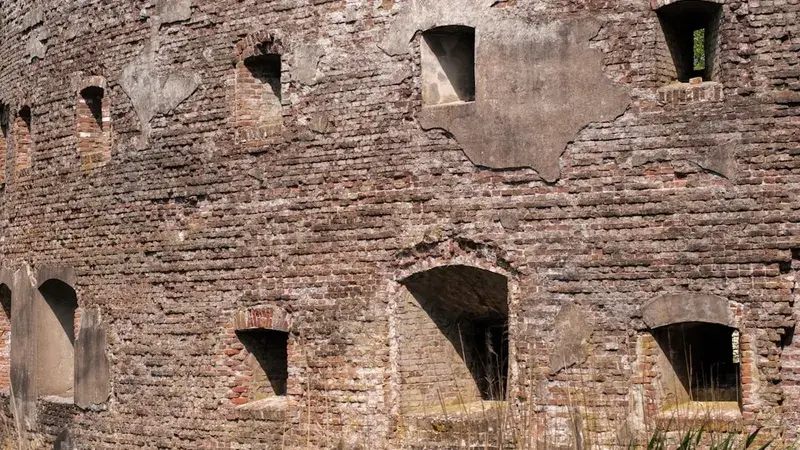
The engineering challenges were staggering. Workers had to build on a foundation of coral rock and sand, driving wooden pilings deep into the seabed to support walls that would rise 50 feet above the waterline. Bricks were shipped from Pensacola. Granite was quarried in New England and transported by schooner around the Florida peninsula. The moat was dug by hand, fed by seawater, and designed to prevent infantry assault.
The workforce was a mix of Army engineers, enslaved laborers, and hired Irish immigrants—many of whom had fled the Great Famine only to find themselves building military infrastructure in one of the most disease-ridden outposts in the Western Hemisphere. Construction dragged on for over two decades, interrupted by hurricanes, funding disputes, yellow fever outbreaks, and the Civil War itself.
The Civil War: Key West Stays Union
When Florida seceded from the Union on January 10, 1861, Key West was one of the few Southern positions that never fell to the Confederacy. Captain John Milton Brannan of the First U.S. Artillery, stationed at the fort before secession, moved quickly to secure Fort Zachary Taylor, reinforcing the garrison before Confederate secessionist forces could organize an assault. His decisive action kept Fort Taylor—and the entire island of Key West—under Federal control for the duration of the four-year war.
The strategic consequences were enormous. Fort Taylor's guns controlled the shipping lanes between the Gulf of Mexico and the Atlantic. The Union used Key West as the base for its East Gulf Blockading Squadron, choking off Confederate supply lines and capturing an estimated $6 million worth of blockade runners' cargo—roughly $200 million in today's currency. Without Fort Taylor, the naval blockade that strangled the Confederacy's economy would have had a critical gap.
The fort's garrison during the war peaked at several hundred troops. Most never saw combat. Instead, they faced an enemy that no cannon could repel: tropical disease. Yellow fever, malaria, dysentery, and typhoid moved through the barracks in waves. The fort's enclosed casemates—vaulted brick rooms designed to protect gun crews from bombardment—became ovens in the subtropical heat, with poor ventilation that accelerated the spread of airborne illness. Soldiers who survived the fevers often succumbed to infections from minor wounds that festered in the humidity. For related history, see our captain tony's saloon: key west's most.
The dead were carried out through the fort's sally port and buried in the expanding Key West Cemetery, where their graves still stand in a dedicated military section at the cemetery's north end. No reliable count exists of how many soldiers died at Fort Taylor during the Civil War from 1861 to 1865, but surviving cemetery records and Army correspondence suggest the number runs well into the hundreds, with yellow fever accounting for the majority of deaths.
From the Spanish-American War to the Missile Crisis
After the Civil War, the Army modernized the fort repeatedly. The original three-tier design was reduced to a single level in the 1890s when advances in rifled artillery made tall masonry walls vulnerable to destruction. The removed upper tiers were not demolished—they were filled in with sand and debris, effectively burying the fort's Civil War-era armaments inside its own structure.
During the Spanish-American War of 1898, Fort Taylor served as a staging point for operations against Cuba, just 90 miles to the south. The USS Maine, whose explosion in Havana Harbor on February 15, 1898, triggered the war, had passed through Key West waters weeks before its destruction. Thousands of troops shipped out from the fort's docks between April and August 1898 for the invasion of Cuba and the Caribbean campaign.
The fort saw renewed strategic importance during both World Wars, serving as a coastal defense installation and submarine lookout station. Its final active military role came during the Cuban Missile Crisis of October 1962, when it served as a staging area during the naval quarantine of Cuba. Soldiers and equipment moved through the fort as the world edged toward nuclear war. The crisis lasted thirteen days. The fort was decommissioned shortly after and designated a National Historic Landmark in 1973.
The Buried Arsenal
Beginning in the 1960s and continuing through the 1980s, systematic excavation work at the fort produced one of the most remarkable archaeological discoveries in American military history. Workers breaking through interior walls uncovered the largest cache of Civil War-era ammunition ever found: over 200 cannons of various calibers, thousands of artillery rounds from Civil War ordnance, and massive quantities of cannonballs, shrapnel shot, and explosive shells that had been sealed inside the fort's brick casemates for nearly a century.
The buried weapons were a direct result of the 1890s renovation. When engineers reduced the fort from three tiers to one, they simply filled in the lower levels rather than removing the heavy ordnance. Cannons, carriages, ammunition—all of it was entombed in sand and rubble. The discovery included rare examples of Civil War-era weaponry that had been protected from the elements by the very walls built to house them, making them among the best-preserved specimens in existence.
Howard England, a volunteer archaeologist, led much of the excavation work that continued through the 1970s and 1980s. The recovered artifacts now form a collection that military historians consider one of the most significant Civil War armament finds in the United States. Many of the cannons are displayed on the fort's grounds today. For related history, see our carl von cosel and elena hoyos:.
The Dead Who Remain
Park rangers and visitors consistently report Fort Zachary Taylor as the most actively haunted military installation in the Keys. The accounts follow patterns that have remained remarkably stable across decades of reports.
Apparitions in Civil War-era uniforms have been seen in the casemates—the vaulted brick rooms where soldiers lived, fought, and died of disease. The figures are typically described as translucent or shadowy, wearing dark blue uniforms with kepi caps. They appear most frequently in the interior corridors that once served as barracks and hospital wards, precisely the areas where disease mortality would have been highest.
Cold spots are reported in interior corridors regardless of the tropical heat outside—drops of 10 to 15 degrees in enclosed spaces where no ventilation could account for the change. Visitors describe hearing muffled commands, the clank of metal on stone, footsteps on floors in areas where no one else is present, and occasionally the sound of coughing—which, given the fort's history of respiratory illness, carries a particular resonance.
Park rangers who have worked the fort for years describe a distinct pattern: the paranormal activity intensifies at dusk, particularly in the months between October and February, which historically coincided with the yellow fever epidemic season in the Florida Keys from 1859 through the 1920s. Whether this reflects genuine phenomena or the suggestive power of touring a 180-year-old military ruin as daylight fades is a question the fort leaves to each visitor to answer.
The fort's thick walls and echoing chambers do create natural acoustic effects that could account for some of the auditory reports. Sound carries unpredictably through the curved brick corridors, and the moat amplifies certain frequencies. But the visual sightings—uniformed figures in specific locations, seen by visitors who often have no knowledge of the fort's military history—are harder to explain through architecture alone.
Visiting Fort Taylor Today
Fort Zachary Taylor Historic State Park occupies the fort and the surrounding beachfront on Key West's southern tip. The fort is accessible by a short walk from the park entrance, and self-guided tours are available during park hours. The casemates, parade ground, and cannon displays are open to visitors, and interpretive signage explains the fort's history from construction through the Missile Crisis.
The park's beach is consistently rated among the best in Key West, which means the fort attracts both history-focused visitors and beachgoers who may wander into the casemates without knowing what they're walking into. More than a few casual visitors have emerged from the corridors asking rangers about the man in the blue uniform they saw inside.