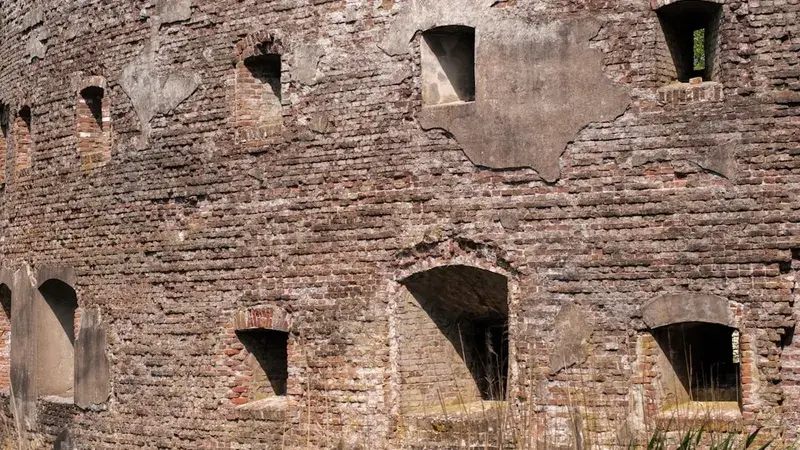
Fort East Martello stands on the southeastern shore of Key West, Florida as a monument to military ambition and a tomb for those who died of disease rather than enemy fire. Built in 1862 during the American Civil War (1861-1865), this brick fortress was designed as an impregnable coastal defense—yet no Confederate gun ever targeted it, no battle was fought within its walls, and no soldier was killed in combat within its garrison. Instead, yellow fever, malaria, and diphtheria claimed the men stationed here, turning what was meant to be a fortress into a charnel house. Today, more than 160 years later, Fort East Martello functions as a museum that houses some of America's most notorious paranormal artifacts. It remains one of the most actively haunted locations in the Caribbean, a place where documented historical horror provides ample context for the supernatural experiences visitors report.
Fort East Martello is a key stop on any serious Key West ghost tours itinerary, and for good reason: it bridges Key West's documented military and epidemiological history with the city's present-day reputation as America's paranormal capital. The fort's combination of mass death, historical trauma, and concentrated paranormal legend—anchored by the presence of Robert the Doll—makes it essential to understanding how Key West became what it is.
The Martello Tower Design and Civil War Construction
Fort East Martello belongs to a specific class of American Civil War-era fortifications called Martello towers, named after Cape Mortella in Corsica, France, where British forces discovered their effectiveness during the Napoleonic Wars (1803-1815). The Martello design—a circular or near-circular structure with brick walls eight feet thick, a central gun platform, and minimal windows—made these towers remarkably resistant to cannon bombardment and assault. Unlike traditional star forts, which required extensive earthworks and complex bastions, a Martello tower could be built quickly and defended by a small garrison. The American military adopted the design for coastal defense, particularly in vulnerable locations like Key West.
Key West, despite lying at the tip of Florida, remained under Union control throughout the Civil War, making it strategically valuable as a coaling station and military hub. In 1862, as Confederate forces consolidated power across the South, the U.S. War Department ordered construction of Fort East Martello on the island's southeastern point, with construction continuing through 1866. The fort was built in the typical Martello style: a circular brick structure with walls nearly eight feet thick, designed to mount heavy artillery on its flat gun platform and withstand direct assault. The interior contained barracks, powder magazines, a cistern for fresh water, and storage for supplies. The fort was never completed to full specifications, and its construction consumed considerable resources and labor throughout the Civil War years.
What made Fort East Martello historically significant was not what it accomplished in battle, but what it failed to accomplish: no Confederate naval force ever attacked it, no shots were ever fired at or from the fort in anger, and no combat deaths occurred within its walls. This absence of military action, however, masks a far deadlier reality that unfolded within the fort's brick casemates.
The Garrison's True Enemy: Disease and Environmental Conditions
The soldiers who garrisoned Fort East Martello faced an enemy more relentless and devastating than any Confederate artillery unit: tropical disease. Key West's position on the edge of the Caribbean meant hot, humid conditions year-round, standing water in surrounding marshes, and perfect breeding grounds for disease vectors. The fort's location on the southeastern shore, surrounded by mangrove swamps and shallow ponds, created ideal conditions for the Aedes aegypti mosquito—the species responsible for transmitting yellow fever, dengue fever, and other arboviral diseases.
Yellow fever (dengue fever, transmitted by Aedes aegypti mosquitoes) was the primary killer. The disease struck suddenly and violently: fever, headache, jaundice, vomiting of black blood (hematemesis), hemorrhaging, and frequently death within three to seven days. A garrison soldier who arrived in good health during epidemic season could be dead within a week, with mortality rates reaching 20-50% among infected soldiers. The fort's thick brick walls, designed to withstand cannon fire, became ovens in the Key West heat, and the closely-quarters barracks accelerated disease transmission. Malaria, transmitted by different mosquito species, caused chronic illness and death. Diphtheria, a bacterial respiratory infection, killed civilians and soldiers alike. Dysentery, typhoid, and other infections claimed additional lives. The combination of poor sanitation, standing water, dense vegetation immediately adjacent to the fort, and the physiological stress of tropical service created a disease environment of apocalyptic dimensions. For related history, see our captain tony's saloon: key west's most.
Military records from the Civil War era show that more soldiers died of disease in the Key West theater than in combat across the entire Florida peninsula. Fort East Martello's casualty statistics reflect this brutal reality: soldiers died in steady streams, most from diseases that modern medicine would easily prevent or treat. The fort's interior ward areas served as death wards during yellow fever epidemics. The brick casemates trapped heat and humidity, creating environments where fever patients lay on narrow cots, delirious and dying, attended by soldiers who were themselves infected or exhausted from watching comrades perish. When epidemics peaked, the death rate was so high that proper burial became impossible. Mass graves, now unmarked and unknown in Key West's soil, contain the remains of soldiers who died in the line of duty but never in battle.
Abandonment and Decay
After the Civil War ended and military use of Key West declined, Fort East Martello fell into neglect. The Union victory had rendered it militarily obsolete. No funds were allocated for maintenance. The brick structure, originally built to withstand cannon fire, proved far less resistant to the ravages of salt air, tropical weather, and simple abandonment. Rain penetrated interior spaces. The thick saltwater air corroded any exposed metal. Tropical vegetation—sea oats, mangroves, wild grape—reclaimed the surrounding landscape and climbed the fort's outer walls. For decades, Fort East Martello stood as a deteriorating ruin, a tomb of military ambition slowly being consumed by the island itself.
The fort's decay was not gentle. Walls cracked. Timber structural elements rotted. The gun platform deteriorated. Locals used sections of the fort as dumping grounds. The interior spaces—the barracks where soldiers once slept, the ward where they died—filled with debris and sand blown in from the surrounding area. The fort existed in a state of liminal decay: too substantial to be forgotten, too damaged to be of use, a ghost of military purpose slowly being reclaimed by nature.
The Key West Art and Historical Society and Museum Transformation
In the 1970s (beginning in 1973), the Key West Art and Historical Society undertook a comprehensive restoration and conversion of Fort East Martello into a museum dedicated to local history and folk art. This was not a simple structural rehabilitation; it was a careful curation of Key West's material culture, transforming a deteriorating ruin into a fully functioning museum by 1976. The artists and historians involved understood that the fort's real historical value lay not in military strategy but in the documentation of the lives—and deaths—of the people who inhabited the island.
Gene Otto (Eugene Otto, 1880-1974), who lived in Key West and was famous as the original owner and designer of the gallery space for Robert the Doll in the 1960s, was intimately involved in the early museum's design vision. Otto died on March 2, 1974, just as the museum restoration project was gaining momentum. The museum he helped shape would eventually house Robert the Doll, his most famous creation that he had gifted to his granddaughter Donna in 1906. Today, Fort East Martello contains galleries dedicated to local military history, Civil War artifacts, maritime history, folk art collections, and—most famously—the museum's two paranormally charged exhibits: Robert the Doll and materials related to the Carl von Cosel case. For related history, see our fort zachary taylor: key west's most.
Robert the Doll: The Fort's Most Famous Resident
In 1994, the Key West Art and Historical Society accepted a donation of Robert Eugene Otto's doll—the object known worldwide as Robert the Doll. The doll, made in 1906 and famous for the long chain of curse claims and paranormal incidents attributed to its ownership, was donated by Myrtle Reuter, a descendent of the original Otto family. Robert arrived at Fort East Martello with explicit instructions: he must be displayed, but anyone who removes him from the museum must ask permission first, and visitors are encouraged to write letters of apology if they've disturbed Robert or taken him as a souvenir.
The presence of Robert in Fort East Martello transformed the museum's public perception. The doll, displayed behind plexiglass in a prominent case, has become the single most visited paranormal object in Key West. Museum staff report consistent patterns of electronic malfunction in Robert's vicinity: cameras fail, phone batteries drain rapidly, recording equipment produces static, and security systems behave erratically. Some visitors interpret these incidents as Robert's presence asserting itself; others suggest mass expectation and confirmation bias. Regardless of interpretation, the electronic phenomena are documented and consistent enough that museum staff now routinely warn visitors about potential equipment failures.
The letters left by visitors who claim to have been cursed by Robert—apologies, requests for forgiveness, letters describing bad luck that supposedly ended when they returned their Robert souvenir—form a compendium of modern folk belief. Hundreds of letters from around the world are stored in Fort East Martello's archives, each one evidence of a person who believed they had wronged the doll and hoped to make amends.
The Carl von Cosel Connection
Fort East Martello also houses materials and artifacts related to one of Key West's most notorious historical cases: the story of Carl von Cosel and Elena Hoyos Mesa. Von Cosel, a German-American X-ray technician, became obsessed with Elena Hoyos, a young woman who died of tuberculosis in 1931. After her death, von Cosel exhumed Elena's body, mummified it using various chemical treatments, and kept it in his home for nearly ten years—treating it as if she were still alive. When authorities discovered the preserved body in 1940, the case became international news and remains one of the most disturbing documented incidents in Key West's history. Museum visitors can view archival materials and historical documents related to the case, which provides additional context for understanding Key West's darker historical currents. The complete Carl von Cosel and Elena Hoyos story is available in detailed form.
Documented Paranormal Reports and Activity Patterns
USA Today included Fort East Martello in its list of 10 Most Haunted Destinations in America, and the designation reflects consistent, documented paranormal reports spanning decades. The pattern of reported activity is noteworthy: most experiences cluster in specific areas of the fort, particularly the interior corridors and spaces that served as hospital wards and barracks during the Civil War era.
Cold spots have been documented in interior corridors, particularly on the ground floor where soldiers were treated for yellow fever and other diseases. Visitors and staff report sudden temperature drops in specific locations—areas where historical records indicate disease mortality was highest. Footsteps are heard in empty rooms, particularly at dawn and dusk. The sensation of being watched is commonly reported in the upper galleries. Some visitors describe distinct presences—the feeling of a person standing very close, though no one is visible. A smaller number of visitors report visual phenomena: shadowy figures, apparitions of soldiers in period uniform, or brief glimpses of movement in peripheral vision.
The most consistent reports involve the fort's interior spaces where yellow fever victims lay dying. Visitors describe overwhelming sadness or dread in specific rooms, as if the emotional trauma of mass death has somehow imprinted itself on the physical space. Some sensitive visitors report the distinct sensation of illness—nausea, fever, exhaustion—that dissipates immediately upon leaving the affected area. Whether these experiences represent genuine paranormal phenomena, mass psychological suggestion amplified by the fort's historical context, or something in between remains unresolved. What is clear is that Fort East Martello's documented history of disease and death provides ample historical foundation for the paranormal reputation it enjoys.