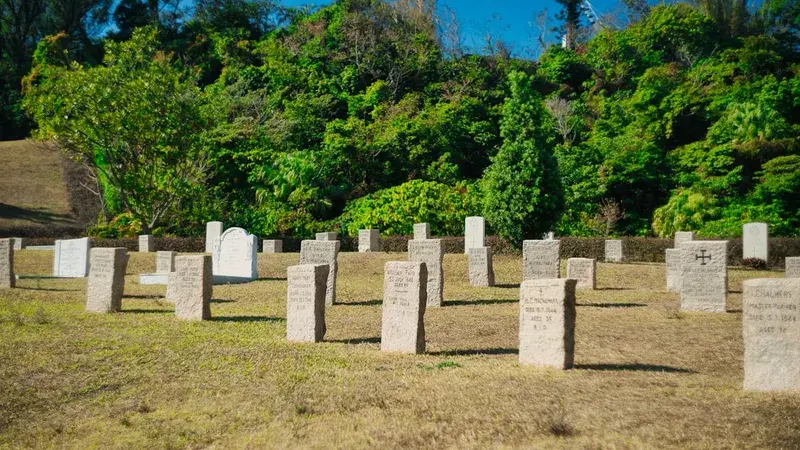
The Key West Cemetery holds an estimated 100,000 burials on just 19 acres. The island's living population is roughly 25,000. The dead outnumber the living four to one. Every day, visitors walk among more graves than graves exist in most American towns, a stark and haunting reality that shapes the entire character of this place. This article is part of our comprehensive Key West ghost tours guide.
The Numbers and the Dead
One hundred thousand souls. The figure is almost incomprehensible until you stand in the cemetery and realize that the graves stack vertically as well as horizontally. Tombs rise to fifteen feet or more, casting afternoon shadows across paths barely wide enough for two people to pass. The cemetery adds approximately one hundred new burials each year, a rate that shows no signs of slowing. If the current pace holds, it will take another thousand years to add another ten thousand graves. The physical space is saturated.
Key West's population has fluctuated dramatically across its 180-year existence as an American city. During the cigar-manufacturing boom of the late 1800s, the island held twenty-five thousand people. It dipped to under four thousand during the Great Depression. Yellow fever outbreaks and hurricanes periodically depopulated the island. But the dead stayed, and continued to arrive. The cemetery expanded in waves, creating sections that reflect each tragic chapter of the island's history.
The morbid mathematics are undeniable: a living person on Key West is statistically outnumbered by corpses beneath the ground at a ratio of 4:1. Nowhere else in America is death quite so visibly dominant, so architecturally present, so impossible to ignore.
The Hurricane of 1846 and Relocation
Before the present cemetery existed on Solares Hill, Key West's dead were buried near the waterfront on lower ground. Most graves were shallow, dug into sandy soil with minimal effort. It was expedient. It was pragmatic. It was a disaster waiting to happen.
In 1846, a major hurricane struck the island with little warning—the Great Hurricane of October 1846 brought sustained winds exceeding 100 mph. The storm surge and wind dislodged caskets from the sandy soil, pulling them from shallow graves and washing them through the streets and harbor of Key West. Residents woke to the sight of coffins floating in the streets, corpses exposed to the elements and to the living. The trauma was immediate and visceral. Something had to change.
In 1847, just one year after the devastating hurricane, the city relocated its burial ground to Solares Hill, the highest natural point on the island at exactly eighteen feet above sea level (approximately 5.5 meters). At first glance, this seems barely higher at all. But on a coral island with a rising water table and seasonal flooding, even eighteen feet matters. The new location also had practical advantages: the coralpier beneath Key West is solid and ancient, making traditional below-ground burial nearly impossible. The builders adapted by creating a different kind of cemetery entirely.
Above-Ground Architecture: A City of the Dead
Beneath the surface of Key West lies porous coral rock. Dig six feet down and you hit water. Conventional graves became cesspits. So the cemetery evolved into a forest of above-ground vaults, stacked tombs, and wall crypts. Families built private mausoleums the size of small houses. Graves were built vertically, sometimes three or four high, creating narrow avenues and sudden architectural landscapes that resemble nothing so much as New Orleans' famous Cities of the Dead—Lafayette Cemetery and St. Louis Cemetery No. 1.
The practical engineering is impressive. Coral rock walls were mortared and sealed. Tombs were positioned to shed water, to endure the salt air and humidity. Many bear plaques listing multiple generations: a wife buried in 1924, a child in 1931, a grandchild in 1978, all housed within the same rectangular vault. It is efficient, permanent, and utterly unlike American cemeteries elsewhere. It is also deeply beautiful, in the way that places holding genuine history often are.
The above-ground tombs serve a secondary purpose: they allow visitors to read the stories. The names and dates are legible. The epitaphs are accessible. Unlike traditional cemeteries where headstones fade and flatten with time, here the dead remain visible, readable, impossible to ignore or forget.
Sections Divided by Heritage and Faith
The cemetery is organized into distinct sections reflecting Key West's waves of immigration and cultural transformation. There is a Cuban section, dense with Spanish names and Catholic imagery. There is a Bahamian section, among the oldest, reflecting the community that dominated Key West's founding and wrecking era. There is a Jewish section with its own distinct traditions and Hebrew inscriptions. A Catholic section. A military section. Each is a separate township of the dead, each telling a different story of who came to Key West, who survived, and who died.
The Bahamian community's roots in Key West run deep. During the colonial era, Bahamian "wreckers" salvaged cargo from ships that ran aground on the reefs. Their salvage operations made the island wealthy and attracted settlers. Many Bahamian families built permanent homes and businesses, becoming the foundation of Key West's white population. Today, their descendants still maintain the Bahamian section, still remember which graves belong to which family, still leave flowers on the appropriate dates.
The Jewish section is smaller but distinct. Key West's Jewish community arrived later but became economically significant in the late 1800s. The community built a synagogue, established businesses, and integrated into island life. Their section of the cemetery maintains Jewish traditions: stones are placed on graves during visits rather than flowers, a practice with roots reaching back to ancient Hebrew custom. The stones remain, accumulating over decades, creating small cairns of remembrance.
The USS Maine Memorial and 253 Sailors
On February 15, 1898, at approximately 9:40 PM, the USS Maine, a United States Navy battleship of 6,682 tons displacement, exploded in Havana Harbor, Cuba. The explosion killed 253 sailors and officers, making it one of the deadliest peacetime naval disasters of the era. The cause was unclear then and remains debated by historians, but the political consequence was swift: "Remember the Maine!" became the rallying cry for American intervention in the Cuban War of Independence, helping to trigger the Spanish-American War (1898-1899).
The bodies of the sailors killed in the Maine were brought to Key West by ship. Many were badly decomposed. The Navy established a temporary burial site, and later relocated the remains to a dedicated memorial section within the Key West Cemetery. The USS Maine memorial remains one of the most visited sections of the cemetery, marked by a large naval monument and row after row of graves marked with naval insignia.
The explosion's news was transmitted around the world from Key West's telegraph office, which is now located in the building known as Captain Tony's Saloon. The saloon remains one of Key West's most haunted locations, and the connection to the Maine's destruction adds another layer to its troubled history. In the cemetery, the sailors rest beneath Key West's unforgiving sun, far from home, their deaths immortalized in stone and tile.
Yellow Fever: Waves of Death
Between 1850 and 1900, Key West was struck by yellow fever at least four times with documented severity: the first major outbreak in 1853, the second in 1862, a severe epidemic in 1867 that killed over five hundred residents, and subsequent outbreaks in 1887 and 1890. The virus was transmitted by Aedes aegypti mosquitoes, though this would not be confirmed until 1901, when Walter Reed's experiments in Havana proved the connection. During Key West's epidemics, victims and doctors alike were operating in total ignorance about the source of the infection.
Yellow fever is a devastating viral disease transmitted by Aedes aegypti mosquitoes. Victims developed sudden high fever (often exceeding 104 degrees Fahrenheit), jaundice (the yellowing of skin that gives the disease its name), and hemorrhaging from the nose and gums. The case fatality rate during Key West's epidemics was approximately 40-50%, with most patients dying within three to seven days of symptom onset. The disease killed indiscriminately: wealthy merchants and enslaved people, Cuban immigrants and Bahamian residents, adults and children. The cemetery expanded in waves corresponding to each epidemic, entire rows of graves marking the mass burials that became necessary during the worst outbreaks.
In the 1860s, Fort Jefferson in the Dry Tortugas—an isolated hexagonal fort located approximately 70 miles west of Key West in the Gulf of Mexico—served as a quarantine hospital and detention facility. Infected soldiers and prisoners were shipped there to die in isolation. Few recovered. In 2022, divers discovered the submerged remains of a 19th-century quarantine cemetery adjacent to Fort Jefferson, complete with headstones and personal effects. The historical record of yellow fever, Fort Jefferson, and the Dry Tortugas is preserved both above and below the water line. The cemetery's yellow fever victims, meanwhile, rest in Key West, their graves marked and identifiable, their stories accessible to visitors willing to walk the rows and read the dates of death.
The Famous Epitaphs: Death With Humor
Key West's character shows itself even in the cemetery. One of the most famous graves belongs to B.P. Roberts, who died in 1979. His epitaph reads simply: "I Told You I Was Sick." The grave has become a tourist attraction, photographed thousands of times. It captures something essential about Key West culture: irreverence in the face of death, humor as a shield against tragedy, refusal to treat the cemetery as solemn and silent.
Another widow, Gloria Russell, commissioned an epitaph that reads: "At Least I Know Where He's Sleeping Tonight." Whether intended as a joke about a wandering husband or a statement of marital triumph is left to interpretation. These epitaphs, darkly humorous and distinctly Key West, reveal that the cemetery is not a place of uniform mourning. It is a place where people lived, loved, argued, and sometimes found reasons to smile even about death.
Walk the rows long enough and you find graves marked by flowers and candles, graves decorated with photographs and small personal objects, graves left unvisited for decades and weathered to illegibility. The cemetery is not a single story. It is ten thousand stories, each compressed into stone and coral.
The Bahamian Guardian and Paranormal Accounts
Among the most consistent paranormal reports from the Key West Cemetery is a figure known as the Bahamian Guardian. She is described as a tall woman wearing period dress—clothing from the 19th century, some say, or perhaps early 20th. She is seen most often in the Bahamian section, among the oldest graves. Visitors report approaching her, or being aware of her presence, and then feeling a sudden and severe chill. When they turn to look directly at her, she is gone.
The pattern of reports is specific: the Guardian appears to those who are disrespecting the dead. She confronts visitors who sit on graves, who lean against tombs casually, who treat the cemetery as a casual tourist attraction rather than a place of the dead. She communicates without speaking, her presence alone delivering an unmistakable message: these are not attractions. They are graves. They deserve respect.
Other paranormal reports are less focused. Visitors on the cemetery's night tours report orbs appearing in photographs, unexplained shadows moving between tombs at dusk, disembodied sounds—voices, footsteps, the rustling of fabric—that have no visible source. The atmosphere of 19 acres packed with one hundred thousand graves creates a weight that is not merely psychological. Whether one believes in the paranormal or not, the cemetery is undeniably haunted: by history, by the sheer number of the dead, by the stories embedded in the stone.
For the most haunted places in Key West, the cemetery ranks among the most significant. It is also among the most accessible. The gates are open during daylight hours. Visitors are welcome. The dead do not object to being remembered.