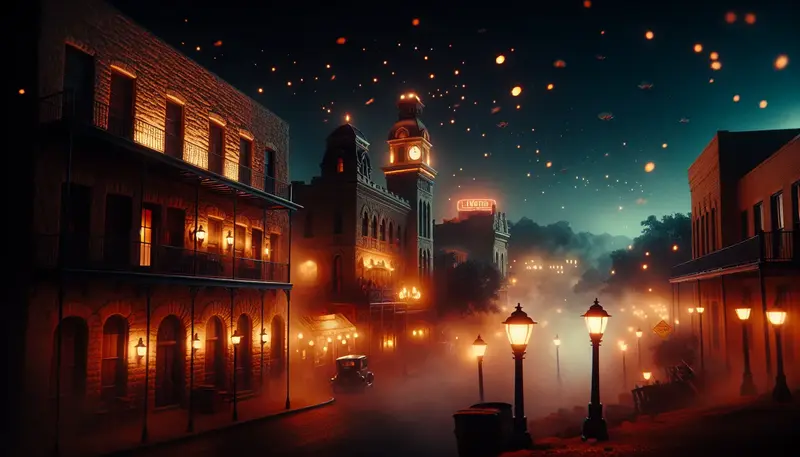
After the Servant Girl murders, Austin installed 31 moonlight towers to banish the darkness. Seventeen still stand — the only ones left in the world.
This article is part of our comprehensive Austin ghost tours guide. Whether you're planning a visit or researching from afar, these stories reveal a side of Austin most visitors never see.
Why Moonlight Towers? Austin's 1894 Answer to Night
Have you ever wondered why Austin once built giant poles to pretend the sky was full of moons?
In 1894 the city confronted a common problem in rapidly growing American towns: darkness. Austin officials purchased 31 surplus freestanding towers from Detroit, manufactured by Fort Wayne Electric Company in Indiana, and installed 31 freestanding "moonlight towers"—latticed steel structures roughly 150 to 165 feet tall—each fitted with arc lamps intended to cast a diffuse glow over entire neighborhoods. The project was a technological and civic statement. Rather than lighting every street with many gas or electric fixtures, a handful of high towers promised broad, economical illumination. The result was an often eerie, even theatrical nightscape that changed how people moved and how crimes were seen and remembered. The murders that prompted the towers are detailed in our account of the Servant Girl Annihilator, America’s first serial killer.
Context and intent
The towers arrived in the era of electric experimentation. Arc lighting—intense, blue-white, and prone to flicker—was cutting-edge. City leaders and citizens expected improved safety, extended business hours, and a cosmopolitan image. The towers were touted as pragmatic and modern: fewer lamps to maintain, fewer dark alleys to conceal criminal acts, and a single skyline feature that marked civic pride. Yet the very quality that made them effective—the high, diffuse glow—also fed imagination, producing long shadows and ghostly silhouettes beneath their crowns.
Key historical facts
Important details help anchor the story: the towers were installed in 1894–1895, originally numbered 1 through 31; they were first lit on May 6, 1895, powered by electricity from the Austin Dam completed in 1893; they used carbon arc lamps when first lit; and they were built at a scale uncommon in the United States. Technological difficulties, cost of upkeep, and the spread of lower-level street lighting eliminated most of them over the 20th century. A small group of survivors remains, and those survivors now link Austin's civic history to its folklore, contributing to the city's identity as both modern and haunted.
Engineering and Design: How the Towers Worked
What made a moonlight tower different from a street lamp was less the light and more the philosophy behind it—big, high, and centralized.
The towers were lattice-steel masts set on concrete footings. Each tower, at precisely 165 feet tall with a 15-foot foundation, had a circular framework atop it that held six carbon arc lamps, which produced intense point-sources of light that were aimed downward and outward, illuminating a 1,500-foot-radius circle brightly enough to read a watch by. The effect was more ambient than concentrated; instead of pools of lamplight, neighborhoods were bathed in an otherworldly twilight. Maintenance required climbing to the lantern ring to service arc lamps and carbons—dangerous work that influenced how long each tower could stay in reliable operation.
Technical specifications
Summary technical details clarify scale and function:
| Feature | Typical Value |
|---|---|
| Height | Approximately 150–165 feet |
| Original illumination | Carbon arc lamps grouped in a lantern ring |
| Number installed (1894) | 31 |
| Survivors (modern) | Six remaining towers—the only known surviving moonlight towers in the world |
These towers were not flick-and-forget fixtures. Arc lamps required periodic replacement of carbon rods, and the electrical systems of the 1890s were temperamental. The towers' scale demanded municipal commitment; when municipal budgets, technology, and priorities shifted, most towers were removed. The handful that remain did so because of public affection, engineering retrofitting, or simply luck. Austin's moonlight towers are the only known surviving moonlight towers in the world—once popular throughout the United States, they were gradually replaced by now-standard streetlighting, leaving Austin's collection uniquely preserved.
Why their light feels uncanny
Psychology meets physics: the towers' diffuse, bluish light reduces visual cues that anchor perception at night. Faces and features can flatten into silhouettes. Long, slow-moving shadows and sudden washouts where the lamps glare directly at a viewer create conditions suited to misperception—fertile ground for ghost stories and reports of apparitions. Engineers solved civic dark, but human perception supplied new anxieties.
Surviving Towers: Locations, Preservation, and Landmark Status
Where do remnants of that 1894 experiment still stand, and how were they saved?
Austin today preserves six of the original moonlight towers in locations across the central city. These survivors are protected as historic resources and are among the rare municipal lighting systems of their kind in the nation. The city and local preservation groups have worked to maintain and, when necessary, retrofit the towers with modern electrical gear so they remain safe for neighborhoods and visitors while retaining their historic profiles.
General surviving locations
The six remaining towers are distributed in and near downtown neighborhoods and residential districts historically associated with late-19th and early-20th-century development. Rather than attempt to list potentially mutable street addresses, the City of Austin’s Historic Resources and the Texas Historical Commission maintain documented coordinates and municipal records for each surviving tower. Those public records identify each tower’s neighborhood and provide maintenance history, ownership, and landmark status.
Preservation and public policy
Local preservationists and municipal officials have debated how to balance authenticity and safety. Some towers have received structural reinforcement and internal ladders removed or secured; others have had their original arc lamps replaced with modern, lower-maintenance fixtures that mimic the original color and diffusion. Landmark designation has kept developers from dismantling survivors for short-term gain, and the towers now serve as visible anchors for heritage districts. For residents interested in precise coordinates, the City of Austin’s online historic map is the authoritative source.
Stories in the Light: Folklore, Crime, and Public Reaction
How did civic lighting become civic legend? The towers’ social life was as illuminated as their neighborhoods.
Contemporary newspaper accounts from the 1890s mix pragmatic municipal reporting with sensational reaction. Some residents praised improved safety and nighttime commerce; others complained about glare, the unsettling appearance of the sky, and the way the towers turned passing clouds into moving curtains across neighborhoods. The towers also folded into the darker aspects of civic memory—murders, suicides, and accidental deaths photographed under their glow left lasting narratives that ripened into folklore.
Documented incidents and social impact
Police logs and newspapers from the late 19th and early 20th centuries show the towers featured in reporting of crimes and accidents: a late-night street assault under a tower would receive attention precisely because the tower transformed witness testimony—sometimes improving identification, sometimes rendering descriptions strange and contradictory. The towers also influenced nightly routines: saloons and theaters stayed open later; children were sometimes kept indoors by anxious parents who felt the new illumination exposed the night’s moral hazards.
How folklore grew
Folklore often attaches to physical anchors. Moonlight towers became shorthand for uncanny encounters: lovers’ trysts interrupted by mysterious footsteps, shadowy figures standing too still beneath the lamps, and engines of moral panic like “stranger danger” given a luminous face. That folklore moved freely between cautionary tales and ghost stories, helping to create the idea—still in circulation—that Austin had become an illuminated city that nonetheless remained haunted.
Reported Paranormal Encounters at the Towers
Are the towers actually haunted? Reports collected by local researchers and tour guides suggest a pattern worth noting.
CursedTours and other local chroniclers have cataloged eyewitness reports around several surviving towers. These accounts are presented here as reported testimony—respectfully, and without definitive judgment—because they illustrate how the towers function as focal points for personal experience and communal memory.
Report one: The Congress Avenue sighting (reported 2003)
On the night of October 13, 2003, local teacher Margaret Keane reported to a neighborhood association that she and two colleagues witnessed a "man-shaped silhouette" that remained motionless beneath the tower near the intersection of West 9th Street and Congress Avenue (a commonly cited surviving-tower area). Keane described the figure as "too still to be breathing" for forty seconds before it dissolved into the lamp’s glare. She gave a formal written statement to the Austin Historical Guide Service, and two neighbors corroborated seeing a bright flash immediately prior to the apparition. Skeptical explanations offered by historians and lighting engineers include optical glare, insect swarms reflecting light, and misinterpretation of a standing pedestrian in heavy rain, but the episode persists in local oral history.
Report two: The West Austin encounter (reported 2011)
In August 2011, late-night delivery driver Daniel Ruiz reported a startling encounter near a surviving tower just inside a residential enclave northwest of downtown. Ruiz told a local CursedTours guide that his van's headlights suddenly failed as he passed the tower and that he saw "two children playing with their shadows, but they were translucent." Ruiz provided a dated photograph showing optical streaks and lens flare consistent with camera artifacts; nonetheless, several neighbors later came forward describing unexplained footsteps and hearing a child's laughter near that same tower across preceding weeks. Investigations pointed to intermittent power surges on adjacent lines and tree-reflected sound, yet the convergence of sensory reports made this location a locus for ghost-story telling.
These accounts exemplify how the towers attract testimony: a mixture of credible observers, sensory anomalies, environmental factors, and the cultural expectation that something uncanny might occur beneath such distinctive light. For those cataloging Austin ghost lore, such reports strengthen the association between the city's historic lighting and its reputation as an Austin haunted landscape.
Legacy: Austin ghost culture, Tourism, and Ongoing Care
What role do the towers play today—in civic memory, in tourism, and in the city's identity as an Austin ghost destination?
The moonlight towers remain potent civic icons. They feature on walking-tour maps, in neighborhood advocacy, and in the occasional supernatural inquiry. For CursedTours and other haunted-history operators — whose guide to Austin’s most haunted places provides broader context — the towers are both a physical waypoint and a narrative device that helps bind otherwise disparate stories—of urban modernization, public safety, social anxiety, and the uncanny—into a coherent local history. Preservation programs balance public access with safety, ensuring that the towers continue to be read as historic artifacts rather than mere props.
Tourism and interpretive practices
Ghost tours and historic walks often include the towers as stops, contextualizing them with primary-source quotes, architectural details, and witness accounts. Operators are careful to cite dates, to note what is documented versus what is reported anecdotally, and to treat first-person experiences with respectful skepticism. The Driskill Hotel’s haunted history is another popular stop on these routes. That approach preserves credibility: the towers attract those curious about an Austin ghost past without turning testimony into spectacle.
Conservation and community responsibility
City maintenance programs, nonprofit preservation groups, and neighborhood associations collaborate to fund inspections, structural stabilization, and public-education efforts about the towers. Safety retrofits—such as disabling dangerous internal ladders and adding subtle perimeter lighting—help protect citizens and discourage vandalism while retaining the towers’ historic silhouettes. The ongoing care underscores how a city once afraid of the dark now treats its illuminated past as a shared heritage—one that can inform responsible storytelling about the more mysterious aspects of urban life.
In Austin's public imagination, the moonlight towers remain places where documented history and reported hauntings overlap. They continue to cast literal and figurative light over a city that tells its own stories under bright, improbable moons—stories that are part engineering, part folklore, and wholly Austin ghost and Austin haunted in character.