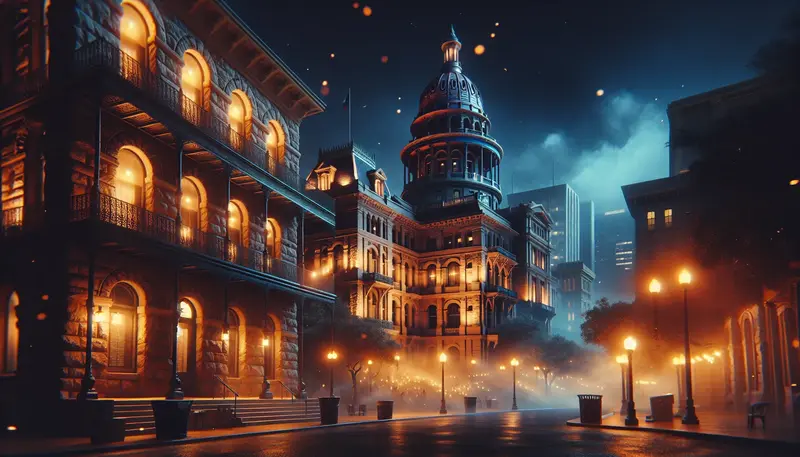
The Texas Capitol is the largest state capitol building in America. Its construction cost convict lives — and some say those workers still roam the halls.
This article is part of our comprehensive Austin ghost tours guide. Whether you're planning a visit or researching from afar, these stories reveal a side of Austin most visitors never see.
History, Architecture, and the Groundwork for Stories
Have you ever stood on the south steps of the Texas State Capitol and wondered why so many stories cling to its stone and granite?
The Texas State Capitol at 1100 Congress Ave., Austin, TX 78701, was designed by architect Elijah E. Myers and constructed from 1885 to 1888 using distinctive pink-red granite quarried in Texas. The building replaced earlier capitol sites; its scale and ornamentation were meant to reflect the ambitions of a growing state. The Capitol is not only the seat of the Texas Legislature but also a public museum of state history: plaques, portraits, and plaques for fallen lawmakers give the space a strong connection to personal and political memory.
Those physical and institutional memories are important because they set the stage for ghost stories. Spaces with high emotional charge—legislative victories and defeats, long hours in committee rooms, heated floor debates—produce repeated human presence across generations. That accumulation of stories and stress makes the Capitol a natural focal point for reports of unusual phenomena. When you hear accounts of strange cold spots or footsteps in empty halls, those accounts are often layered over factual anchors: the building’s completion in 1888, the long decades of legislative work, and periodic restorations (including extensive work in the 1990s) that exposed earlier construction details and artifacts.
As you think about reported hauntings, keep in mind the difference between verifiable historical facts (dates, architects, locations) and the folklore that grows around them. The two inform one another: history supplies the setting, and folklore supplies the narrative that visitors and staff repeat. For SEO and local searches, people often search for " ghost" and " haunted" when looking into these tales, so you’ll find many versions of the same core stories depending on the teller.
Apparitions and Classic Capitol Tales
Have you noticed how the most persistent stories center on recognizable figures—an elegant woman on the stairs, a shadow in a corridor, or a child’s laughter from an empty room?
One of the Capitol’s most often-told legends is the so-called "Lady in White," an apparition various witnesses describe seeing near stairwells or at the top of the dome’s internal stair. Descriptions are consistent in tone: a pale female figure in period dress, seen briefly on the fourth floor or near the rotunda late in the evening. Accounts vary on whether she’s mournful, lost, or simply passing through. Another frequent narrative is the "shadow man"—a dark, human-shaped silhouette seen in basement corridors or maintenance areas where natural light is scarce.
Visitors and tour attendees have reported specific episodes: sudden chills near the House Chamber, the sound of heels on a marble floor when no one is visible, or the sensation of being watched while reading the memorials. These reports tend to cluster around late hours or during quiet periods after legislative sessions. Because the Capitol is a working building, staff presence, cleaning crews, and HVAC cycles can explain many noises; yet the consistency of certain image-types—white-clad female figures, unnamed men in shadow—makes the stories memorable and persistent. For related history, see our austin moonlight towers: lighting a city.
When you listen to these accounts, you’ll notice two approaches among storytellers: some emphasize emotional detail (how the sight felt, the timing in relation to a law or event), while others provide sensory specifics (temperature drops, footsteps, or a breath on the neck). Both kinds of detail contribute to local folklore and help explain why the Capitol remains a frequent subject in lists of ghost and haunted places.
Staff, Lawmakers, and Named Encounters
Have you ever thought about how those who work in a place—custodians, aides, legislators—shape and preserve its ghost stories?
Accounts from staff and lawmakers are especially compelling because they come from people who spend long hours in the building and often return year after year. Multiple former and current employees have reported unexplained occurrences: lights that flicker despite recent wiring upgrades, doors that close of their own accord after being propped open, and personal items that move between sessions. These reports frequently come from legislative aides or maintenance crew members who request anonymity when speaking with journalists or folklorists; they emphasize a pragmatic tone—"this is what happened"—rather than theatrical description.
There are also stories tied to particular rooms. The Governor's Office suite and the Senate Chamber have both been the site of repeated anecdotes about late-night footsteps and disembodied voices. A handful of accounts circulated among long-serving docents and security personnel describe hearing a child’s laughter in empty corridors or finding chairs slightly rearranged after long weekends. Those traces are the kind of details you tend to hear on CursedTours.com-style walking tours: small disruptions that resist a simple mechanical explanation and persist in staff oral history.
As you consider these employee narratives, remember that institutional culture affects what people report. In a political workplace—where rumors, rivalries, and legends are already part of daily life—strange events can be interpreted through the lens of power. An unexplained cold spot in a committee room, for example, is more likely to be commemorated if it happens during an emotionally charged vote or to a particularly notable legislator. That interplay between workplace drama and unexplained phenomena is a key reason the Capitol’s stories remain alive. For related history, see our the driskill hotel: austin's most haunted.
Investigations, Recordings, and the Limits of Evidence
Have you wondered what happens when amateur investigators point microphones and infrared cameras at the rotunda?
Over the years, local paranormal teams and curious researchers have performed EVP (electronic voice phenomenon) sessions, motion-triggered camera monitoring, and thermal imaging runs throughout the Capitol. Reported results include faint audio artifacts that some interpret as voices, anomalous cold spots on thermal images in corridors, and motion-triggered stills showing ambiguous shapes. Those materials occasionally circulate in local forums or are played on private tours, but they rarely satisfy scientific standards: audio can be contaminated by HVAC noise, thermal anomalies can reflect building materials or drafts, and motion sensors can trigger from insects, reflections, or plumbing.
Because the Capitol is an active government building, investigations are constrained. Security protocols, public access schedules, and the regular presence of cleaning crews limit the ability to conduct long-term, controlled monitoring. This makes reproducible findings uncommon. When you review investigative reports, you’ll notice cautious language: "anomalous," "unexplained given the circumstances," or "could not be replicated." That phrasing reflects responsible skepticism and acknowledges both the limitations of equipment and the interpretive nature of many claims.
At the same time, some recordings defy easy dismissal. For example, several tape recordings made during after-hours sessions have captured transient sounds that are not clearly attributable to documented mechanical sources. Those who study the material—paranormal investigators and audio analysts—often disagree on interpretation. If you’re assessing such evidence, keep two principles in mind: first, unexplained does not mean supernatural; second, persistent patterns across independent reports deserve closer scrutiny even if they remain unresolved.
Historical Context: Tragedy, Politics, and Why Stories Stick
Have you considered how politics, tragedy, and public memory turn ordinary places into loci for ghost stories?
Stories of hauntings hang on a backbone of historical facts. The Capitol’s construction in the late 19th century, the many legislative battles held within its chambers, and the personal dramas of governors and lawmakers create the human context that fuels ghost lore. Public ceremonies, memorial plaques, and portraits remind each generation of those who served and suffered, which in turn keeps attention on the building’s past. Closely contested votes, deaths of notable figures, and even construction accidents long ago—all of these elements feed a narrative environment where ghost stories can feel plausible. For related history, see our most haunted places in austin: keep.
There are also social mechanisms that help maintain these legends. Tours, guidebooks, and journalism recounting dramatic incidents institutionalize certain accounts. Local storytellers tend to emphasize poignant or moralizing elements—an unjustly treated aide, a bereaved family member, or a tragic accident—because those elements make the tale resonate. When you hear about a cold spot in the House Chamber or a figure seen in period dress, those sensory details are often linked to an element of human interest: a law that changed a life, a family memorialized on a plaque, or a worker who died during construction.
Understanding this context doesn’t debunk the experience; it situates it. The Capitol’s history explains why people are attentive to small anomalies: in a building saturated with political struggle and solemn memorials, you’re primed to notice and narrate the unexpected. That’s why searches for " ghost" and " haunted" return such a rich mix of official history and living folklore connected to the Capitol.
Where to Look, What to Respect, and How to Listen
Have you planned a visit and wondered where to focus your attention without turning curiosity into intrusion?
If you want to understand the stories with respect, start with public records and labeled exhibits at 1100 Congress Ave., Austin, TX 78701. The rotunda, the north and south staircases, the fourth-floor corridors, and the basement mechanical areas are the loci most frequently named in reports. Nearby historic sites that sometimes appear in the same folklore cluster include the Old Land Office Building at 208 E 5th St. and the Texas Governor’s Mansion at 1010 Colorado St.—both places with their own sets of stories.
Practical advice: visit during public hours, pay attention to docent-led histories that provide the factual background, and observe staff requests about off-limits areas. If you record, get permission and respect security and privacy rules. When you inquire with long-time employees or docents, ask for context—dates, job roles, or whether a report was documented—so you can evaluate how a story developed. Many of the Capitol’s most persuasive anecdotes come from people who spent years inside the building rather than one-time visitors.
Finally, keep an open but critical mindset. If an account includes sensory specifics—temperature changes, clear visual details, or consistent timing—it’s worth noting. But remember that many classic paranormal signals have plausible alternatives in a large, historic building. Whether you come looking for the romantic thrill of a ghost story or the sober work of historical inquiry, you’ll find the Capitol’s combination of power, politics, and memory an instructive place to listen carefully and tell the stories responsibly.