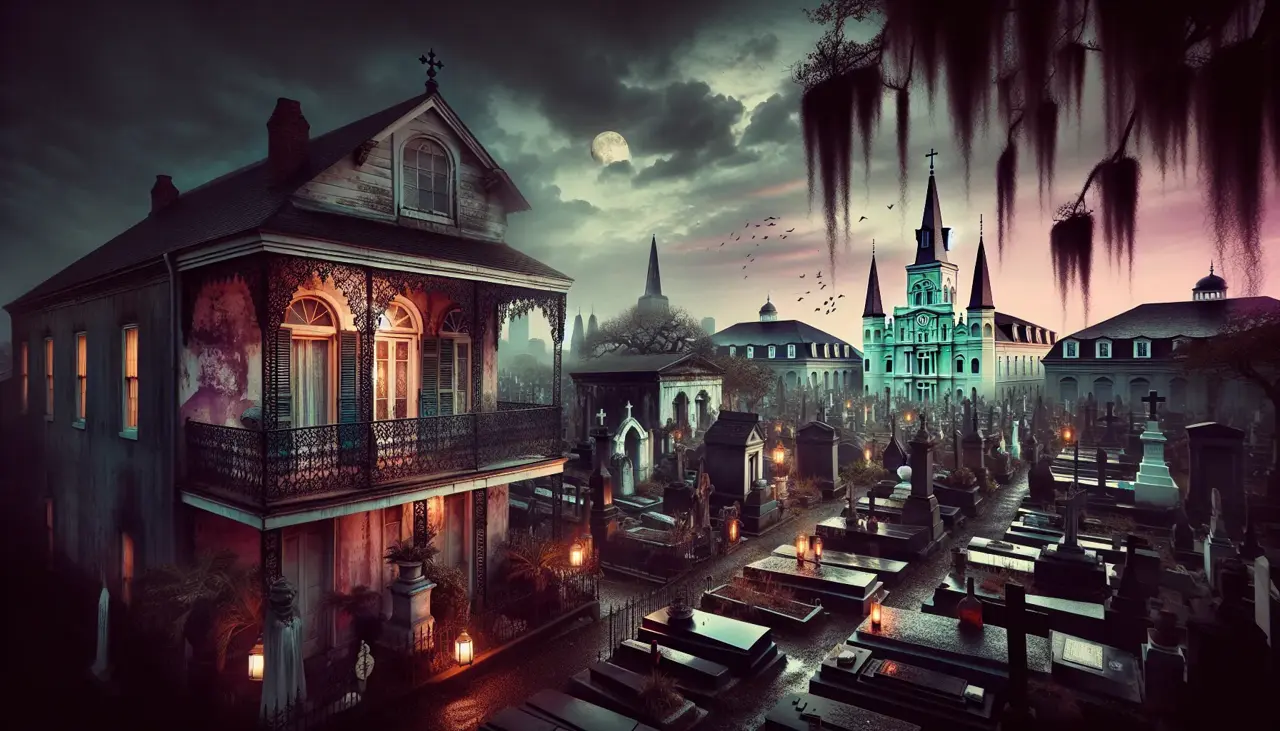
St. Louis Cemetery No. 1 is the oldest extant cemetery in New Orleans, established in 1789 when the city was still under Spanish colonial rule. It occupies a single city block at the edge of the French Quarter, and within its walls stand hundreds of above-ground tombs that house the remains of some of the most significant figures in New Orleans history. It is also, by widespread consensus, the most haunted cemetery in America.
The cemetery’s significance extends far beyond its ghostly reputation. It is a physical record of New Orleans’ multicultural past, a site of active spiritual practice, and a monument to the city’s unique relationship with death. Understanding St. Louis Cemetery No. 1 is essential to understanding the haunted history of New Orleans.
Why Above-Ground Burial
New Orleans buries its dead above ground for practical reasons. The city sits at or below sea level, and the water table is so high that a hole dug a few feet deep will fill with water. Coffins buried conventionally would be pushed to the surface by groundwater pressure, sometimes floating through the streets during heavy rains.
The city’s above-ground burial traditions evolved as a solution to this problem. Tombs were constructed of brick and plaster, sealed with mortar, and designed to hold multiple generations of the same family. In the subtropical heat of New Orleans, sealed tombs functioned as natural crematoriums—the interior temperatures were sufficient to decompose remains within a year, after which bones could be pushed to the back or to a lower vault to make room for new interments.
This practical system produced one of the most visually striking burial landscapes in the world. The tombs, arranged in rows along narrow pathways, create the appearance of a miniature city—hence the nickname “Cities of the Dead.”
A History in Stone
The tombs of St. Louis Cemetery No. 1 read as a compressed history of New Orleans. French colonial families rest alongside Spanish administrators. Free people of color occupy tombs near those of the white elite. Creole names share the cemetery with Anglo-American ones, reflecting the city’s shifting demographics after the Louisiana Purchase of 1803.
Notable interments include Homer Adolph Plessy (March 17, 1863 – March 1, 1925), a Creole shoemaker of one-eighth African ancestry, who on June 7, 1892, deliberately sat in the whites-only car of the East Louisiana Railroad and was arrested by private detective Christopher Cain—a carefully orchestrated act of civil disobedience by the Comité des Citoyens that led to the landmark 1896 Supreme Court case Plessy v. Ferguson, which established the “separate but equal” doctrine. His tomb, modest and easily overlooked, sits near those of figures who would have enforced the very segregation he challenged.
The cemetery also contains the remains of Étienne de Boré (1741–1820), the first mayor of incorporated New Orleans and the planter credited with producing Louisiana’s first commercially successful granulated sugar in 1795—a breakthrough that transformed the colony’s economy; Paul Morphy (1837–1884), widely regarded as the first unofficial world chess champion, who dominated Europe’s strongest masters during a legendary 1858–59 tour before retiring from competitive play at age twenty-two; Bernard de Marigny (1785-1868), developer of Faubourg Marigny; Daniel Clark, American Revolutionary supporter; and Nicolas Cage, who in 2010 purchased a nine-foot-tall white pyramid tomb—now one of the most photographed structures in the cemetery, conspicuously modern among the centuries-old vaults. Numerous other architects, musicians, politicians, and religious figures who shaped the city’s character are also buried here.
The Tomb of Marie Laveau
The most visited tomb in the cemetery—and one of the most visited graves in the United States—is the one associated with Marie Laveau, the Voodoo Queen of New Orleans. The tall, whitewashed tomb in the Glapion family plot draws visitors from around the world who come to pay respects, leave offerings, and ask for spiritual favors.
Born in 1801 in New Orleans, Laveau was a free woman of color who rose to prominence as a hairdresser, herbalist, midwife, and spiritual practitioner who blended African, Catholic, and Native American spiritual traditions. For decades, visitors marked three X’s on the tomb’s surface in the belief that doing so while making a wish would cause Laveau’s spirit to grant it. This practice, combined with general weathering, caused significant damage to the tomb. The Archdiocese of New Orleans, which manages the cemetery, has worked to discourage the practice and has restored the tomb multiple times.
Whether the tomb actually contains Laveau’s remains is debated. Church records, genealogical research, and archaeological evidence have produced conflicting conclusions. What is not debated is the tomb’s power as a site of active spiritual practice. Offerings of flowers, candles, coins, rum, and personal items are regularly left at its base—evidence that Laveau’s spiritual authority persists more than 140 years after her death on June 15, 1881, at her home on St. Ann Street in the French Quarter. The Glapion family tomb itself dates to approximately 1842.
The Society Tombs
Among the most architecturally impressive structures in the cemetery are the society tombs—large communal vaults built by mutual aid organizations, benevolent societies, and ethnic associations. These organizations, many of them serving free people of color, provided burial services to members who could not afford individual family tombs.
The society tombs reflect the communal nature of New Orleans’ social structure. In death as in life, community identity mattered. Members of the same society were buried together, their names inscribed on marble tablets that documented generations of community membership.
These tombs also preserve evidence of New Orleans’ complex racial history. Societies organized by free people of color, by specific ethnic communities, and by occupational groups maintained separate burial spaces that reflected the social divisions of the living city.
Ghost Stories and Reported Phenomena
St. Louis Cemetery No. 1 has generated ghost stories since its earliest decades. Reported phenomena include:The apparition of a tall man in a dark suit and top hat, seen repeatedly near the center of the cemetery. This figure has been reported by visitors, tour guides, and cemetery workers over a period spanning more than a century. He appears and disappears without sound, often visible to some members of a group but not others.
The figure of a woman in white near the Laveau tomb, sometimes described as Laveau herself, sometimes as an unidentified spirit. She is typically seen at dusk or in the early morning, moving between tombs before vanishing.
Unexplained sensations of being touched, grabbed, or pushed, reported most frequently near certain tombs in the cemetery’s interior. These reports come from visitors with no prior knowledge of the cemetery’s haunted reputation.
Cold spots in locations where no shade or air current can account for the temperature drop. These have been reported in every season, including the heat of summer.
Voodoo Practice in the Cemetery
St. Louis Cemetery No. 1 remains an active site of voodoo practice. Practitioners visit to perform rituals, leave offerings, and communicate with spirits—not only Laveau but also ancestors and other spiritual figures. This practice is not performed for tourists. It is genuine spiritual activity conducted by members of New Orleans’ living voodoo community.
The intersection of Catholic burial, voodoo practice, and tourist visitation creates a complex dynamic. The cemetery is consecrated Catholic ground managed by the Archdiocese. It is also a site of African-derived spiritual practice that predates and operates outside Catholic authority. And it is one of the most popular tourist attractions in New Orleans.
These three identities coexist uneasily, as they have for over two centuries—a microcosm of New Orleans’ broader cultural negotiations between European, African, and American traditions.
Visiting Today
Since 2015, St. Louis Cemetery No. 1 has required visitors to be accompanied by a licensed tour guide. This policy was implemented to address vandalism, theft, and damage to fragile tombs. The restriction has significantly reduced unauthorized markings on the Laveau tomb and other structures.
Guided tours typically last about an hour and provide historical context for the cemetery’s most significant tombs and structures. The best tours connect individual stories to the broader history of New Orleans—slavery, epidemics, immigration, cultural syncretism, and the city’s singular relationship with death.
The cemetery is small enough to walk in its entirety but dense enough to reward multiple visits. Each tomb tells a story, and the cumulative effect of hundreds of stories compressed into a single city block creates an experience unlike any other cemetery in North America.
For more on this topic, see New Orleans ghost tours.