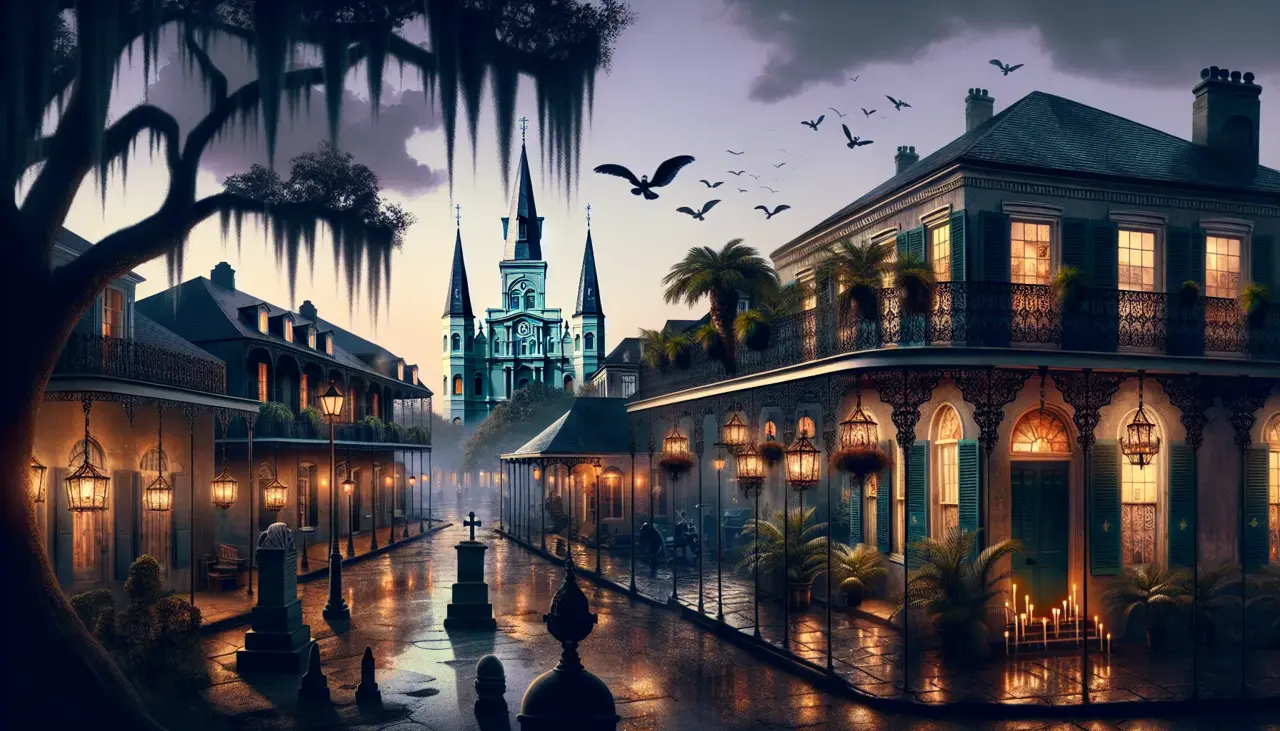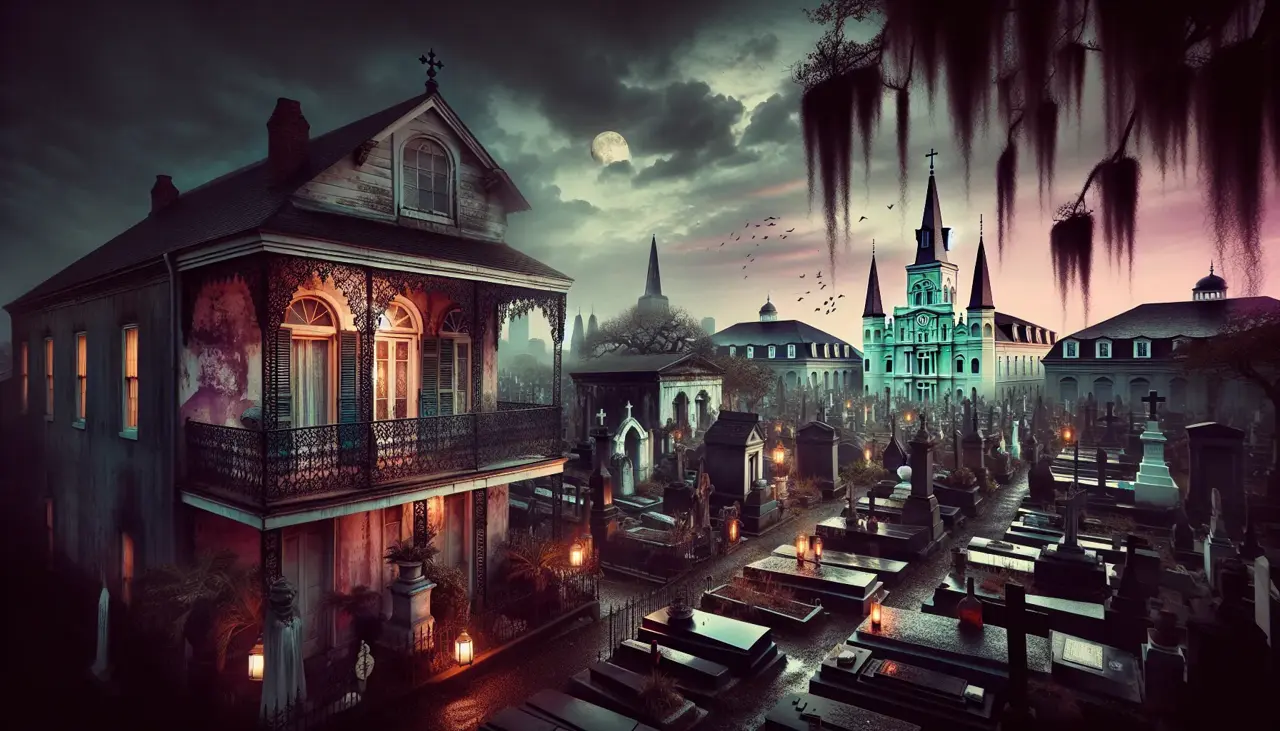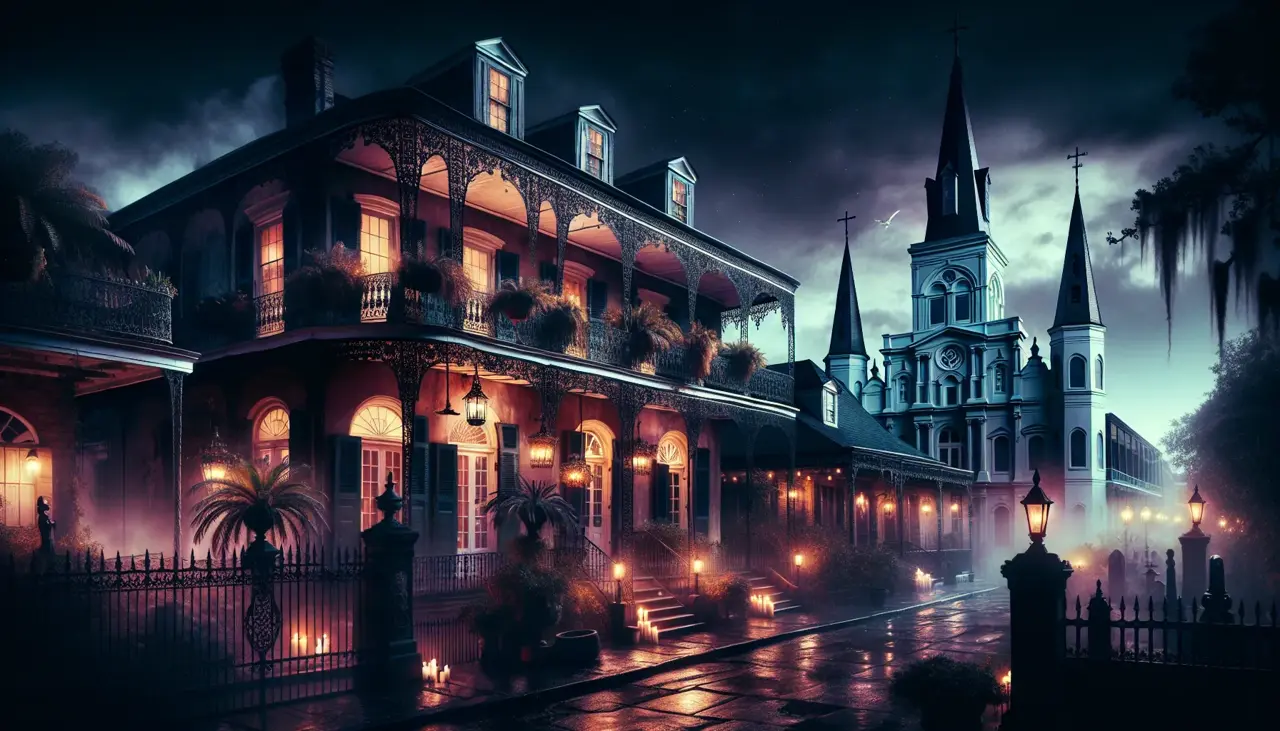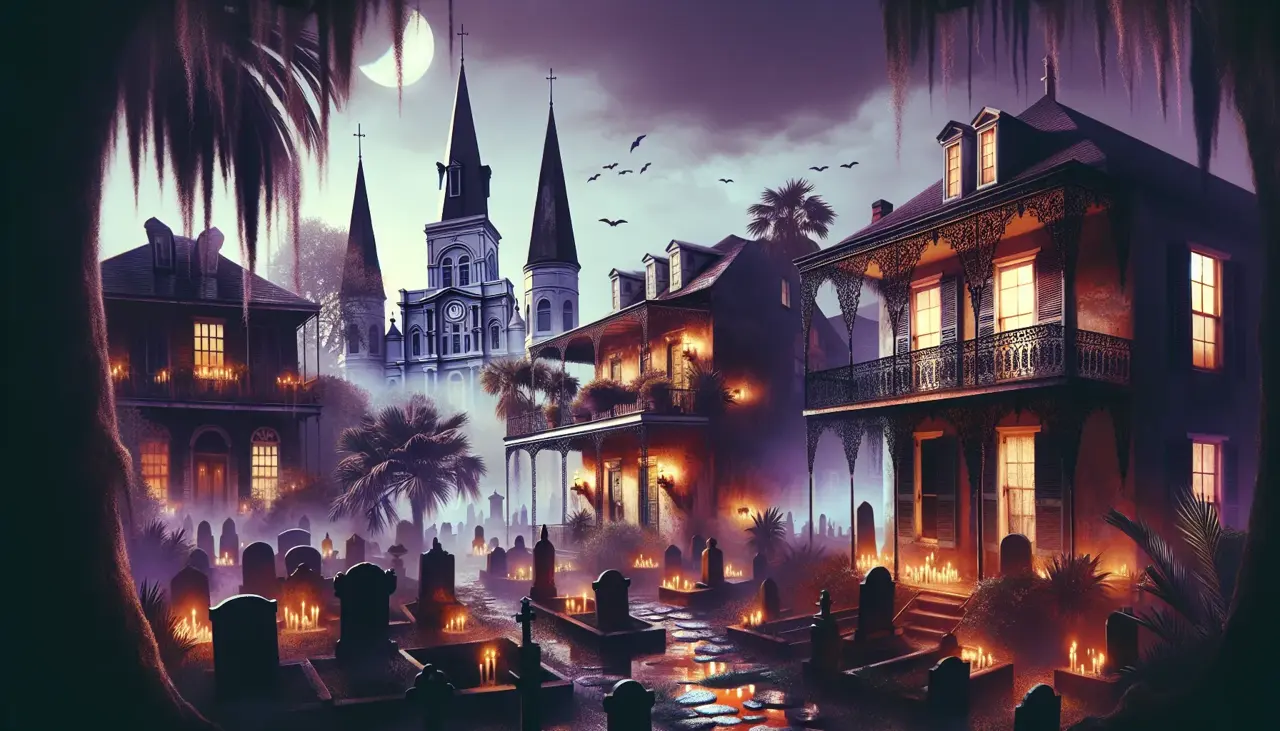
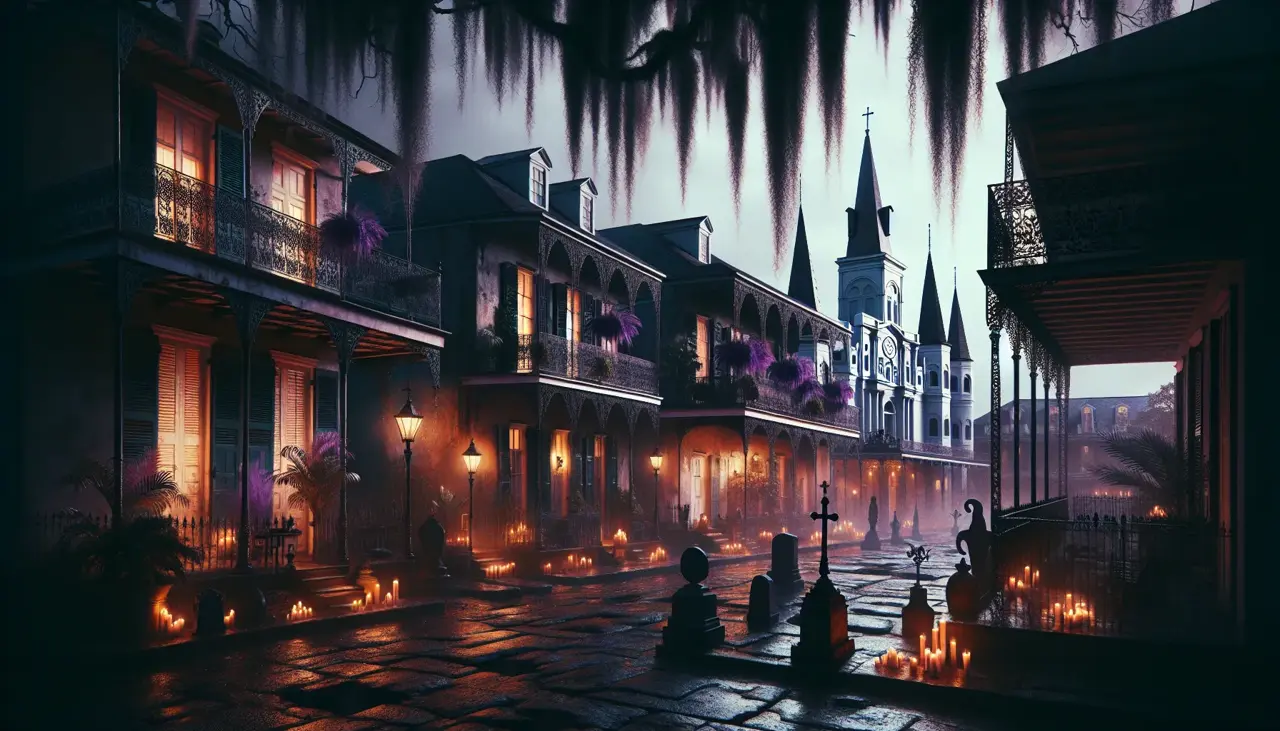
The French Quarter of New Orleans—the Vieux Carré—occupies roughly thirteen blocks by six blocks along a bend in the Mississippi River. Within this compact grid, nearly every building carries history that stretches back centuries. And within that history, death is a recurring character. Fire, disease, murder, slavery, war, and simple human cruelty have left their marks on the Quarter’s architecture and its stories.
The ghost stories of the French Quarter are not incidental to its character. They are an expression of it—a neighborhood so saturated with history that the past refuses to remain past. These stories are part of the broader haunted history of New Orleans, but the French Quarter concentrates them into an area you can walk in an afternoon.
The Fire That Made the Quarter
The French Quarter that stands today is largely not French. Two catastrophic fires devastated the Quarter: the first on March 21, 1788 and the second on December 8, 1794. These fires destroyed most of the original French colonial buildings, with the 1788 fire alone destroying approximately 856 buildings and killing at least 6 people. The Quarter was rebuilt under Spanish colonial rule, which is why its architecture features Spanish-style courtyards, wrought-iron balconies, and stuccoed brick rather than French timber construction. These fires killed dozens and left thousands homeless. They also created the architectural canvas on which two centuries of subsequent ghost stories would be painted. Buildings constructed in the aftermath of mass death carry that history in their foundations.
The Gardette-LePretre House: The Sultan’s Massacre
At 716 Dauphine Street stands the Gardette-LePretre House, a mansion carrying one of the Quarter’s most lurid legends. The story holds that during the early 1800s, a Turkish man—variously described as a sultan, a prince, or a wealthy impostor—rented the house and filled it with a harem, servants, and extravagant furnishings, allegedly for an extended stay lasting several months. Neighbors reported strange music, heavy incense, and curtained windows at all hours.
One morning, the story goes, blood was found seeping under the front door. Inside, everyone had been hacked to pieces. The sultan himself was discovered buried alive in the courtyard, his hand protruding from the earth.
Historical evidence for this story is slim to nonexistent. No contemporary newspaper accounts have been found confirming such a massacre. The legend likely grew from fragments of the house’s actual history—it was indeed rented to a foreign tenant at various points—amplified by decades of retelling.
Yet the house’s haunted reputation persists. Residents have reported the scent of incense, sounds of Middle Eastern music, and apparitions visible through upper-floor windows. The story endures because it encapsulates anxieties about the exotic, the foreign, and the violent that have always been part of New Orleans’ port-city identity.
The Andrew Jackson Hotel: The Orphan Fire
The Andrew Jackson Hotel on 919 Royal Street stands on the site of a former courthouse that served as an orphanage in the early 1800s. In 1794, during one of the Quarter’s catastrophic fires, flames swept through the building, killing approximately a dozen children trapped inside before aid could reach them. The orphanage was rebuilt and continued operating, but the memory of the dead children persisted.
Guests at the hotel—many of whom claim no prior knowledge of its history—have reported the sounds of children playing in hallways, small handprints appearing on mirrors, and the sensation of a child’s hand grasping theirs. Staff members have reported finding toys moved from their original positions and beds that appear to have been jumped on in vacant rooms.
The Old Absinthe House: Spirits of a Different Kind
The Old Absinthe House at 240 Bourbon Street has continuously served alcohol since 1807, making it one of the oldest continuously operating bars in the United States. Its notable historical patrons over the centuries reportedly included President Andrew Jackson, author Mark Twain, playwright Oscar Wilde, and President Franklin D. Roosevelt. The upstairs rooms, once used for private meetings and allegedly for pirate plotting, carry a reputation for paranormal activity.Reported phenomena include the apparition of a woman in Creole dress on the second floor, unexplained footsteps in empty rooms above the bar, and glasses that move or shatter without apparent cause. The building’s long history of serving as a meeting place for the powerful, the criminal, and the creative has given it a layered atmosphere that even skeptics find palpable.
The Haunted Pharmacy
The New Orleans Pharmacy Museum at 514 Chartres Street occupies the building where Louis Joseph Dufilho Jr. became America’s first officially licensed pharmacist in 1823, earning his pharmaceutical license from the State of Louisiana. The building’s haunted reputation, however, centers on a later occupant—a Dr. Dupas, who allegedly conducted experiments on enslaved people and patients, using them to test medicines and surgical techniques.
Visitors have reported a spectral figure in 19th-century medical attire, the sound of glass shattering in the courtyard where Dupas allegedly disposed of failed experiments, and a pervasive feeling of unease in the rear of the building. The museum itself displays the tools and medicines of 19th-century pharmacy, many of which—arsenic, mercury, opium—were as likely to kill as to cure.
Pirate’s Alley: Shadows Between Buildings
The narrow passageway running alongside St. Louis Cathedral, known as Pirate’s Alley, carries the name of Jean Lafitte (1780-1823), the legendary privateer and smuggler, and his associates, who allegedly conducted business in the shadows between the cathedral and the Cabildo during the early 19th century. Whether Lafitte actually frequented this specific alley is uncertain, but the association has persisted for nearly two centuries.
The alley is atmospheric at any hour but genuinely unsettling after dark. Shadows fall at unexpected angles. Sound behaves strangely between the narrow walls. Visitors have reported seeing figures that disappear when approached and hearing whispered conversations in empty stretches of the passage. William Faulkner wrote his first novel in an apartment above the alley, and one wonders how much the location contributed to his gothic sensibility.
The Ghosts of Royal Street
Royal Street, the French Quarter’s most elegant thoroughfare, carries ghost stories behind virtually every facade. Beyond the LaLaurie Mansion, the street harbors the Cornstalk Hotel (where a ghost in Civil War uniform patrols the upper gallery), the Court of Two Sisters (where two Creole sisters who ran a notions shop are said to haunt the courtyard), and numerous private residences with centuries-old reputations for disturbance.
The density of reported hauntings on Royal Street reflects its history as the center of Creole social life—and Creole death. The families who built these homes lived, died, celebrated, mourned, owned enslaved people, survived epidemics, and endured wars within their walls. The architecture absorbed it all.
Bourbon Street After Dark
Bourbon Street’s modern reputation as a neon-lit party zone obscures a darker history. Before it was a tourist attraction, Bourbon Street was a residential neighborhood that experienced the same fires, epidemics, and violence as the rest of the Quarter. Lafitte’s Blacksmith Shop Bar at 941 Bourbon is the street’s most famously haunted building, but it is far from the only one.
The former site of the Storyville red-light district, which operated from 1897 to 1917 on the Quarter’s edge, carries its own legacy of exploitation and death. Women who worked in Storyville’s brothels often died young—of disease, violence, addiction, or despair. Their stories are largely unrecorded, but their presence is felt in the area’s persistent reputation for unexplained phenomena.
Why the French Quarter Haunts
The French Quarter’s haunted reputation is not the product of imagination or marketing. It is the natural consequence of three centuries of intense human experience compressed into a few dozen blocks. People were born, enslaved, freed, married, murdered, burned, drowned, infected, and buried within walking distance of one another. The density of human experience is extraordinary.
Ghost tours of the French Quarter work as well as they do because the stories are tied to specific, visible locations. The buildings are still there. The streets have the same names. The architecture has changed less than in almost any other American neighborhood. Walking through the Quarter at night, with its gas lamps and narrow passages, it is easy to feel that the distance between past and present is thinner here than anywhere else.
For more on this topic, see New Orleans ghost tours.