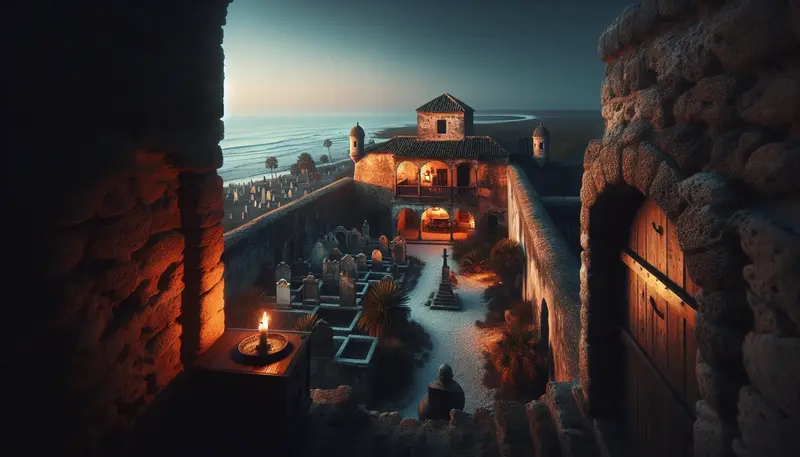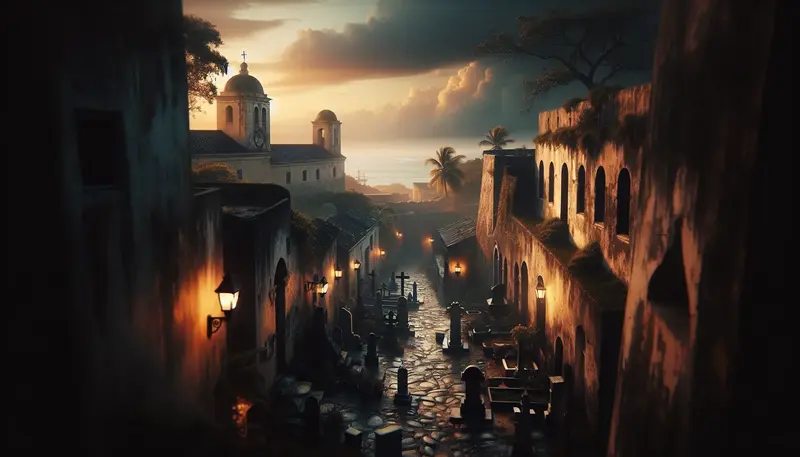

America's oldest city has been sacked, burned, besieged, and ravaged by disease more times than any other settlement on the continent.
This article is part of our comprehensive St. Augustine ghost tours guide. Whether you're planning a visit or researching from afar, these stories reveal a side of St. Augustine most visitors never see.
Founding Blood: 1565, Menéndez, and the Matanzas Massacre
Have you ever wondered how a city that markets itself as “the nation’s oldest” can also be one of its bloodiest? St. Augustine was founded on September 8, 1565, when Spanish admiral Pedro Menéndez de Avilés established a permanent settlement on the Matanzas Bay shore. Menéndez’s purpose was strategic — to secure Spain’s claims in La Florida — but his arrival precipitated an episode that still echoes in local memory.
Just weeks earlier, the French Huguenot expedition under Jean Ribault had established Fort Caroline near present-day Jacksonville. In a swift and brutal sequence in September 1565, Menéndez attacked Fort Caroline, then pursued shipwrecked French survivors along what the Spanish named Matanzas Inlet (“Massacre Inlet”). Contemporary Spanish accounts and later histories record that Menéndez ordered the execution of many captured Frenchmen; the site’s name persists as a stark reminder of that violence. Those events established a pattern: St. Augustine grew up as a fortified, contested port where power was maintained through force.
That combination of colonial ambition, warfare, and execution created a layered historical record — manifest in written documents, maps, and local oral histories. For historians and tour narrators alike, those records are the backbone of any account that also entertains reports of hauntings. When people speak of a St. Augustine ghost that seems to carry the weight of centuries, they are usually referencing a place shaped first by concrete acts like the Matanzas executions and the founding of a permanent Spanish settlement on a precise date: September 8, 1565.
Fortress and Siege: Castillo de San Marcos, Fort Mose, and 17th–18th Century Violence
St. Augustine’s military architecture is a direct response to the threats that followed the founding. Construction on the Castillo de San Marcos began in 1672 and continued intermittently through the late 17th century, using coquina stone quarried on nearby Anastasia Island. That fort at 1 S Castillo Dr was intended to protect Spain’s northernmost colonial outpost, and it repeatedly saw the face of war.
One notable crisis came in 1740 when General James Oglethorpe of Georgia launched a prolonged siege against St. Augustine. Oglethorpe blockaded the harbor and bombarded Spanish positions for weeks, but the Castillo’s coquina walls absorbed cannon fire in surprising ways, and the siege failed. The fort’s history also intersects with the story of Fort Mose, established in 1738 just north of the town as the first legally sanctioned free black settlement in what is now the United States. Fort Mose’s militia and its men of African descent were often caught in the crossfire between Spanish and British interests, most famously during skirmishes tied to the 1740 conflict.
Those conflicts left material traces — bullet marks on walls, records of prisoners and casualties, and human remains uncovered by archaeologists — and cultural traces in local folklore. Witnesses and visitors to the Castillo sometimes report hearing phantom footsteps on the parade ground or sensing movement near the old embrasures. Whether you are tracing the documented chronology (1672 construction start, 1740 siege by Oglethorpe) or listening to modern reports, the fort stands as a locus where documented violence gives rise to stories of lingering presences. For related history, see our castillo de san marcos: 350 years.
Pestilence at the Port: Disease, Quarantine, and 18th–19th Century Mortality
Ports are conduits for both goods and germs. For four centuries St. Augustine functioned as a working harbor connecting Europe, the Caribbean, and the Atlantic seaboard; with that commerce came repeated waves of infectious disease. Records from colonial and 19th‑century municipal registers document quarantines, shipping logs noting ill crewmen, and cemetery markers that tally the human cost.
Yellow fever, smallpox, and other epidemics swept through the region at various times in the 1700s and 1800s. The movement of troops, the arrival of enslaved Africans, and seasonal shipping patterns created predictable spikes in mortality. The transfer of Florida to the United States in 1821 (following the Adams–Onís Treaty signed in 1819 and implemented in 1821) shifted administrative responses, but the epidemiological realities remained harsh; contemporary papers and port authority records from the 19th century show recurrent quarantines and high death rates among transient sailors and laborers. During the Civil War years, coastal operations, occupations, and refugee flows further stressed public health.
When people report a St. Augustine haunted by disease — cold spots on hospital grounds, muffled cries near unmarked graves, or the sensation of being watched in old burial areas — those experiences intersect with material history. Archaeological excavations and municipal death rolls often confirm concentrated mortality in particular zones; those same zones later become focal points for ghost stories. The historical record of disease gives plausible context to many modern reports rather than demanding supernatural explanations.
Sites of Suffering: The González–Alvarez House, Old Jail, and Hospital Grounds
Certain addresses in town accumulate narratives because they are places where trauma repeatedly occurred. The González–Alvarez House (commonly called the “Oldest House”) at 14 St. George Street dates to the late 1600s and has seen Spanish, British, and American occupants. The structure’s long occupancy history — births, deaths, neglect, and restoration — creates the kind of palimpsest that fuels St. Augustine ghost lore.
Nearby, the Old Jail at 167 San Marco Ave (the 1891 masonry county jail now a museum) is another built environment where confinement, punishment, and death leave impressions. Visitors and staff routinely report footsteps pacing the galleries after hours, metallic clinks like keys, and sudden temperature drops in celled rooms. Those reports often coincide with archival records of inmates who died in custody or with documented incidents of violence inside the facility. The combination of physical evidence (structural modifications, original ironwork) and documentary traces (jail registers, sheriff’s reports) anchors the anecdotal experiences.
Hospital grounds and burial plots — municipal and church cemeteries — also generate encounters: flashes of movement among headstones, whispers in records rooms, and lights that do not correspond to any known source. These are not isolated to people seeking thrills. Scholars, archaeologists, and preservationists who catalog human remains and interpret mortuary practices report that respectful attention to the dead often stimulates personal experiences; what one visitor calls a “cold, watching presence” another interprets as grief lingering in space. That respectful skepticism — acknowledging what people report while testing claims with records — is the route that keeps historical inquiry honest. For related history, see our most haunted places in st. augustine:.
Lighthouse Lights and Maritime Tragedy: Children, Keepers, and Recorded Phenomena
The St. Augustine Lighthouse & Maritime Museum on Anastasia Island is one of the city’s best-known haunted claims. The tall tower that helped guide ships into the Matanzas Bay area also stands near treacherous shoals where sailors and passengers drowned. Maritime losses, combined with the hard, isolated life of keepers and their families, make lighthouses classic settings for reported paranormal activity.
Visitors to the lighthouse property commonly report children’s laughter near foundations where contemporary accounts record fatal accidents, sudden interferences with electronic devices inside keeper’s quarters, and shadowy figures on the stairwell. Investigators — both amateur and professional — have sometimes captured unexplained audio clips and temperature anomalies on the site; those findings are usually presented as suggestive rather than conclusive. Whether you read these accounts as evidence of a St. Augustine ghost population or as psychological responses to a dramatic environment depends on how you weigh testimony against controlled observation.
Maritime tragedies also extend to shipwrecks off the coast and to small boats lost in sudden storms. The combination of documented fatalities and the lighthouse’s public visibility has made it a focal point for modern paranormal teams and for people who come specifically to ask questions. The responsible approach is to respect both the historical record of loss and the personal nature of eyewitness reports: many who work or volunteer at the lighthouse will tell you about nights when the site felt charged, and some will report discrete incidents — lights moving against known patterns or voices recorded on nighttime audio — that remain unexplained after standard checks.
Separating History from Haunting: Evidence, Ethics, and What You Should Expect
If you’re trying to make sense of St. Augustine’s reputation as a St. Augustine ghost destination, start by treating every haunting claim as a hypothesis tied to a testable history. Documents — ship manifests, city council minutes, burial registers, and architectural plans — offer a foundation for assessing why a particular place produces particular reports. For example, if a house at 14 St. George Street has multiple recorded deaths in the 18th and 19th centuries, that fact provides necessary context for eyewitness accounts describing apparitions or cold spots.
At the same time, apply respectful skepticism. Personal testimony is valuable, but it is not proof in isolation. Photographs, audio recordings, and physical measurements that survive routine checks are worth noting; so are negative results that suggest suggestion or expectation effects. Ethical practice also matters: treating sites and their histories with reverence, consulting descendant communities, adhering to preservation rules, and avoiding sensationalist language keeps historical interpretation credible. Researchers should record who reported what, when, and under what conditions, and they should seek corroborating archival evidence where available.
St. Augustine’s long record of warfare, plague, slavery, maritime disaster, and colonial policy makes its streets fertile for stories — both well-documented and speculative. Whether you approach those stories as a skeptic, a believer, or something between, the best method is to let the documented past inform your interpretation of reported phenomena. In doing so you honor the facts and the people whose lives produced them, and you give every St. Augustine haunted claim the fair hearing it deserves.