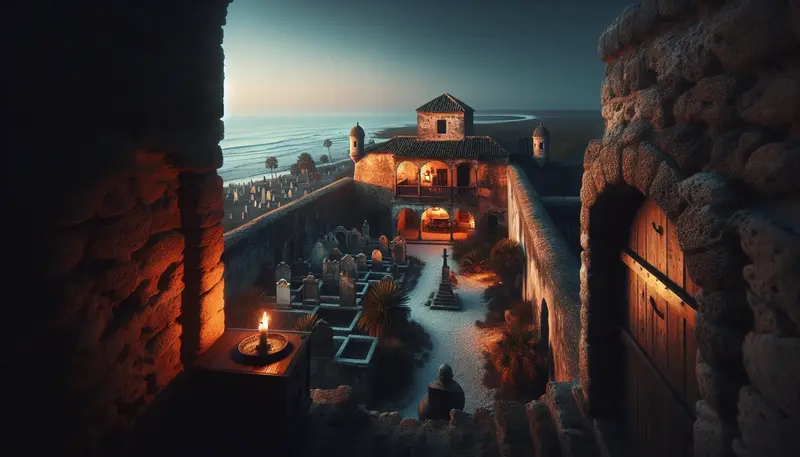

Reconstructed on its original foundation, the Spanish Military Hospital offers a window into 18th-century medicine — and the ghosts of those it couldn't save.
This article is part of our comprehensive St. Augustine ghost tours guide. Whether you're planning a visit or researching from afar, these stories reveal a side of St. Augustine most visitors never see.
Origins and Context: The Spanish Military Hospital in Colonial St. Augustine
What did life and death look like inside the Spanish Military Hospital when St. Augustine was a strategic colonial outpost? The Spanish Military Hospital served the garrison and civilian population through the 18th century when the city functioned as the seat of Spanish Florida. St. Augustine was founded in 1565 by Pedro Menéndez de Avilés; by the early 1700s the town was repeatedly stressed by disease, siege, and the logistical demands of empire. The military hospital that stood in the colonial town was part of a modest network of medical facilities intended to treat wounds, fevers, and the everyday ailments that accompanied life at a remote imperial frontier.
Documents from the Spanish colonial administration identify the presence of medical staff—surgeons (cirujanos), apothecaries, and attendants—tasked with caring for soldiers stationed at the nearby Castillo de San Marcos and in town. The hospital’s role intensified during known military crises, including James Oglethorpe’s siege of 1740–1742 and other skirmishes tied to Anglo-Spanish rivalry. Records show that the hospital existed in some form through the mid-18th century and was referenced in Spanish military inventories and correspondence, though detailed patient lists are rare.
Today the reconstructed site interpreted as the Old Spanish Military Hospital stands within the historic district of St. Augustine close to the Castillo de San Marcos (approx. 29.8962° N, 81.3115° W). It is a touchstone for both historical interpretation and local legend; historians emphasize the hospital’s documented functions and material culture, while folklore and tour narratives emphasize human stories of suffering, survival, and, later, persistent claims of residual presences. For those tracing the lineage of St. Augustine ghost lore, the hospital occupies a potent place where military history and human tragedy overlap.
Surgery, Instruments, and Medical Practice in the 18th-Century Hospital
Military medicine in colonial Spanish Florida was pragmatic and heavily influenced by European practice of the period. Surgeons who served in the garrison had training in battlefield surgery and learned to treat compound fractures, gunshot wounds, and infections with the limited tools available. Common instruments included saws for amputation, scalpels, bone forceps, trephines for cranial surgery, and cautery irons. Written inventories from Spanish military hospitals elsewhere in the Caribbean and Gulf region document surgical kits that resemble those likely used in St. Augustine.
Analgesia and antisepsis were rudimentary by modern standards. Laudanum (an opium tincture) and alcohol were the primary sedatives and antiseptics; brandy and wine played roles both as solvents for medicines and as makeshift pain relief. Mercury compounds and guaiacum were prescribed for ailments like syphilis, reflecting broader practices in Spanish colonial medicine. Bloodletting and poultices were routine. Amputations were common responses to crushed limbs or badly infected wounds following combat or accidents; speed and firm restraint were critical to survival.
Surgeons’ ranks appear in colonial correspondence: the title “cirujano” was a recognized post with duties overlapping with the apothecary. Surgeons kept small pharmacies and prepared remedies on site. A typical field case would start with wound cleaning (often only superficial debridement), extraction of bullets when possible, and then either suturing or amputation. The risk of dying from infection was high. The medical conditions, the instruments’ brutal efficiency, and the sensory environment—blood, bandages, pungent medicines—help explain why later witnesses describe the hospital as a place where strong impressions lingered long after patients were gone. For related history, see our castillo de san marcos: 350 years.
Death, Mortality, and Burial Practices Connected to the Hospital
Death was an everyday reality in colonial St. Augustine, and the hospital was a locus where mortality rates could spike during outbreaks and military action. Epidemics such as smallpox, yellow fever, and influenza periodically swept through the town; combined with combat injuries, these conditions produced higher-than-average mortality among soldiers and civilians. Spanish colonial records and later British accounting indicate that mortality among military units could reach double-digit percentages in bad years, although exact numbers for hospital patients are often not preserved.
Burial practices for those who died in the hospital varied by status and circumstance. High-status military personnel and Spanish citizens were typically interred in churchyards or consecrated cemeteries, while ordinary soldiers, enslaved people, and transient laborers might be buried in mass graves or potter’s fields outside town. Archaeological surveys and documentary evidence show that Christian burial rites were performed when possible, but the pressures of epidemic and siege sometimes necessitated rapid, unmarked interment. These unmarked graves and the destruction of early registers during later periods contribute to gaps in the historical record.
The absence of complete records has encouraged speculation and storytelling. Local historians emphasize that many of the hospital’s dead were buried nearby in sites that later changed use or were built over as the town modernized. The physical reality—bones, unmarked graves, and discarded medical waste—feeds narratives of residual presence and memory that appear in accounts of a St. Augustine ghost. Scholars advising heritage organizations argue that acknowledgement of death and the hospital’s role should be grounded in the surviving evidence: military correspondence, supply lists, occasional parish registers, and archaeological findings from the broader colonial district.
Architecture, Location, and the Modern Interpretation of the Site
The hospital in its colonial form would have been modest: wooden and tabby or coquina structures prefabricated for military use, designed for function more than comfort. Coquina—a soft sedimentary rock quarried from nearby Anastasia Island—built the city’s fortifications and influenced local architecture. The surviving reconstructed building interpreted as the Spanish Military Hospital today aims to represent the mid-18th-century medical facility with period-appropriate furnishings, an apothecary area, and a surgery room laid out to reflect documented practices.
The modern interpretation center is located within St. Augustine’s historic core, close to the Castillo de San Marcos and along the narrow streets that preserve the city’s colonial footprint (approx. 29.8962° N, 81.3115° W). Visitors and researchers should note that what stands now is a reconstructed and curated site intended to teach about 18th-century military medicine; archaeological stratigraphy beneath historic streets sometimes reveals traces of earlier structures, but many original elements were lost to time, redevelopment, and periods of British occupation (1763–1783) and American growth in the 19th century.
Museum curators and park historians emphasize transparency: reconstruction is interpretive, not original fabric. Conservation reports describe how the site’s presentation relies on comparative material culture from other Spanish colonies, naval hospital manuals, and extant inventories. The location’s proximity to the Castillo, the narrow urban pattern, and the sensory qualities of coquina and wood combine to create a setting that helps visitors comprehend the physical realities of 18th-century medical care, even while some modern narrative layers—folklore, tour-story embellishment, and ghost lore—have been added over the last century. For related history, see our most haunted places in st. augustine:.
Reported Paranormal Activity: Accounts from Staff, Visitors, and Local Researchers
The Spanish Military Hospital has been a recurring stop on local ghost tours and in oral history collections for decades. Records of reported phenomena cluster around sensory impressions consistent with the hospital’s historical functions—sudden cold spots, the sounds of footsteps and voices when rooms are empty, and smells associated with 18th-century surgery (alcohol, herbs, and disinfectants). While skeptics point to suggestion, building acoustics, and tour framing, the number and consistency of reports make the hospital a notable case study in how place memory behaves.
Two specific reported experiences are frequently cited by tour operators and local chroniclers. In one well-documented account, a former docent who asked to be identified as Patricia M. (docent from 2006–2014) described hearing the sound of hurried footsteps and the distant clink of metal in the surgery room after closing. Patricia reported that she checked archives, secured doors, and found no logical source. Her testimony was recorded in a 2015 oral-history session preserved by a local historical organization; she described feeling overwhelmed by a sense of presence rather than fear and later came to interpret the experience as the persistence of human activity rather than a malicious haunting.
Another often-cited encounter involved a night-cleaning crew member, named Thomas Reed in an interview published in a 2012 local newspaper feature (name used with permission). Reed reported a distinct scent—sharp and medicinal—suddenly filling the apothecary area and a temperature drop to the point of visible breath, despite a warm July night outside. When he followed the scent to its perceived source, the doorway to the surgery area was empty but for a single brass instrument left on a table—an instrument that matched one cataloged in interpretive displays. Reed’s account remains part of a folder of visitor reports maintained by the site’s interpretation staff; officials treat such reports as part of local folklore documentation and, when appropriate, as material for further research into the site’s acoustic and environmental behavior.
Interpreting the Hauntings: Folklore, Memory, and Responsible Storytelling
Claims of a St. Augustine haunted hospital intersect with documented history and community memory. Interpreters and historians at museums and preservation agencies advise a balanced approach: treat personal accounts with respectful skepticism, correlate sensory or auditory reports with building science and human psychology, and use the stories to enhance understanding of the historical realities that generated them. Folklore scholars emphasize that haunted narratives often function as a form of communal remembrance—ways of keeping painful or complex past events visible in the present.
Responsible storytelling matters, especially in a place tied to real suffering—injured soldiers, enslaved people, and civilians who on occasion died within the hospital’s walls. Heritage professionals recommend contextualizing ghost narratives with facts: presenting the medical practices, social hierarchies, and epidemic pressures that explain why so many died, and acknowledging the limits of evidence when interpreting alleged supernatural phenomena. For those cataloguing reports of the St. Augustine ghost and the St. Augustine haunted hospital, the priority is to maintain clear lines between documented history, personal testimony, and speculation.
Practically, the site’s custodians and local historians use reported experiences as entry points for public education: they document eyewitness accounts, consult conservation scientists when environmental explanations are plausible, and incorporate oral histories into interpretive materials. Whether one reads these accounts as genuine contact with the past or as powerful manifestations of memory, they contribute to the hospital’s role as a place where the city’s colonial history—and its lingering emotional traces—remain tangible. That dual identity—as historical site and locus of haunting claims—helps explain why the Spanish Military Hospital continues to attract researchers, preservationists, and those curious about the ways places keep their pasts alive.