Beneath Rome lie over 40 catacombs containing an estimated 750,000 burials. Only a fraction have been explored — and some sections remain sealed.
This article is part of our comprehensive Rome ghost tours guide. Whether you're planning a visit or researching from afar, these stories reveal a side of Rome most visitors never see.
A Subterranean Question
?What makes the Roman catacombs more than just underground cemeteries and why do they still draw stories of the uncanny?
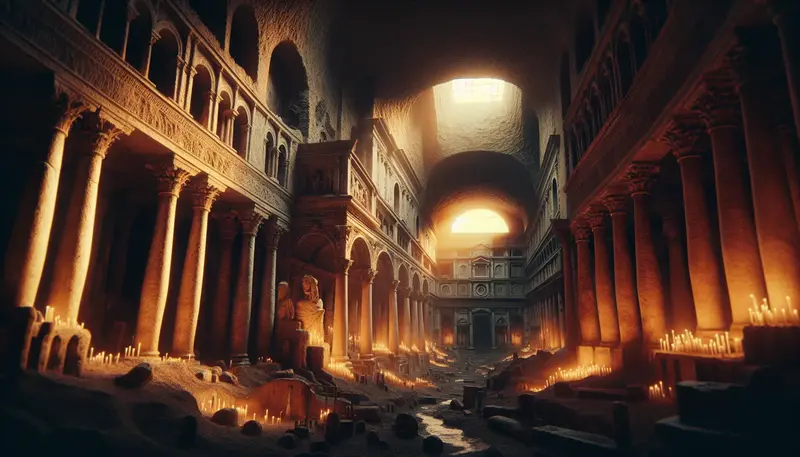
The catacombs of Rome are a complex, branching network of galleries, chambers, and niches that began as ordinary burial places and became repositories of ritual, art, and memory from the 2nd through the 5th centuries CE. Scholars point to the law and custom of extramural burial in ancient Rome—burials were normally kept outside the city walls—and to the dense Christian and Jewish communities that turned these underground corridors into long-term necropolises. Antonio Bosio (1575–1629), often called the “Columbus of the Catacombs,” cataloged many galleries and launched the modern study of these spaces. The result is a subterranean landscape that can legitimately be described as “miles of the dead,” a phrase that captures both the literal length of the passageways and the layered human histories they contain.
Origins and span
Construction began in the 2nd century CE as family tombs and communal galleries; use continued in many places into the 5th century. While estimates vary, Rome’s catacomb systems include dozens of principal sites—San Callisto, San Sebastiano, Domitilla, Priscilla among them—linked by hundreds of tunnels and side chambers. Their spread along roads like the Via Appia Antica and Via Salaria reflects patterns of suburban cemetery development outside the ancient city.
How history and legend intertwine
Because they held early Christian art, relics, and martyr narratives, catacombs became fertile ground for later legend. Documented archaeological facts—inscriptions, frescoes, funerary inscriptions—sit beside centuries of stories: miracle accounts, pilgrim testimonies, and more recent paranormal reports. The interplay of firm record and folklore is one reason the galleries remain such compelling places for historians and ghost-story collectors alike.
Major Catacombs and Exact Locations
The best-known Roman catacombs are concentrated on the Appian Way and in the southern suburbs, where surviving entrances and visitor routes make direct encounters possible.
Key sites and addresses
Precise locations help ground interpretation and visiting. Below is a concise table of principal, accessible catacombs, their addresses, and a short note on what makes each significant.
| Catacomb | Address / Location | Notable features |
|---|---|---|
| San Callisto | Via Appia Antica, 110–126 | Large 3rd–4th century Christian cemeteries, papal crypts, frescoes; central to many martyr legends. |
| San Sebastiano | Via Appia Antica, 136 | Associated with St. Sebastian and earlier Roman mausolea; mixes pagan and Christian layers. |
| Domitilla | Via delle Sette Chiese, 282 | Known for long, well-preserved galleries and early Christian fresco cycles. |
| Priscilla | Via Salaria, 430 | Called the “Queen of the Catacombs” for its rich iconography, including early Marian images. |
How the sites differ
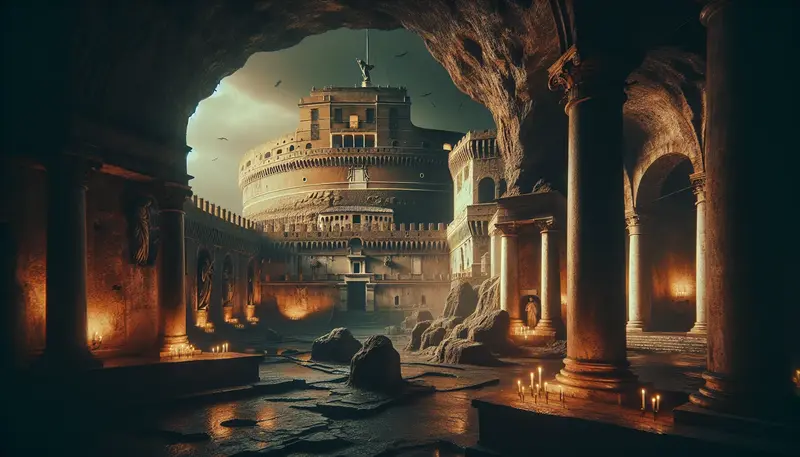
San Callisto and Domitilla are comparatively vast and have been the focus of conservation and tourist access; Priscilla is prized for its art; San Sebastiano for its layered burial history. Many smaller or sealed catacombs exist beyond these, often accessible only to researchers with permits from the Soprintendenza Speciale Archeologia, Belle Arti e Paesaggio di Roma. For related history, see our castel sant'angelo: rome's fortress of ghosts.
Burial Practices, Art, and Archaeology
Understanding the catacombs’ physical features is crucial to interpreting what people experience there. The galleries are functional funerary architectures with loculi (slot graves), arcosolia (arched recesses), and cubicula (small chambers) used for family burials and memorial rites.
Material culture and inscriptions
Archaeologists rely on inscriptions, pottery, oil lamps, graffiti, and fresco styles to date chambers and identify communities. Funerary inscriptions provide names, ages, and occasional professions; iconography—symbolic fish, peacocks, and early Christograms—illustrates belief and identity. Many of these details were carefully recorded by 18th- and 19th-century antiquarians and later systematically studied by scholars in the 20th century.
Conservation and scientific work
Modern conservation uses controlled lighting, humidity monitoring, and restricted public access to slow deterioration of pigments and plaster. Excavations conducted under licensed supervision have yielded bone assemblages, glassware fragments, and lamps that help reconstruct funerary rituals. Radiocarbon dating and paleopathological analysis occasionally provide new chronological and social information; however, intrusive sampling is tightly regulated to preserve integrity.
Folklore, Legends, and Reported Paranormal Experiences
Catacombs have accumulated stories: martyrdom accounts, pilgrim miracles, and contemporary reports of anomalous sights and sounds. Those tales are part of the sites’ cultural record and should be reported with the distinction between testimony and proven fact.
Documented local reports
One oft-cited modern account comes from the Catacombs of San Callisto (Via Appia Antica, 110–126). In 1979, local guide Marco Rossi reported to a Rome-based newspaper that visitors had seen small, steady lights moving along a corridor that produced no shadow on the walls; Rossi emphasized that the lights corresponded to no known torch or lamp and that several independent visitors described the same phenomenon. Rossi’s reports were recorded as eyewitness testimony; investigators suggested explanations including reflections, bioluminescent fungi on damp surfaces, or optical illusions in low light. For related history, see our most haunted places in rome.
Another unsettling testimony
At the Catacombs of Domitilla (Via delle Sette Chiese, 282), guide Laura Conti reported in 1998 that a group of visitors heard a child’s laughter and felt a sudden and localized drop in temperature in the Cubiculum of the Children—an effect several members of the group described concurrently. Conti, who had worked in the catacombs for years, insisted that the sound was not wind or traffic. Skeptical investigators later noted the site's complex acoustics and subterranean drafts that can focus sound and cause abrupt thermal shifts, but Conti’s testimony remains part of the site’s oral record.
Access, Preservation, and Responsible Visiting
Legal and conservation frameworks shape how people encounter these places today. Most large catacombs are managed by ecclesiastical authorities in partnership with Italy’s Ministry of Culture; entry rules, hours, and photography restrictions vary by site.
Practical visiting information
Those who intend to visit should check official hours and rules. San Callisto and San Sebastiano on the Via Appia Antica normally offer guided tours that limit time underground, while Domitilla and Priscilla also open for scheduled visits. Unsupervised entry into sealed galleries is illegal and dangerous: tunnels can collapse, humidity can cause disorientation, and old ventilation is poor. The Soprintendenza requires permits for research access. Visitors who photograph must follow posted rules to avoid damaging sensitive pigments and to respect the sacral nature of many spaces.
Conservation priorities
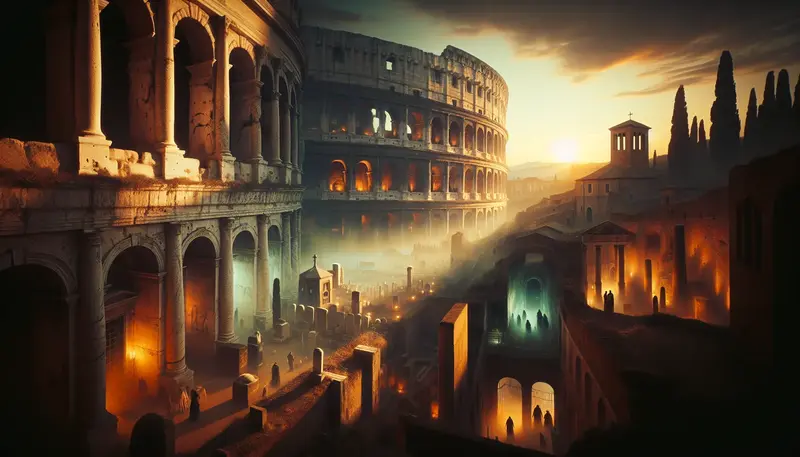
Preservation teams focus on controlling humidity, stabilizing plaster, and limiting foot traffic. Restorations led by conservators in collaboration with the Vatican and state agencies have saved frescoes and epigraphic panels, but every human presence alters microclimates. Responsible visitation—keeping to defined paths, avoiding flash photography where prohibited, and following curator guidance—helps ensure these places survive for future study and memory. For related history, see our the colosseum's ghosts: gladiators, martyrs, and.
Interpreting Experiences: Skepticism, Explanation, and the Lasting Allure
The catacombs provoke strong reactions: awe, sorrow, curiosity — and occasionally reports of apparitions or inexplicable phenomena. Interpreting those experiences requires a careful weighing of natural explanations and the human tendency to read meaning into ambiguous sensations.
Natural causes for uncanny impressions
Many reported phenomena have plausible natural causes. Acoustics in narrow tunnels can create echoes and apparent voices; temperature gradients produce localized chills as cool air pools; electromagnetic anomalies from old wiring or metal artifacts may affect instruments and, some claim, subjective sensations. Visual effects—afterimages, pareidolia (seeing faces or figures in random patterns), and the brain’s pattern-seeking in dim light—can create convincing perceptions of presence where none objectively exists.
Why stories persist
Beyond immediate explanations, narratives of the dead and of miraculous events have long served communities as modes of memory-making. Reports such as an English tourist’s 2012 account of a pale figure seen briefly near an arcosolium in San Sebastiano (reported to a guide and later to a travel forum) or Marco Rossi’s and Laura Conti’s testimonies add modern layers to a centuries-old palimpsest of belief and fear. Whether readers are seeking hard evidence or meaningful stories, these accounts help keep the catacombs alive in public imagination—part archaeological site, part atmospheric locus for the and traditions.