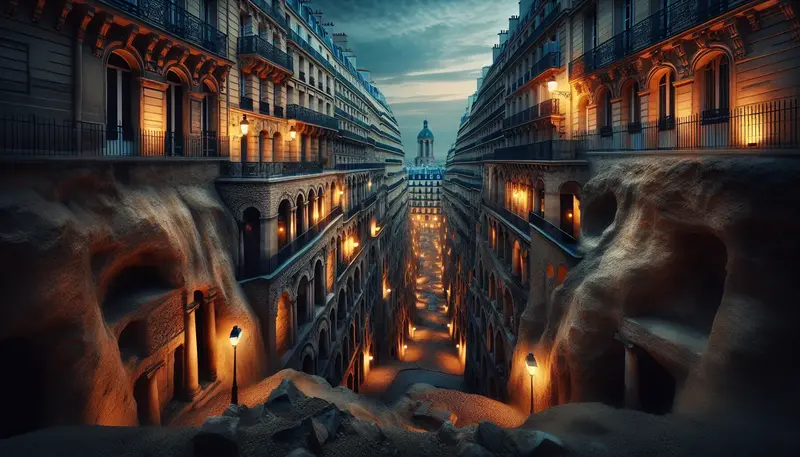
In the 1780s, Paris moved six million skeletons from overflowing cemeteries into abandoned quarries. The result is the world's largest ossuary.
This article is part of our comprehensive Paris ghost tours guide. Whether you're planning a visit or researching from afar, these stories reveal a side of Paris most visitors never see.
History Beneath the Streets
Have visitors ever wondered how six million human remains came to rest beneath Paris? The simple answer threads through urban planning, public health crises, and the development of an underground network that predates modern Paris.
The underground quarries that would become the Catacombs were first systematically inspected under Charles-Axel Guillaumot, appointed inspector of quarries in 1777. Guillaumot (1730–1807) mapped and stabilized miles of former limestone mines to prevent collapses on the surface. By the late 18th century the city faced a separate, grimmer problem: overflowing cemeteries. The medieval cemetery of the Saints-Innocents, in the 1st arrondissement near Rue Saint-Denis, had been in continuous use for centuries and by the 1780s its pits and mass graves were creating sanitation problems.
Beginning in 1786, municipal authorities authorized transfers of human remains from crowded cemeteries into the stabilized quarry galleries outside the city center. Work continued in fits and starts over the following decades; the major program of transfer is generally dated from 1786 through about 1814. Bones were moved at night, accompanied by priests and liturgical prayers, and reassembled in the quarries that were progressively relabeled “ossuaire municipal.” The public-facing ossuary was arranged and given a more formal layout in the first decades of the 19th century. The site that most visitors know today—an ossuary accessible from Place Denfert-Rochereau at 1 Avenue du Colonel Henri Rol-Tanguy (75014 Paris)—was prepared and opened to visitors in 1809.
Over time the Catacombs gained layers of meaning: practical solution, macabre curiosity, Romantic tourist attraction and, for some, a shrine. The notion that “six million” dead are arranged in the subterranean galleries has been repeated in guidebooks and newspapers for generations. In literal terms, that figure is an estimate rather than an exact register; nevertheless it conveys the scale of the ossuary. The history of the Catacombs ties municipal engineering and health policy to cultural memory, and it explains why the bones under Paris were not hidden so much as institutionalized.
Anatomy of the Quarries and Ossuary
The Catacombs are a palimpsest of older industry and later municipal reuse—ancient quarries of Lutetian limestone overlaid with corridors, chambers and memorial inscriptions. The network of abandoned quarries beneath Paris runs for roughly 300 kilometers (about 186 miles) according to surveys, but only a small portion—approximately 1.7 kilometers—constitutes the official, public route of the Musée des Catacombes. Most of the rest is off-limits and maintained by the city’s Service de l’Inspection Générale des Carrières.
Visitors entering at the official access point at Place Denfert-Rochereau (1 Avenue du Colonel Henri Rol-Tanguy) descend about 20 meters (65 feet) below street level. The public route winds through narrow corridors lined with skulls and femurs, passing plaques that explain origins and carry inscriptions such as “Arrête! C’est ici l’empire de la mort” (Stop! This is the empire of the dead)—a famous 19th-century warning placed at the ossuary’s threshold.
Structurally, the quarries are made up of rooms carved for stone extraction and later reinforced with pillars. Some chambers were repurposed or reinforced when skulls were stacked into decorative patterns and when the Musée reworked presentation and access in the 19th and 20th centuries. Modern visitors move through galleries that balance conservation with safety: dim lighting, footpaths, low ceilings in places, and carefully monitored temperature and humidity to preserve both stone and bones.
Beyond the official route lie mapped-but-closed galleries that connect to other arrondissements, municipal utilities, and historical points under Paris. Unauthorized access—commonly attempted by cataphiles who traffic in urban exploration—can lead into unmapped voids, flooded sections, and unstable areas. For those researching or reading about the site, the distinction between the curated ossuary and the broader quarry system is essential to understanding both the physical risks and the cultural meanings layered beneath the City of Light.
Why the Bones Were Moved: Public Health and Politics
The decision to transfer millions of skeletal remains into the quarries was driven largely by public health concerns, property pressures and political urgency. By the mid-18th century, Parisian cemeteries such as the Saints-Innocents—located near what became the Halles and Les Halles markets—had been in constant use for centuries. Decomposition, overflowing graves and contamination of nearby wells and cellars prompted medical and municipal alarm.
Episodes in the 1750s–1780s highlighted the problem: subterranean cavities and decomposing matter occasionally released foul odors and substances into surrounding buildings, and outbreaks of disease were increasingly linked in public discourse to the state of urban burial spaces. The Parlement of Paris and city officials pushed for reforms. Inspector of Quarries Charles-Axel Guillaumot’s stabilization work made it physically possible to reuse underground space, while municipal ordinances provided the legal mechanism for exhumation and reinterment. Transfers were carried out at night to limit public disturbance; clergy accompanied many of the processions to preserve religious rites.
Between 1786 and the Restoration, bones from a number of parish cemeteries were moved into the newly consecrated ossuary. The transfers were sometimes theatrical. Contemporary reports describe solemn processions, torches and liturgy; municipal ledgers record dates, origins and the shifting management of the subterranean site. The Napoleonic era and 19th-century prefectures then codified the Catacombs’ status as a controlled municipal ossuary, and in 1809 parts of the galleries were officially arranged for occasional visitor access.
The politics of this project touched property owners, parish authorities and the urban poor. Cemeteries were closed and repurposed, often with expropriation and compensation debates. In short, the Catacombs are not merely a curiosity; they are the product of deliberate municipal action to deal with the legacies of urban growth and to redesign burial practice in a modernizing capital.
Lives and Symbols: Who's in the Catacombs
Remarkably, the ossuary is not a series of individually marked or documented graves. Bones from multiple cemeteries were moved en masse and arranged in symbolic displays rather than returned to identifiable family plots. As a result, the Catacombs represent a social cross-section of pre-19th-century Paris—poor parishioners, plague victims, and residents whose families lacked the means or will to maintain private tombs.
Some of the skulls and bones show traces of trauma or disease that allow paleopathological readings: healed fractures, dental work, and signs of nutritional stress. These physical clues help historians piece together the life conditions of earlier Parisians. Yet the presentation—the walls of femurs, the pilasters of skulls, the carefully placed inscriptions—turns anonymous remains into a didactic tableau about mortality and municipal order.
Certain elements within the Catacombs carry symbolic weight. The warning plaque at the ossuary entrance, for instance, frames what follows as moral and existential instruction. Decorative motifs—occasional arrangements into crosses or patterns—were often set up during the 1809 arrangement and later refinements. Visitors must remember that the arrangement was intentional: it was meant to be both respectful and instructive, a municipal memorial as much as a storage site.
Because remains were relocated from distinct parish cemeteries, genealogical identification is essentially impossible for most interred souls. The six million figure—an estimate based on contemporary transfer records and cemetery capacities—stands as a collective memorial rather than a ledger of named individuals. For historians and conservators, the Catacombs raise ethical and methodological questions about how to treat anonymous remains that have become a public site, a topic that continues to shape conservation policies today. For a broader survey, see our guide to Paris’s most haunted places.
Ghost Stories, Witnesses, and Reported Phenomena
The Catacombs’ atmosphere—tight galleries, echoing chambers, and walls of skulls—naturally generates anecdotes about apparitions and uncanny sensations. Reports are treated differently depending on source: tour guides may pass along local lore, informal urban explorers sometimes claim dramatic encounters, and a few long-term workers have given testimony of experiences that they themselves regard as unexplained. The tone here is one of respectful skepticism: these are reported phenomena, not validated evidence of the supernatural.
One widely circulated account comes from Marie Simon, a university student who in 1997 was in a small group permitted to photograph near the official entrance at Place Denfert-Rochereau (1 Avenue du Colonel Henri Rol-Tanguy). Simon later told local guides that during a late-evening visit she heard what she described as distant, choir-like singing and then saw, for a matter of seconds, a pale figure moving at the edge of her headlamp beam. Her report appears in several contemporary guidebook notes; museum staff who spoke with Simon treated the episode as anecdotal and noted that acoustics in low corridors can produce auditory illusions.
A second account comes from Lucien Bernard, who worked intermittently as a maintenance contractor for the Musée des Catacombes in 2008. Bernard reported a persistent coldness and the sensation of being watched in a side gallery while performing conservation work; he also described hearing footsteps behind him when no one else was logged into the site. Bernard’s testimony was recorded informally by a union representative; museum administration logged the incident as “unexplained sensations” and emphasized that electrical and ventilation issues can create drafts, temperature differentials and sounds that the ear interprets as human presence.
Cataphiles—the underground explorers who access off-limits galleries—often repeat stories of shadowy figures, phantom lights, or dreams of former residents. Psychologists and sensory researchers note how darkness, claustrophobia, low-frequency sound and high emotional expectation can conjure convincing subjective experiences. In short, accounts like Marie Simon’s and Lucien Bernard’s matter because they are sincere reports, but they remain anecdotal. They contribute to the Catacombs’ reputation as a Paris ghost and Paris haunted site without providing proof of the paranormal. Above ground, Père Lachaise Cemetery’s famous graves and ghost stories add another layer to the city’s spectral reputation.
Visiting, Trespass, and Conservation
The Musée des Catacombes offers the only lawful, curated experience of the ossuary. The official entrance at 1 Avenue du Colonel Henri Rol-Tanguy leads down to the municipal ossuary and a carefully managed public route; conservation policies restrict photography with flash in some areas, and capacity controls limit how many can descend at once. The museum emphasizes historical interpretation, artifact preservation and the respectful treatment of human remains.
Outside of the museum, the subterranean quarry network is a magnet for illegal entry. Cataphiles—urban explorers who navigate closed sections—occasionally install underground studios, cafés or galleries. These activities are dangerous and illegal. Paris police periodically conduct operations to close unauthorized entrances and to arrest or fine trespassers. Past incidents have ranged from simple fines to serious rescues; flooding, hypoxia, and collapse hazards are real risks in unmapped galleries.
Conservation is ongoing: city engineers and the Service de l’Inspection Générale des Carrières monitor geological stability, while museum curators work on humidity, lighting and bone conservation. Academic researchers periodically study the ossuary for osteological, environmental and historical data. For those interested in the Catacombs as cultural heritage, the key messages are clear—respect the site’s legal boundaries, understand the risks of unauthorized entry, and approach accounts of hauntings with curiosity and critical thinking. The revolutionary-era guillotine sites across Paris carry a similarly charged atmosphere.
Whether treated as a municipal ossuary, a macabre museum, or a locus of urban legend, the Catacombs remain a compelling subterranean record of Paris. They prompt questions about mortality, memory and municipal responsibility, and they continue to attract attention—both rational and uncanny—as a Paris ghost and Paris haunted landmark that sits quietly beneath the city’s streets.