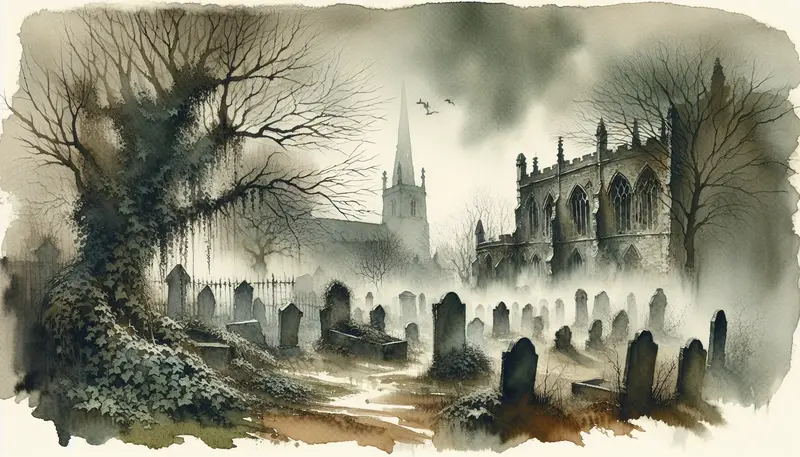
The Great Plague of 1665-1666 killed approximately 100,000 Londoners (roughly 20% of the city's population of 460,000). Many were buried in mass graves and plague pits that now lie beneath parks, London Underground stations, and office buildings across the City of London and Southwark.
This article is part of our comprehensive London ghost tours guide. Whether you're planning a visit or researching from afar, these stories reveal a side of London most visitors never see.
The Scale of Death: Where London's Plague Pits Are
The story of London’s plague pits begins with staggering numbers. The Black Death of 1348–1350 killed an estimated one third of England’s population, and London’s medieval burial grounds filled quickly. When the Great Plague of 1665 struck, parish registers, bills of mortality, and contemporary accounts show weekly death tolls in the thousands. You’ll find the physical evidence of those catastrophes in pockets around the City and Southwark: East Smithfield, areas around Whitechapel, parts of Southwark near Redcross Way, and scattered pits beneath streets in the City of London where medieval boundaries concentrated burials.
Key known and likely locations include the East Smithfield Black Death cemetery (established 1348–49 near what is now the eastern edge of the City close to St Katharine Docks and the Tower of London), the Crossbones unconsecrated burial ground in Southwark (off Redcross Way, near Union Street, SE1), and multiple parish-level mass graves used during the 1665 epidemic in parishes such as St Giles Cripplegate and St Mary’s Whitechapel. In many cases the precise boundaries are blurred: later building works, street realignments, and Victorian redevelopment overlaid the older pits. You will often be standing above graves while traversing alleys, markets, and building sites.
Important dates and places
These milestones help you place the pits:
-
1348–1350: Black Death primary cemetery at East Smithfield (near the Tower of London / St Katharine’s area).
-
1665–1666: Great Plague mass graves in multiple parishes across the City of London and Middlesex; many small pits rather than one single necropolis.
-
Medieval–19th century: Crossbones, Southwark: active as an unconsecrated burial ground for paupers and sex workers for centuries, intensifying in periods of epidemic death.
When you read modern accounts of London as a "haunted" city, remember that many hauntings are reported precisely at places where the dead were hurriedly interred: a fact that connects folklore to physical history. References to the "London ghost" often point visitors towards this less-visible urban archaeology.
Archaeology and Finds: What Excavations Tell You
The archaeological record has changed how you understand plague pits. Excavations conducted by university teams and professional units such as Museum of London Archaeology (MOLA) have exposed mass graves, skeletal assemblages, and burial patterns that corroborate documentary sources and enrich the story with biological detail. The bones tell a demographic story: who died, how quickly, and sometimes even what they died from.
Recent osteoarchaeological work has focused on East Smithfield’s medieval cemetery and on numerous Victorian- and Georgian-era burial grounds disturbed by redevelopment. Radiocarbon dating (particularly accelerator mass spectrometry dating from the 1990s onward), stratigraphy, and ancient DNA analysis (aDNA) have definitively demonstrated that Yersinia pestis—the gram-negative bacterium associated with plague transmission via fleas—was present in Black Death burials at East Smithfield and other 14th-century plague cemeteries. Studies published between 2004 and 2020 by researchers at McMaster University and other institutions have sequenced DNA from over 200 plague victims. These scientific results anchor the folklore you may hear on the street: the dead really are there, and in measurable numbers. For related history, see our haunted pubs of london: where history.
Table: Select archaeological discoveries
| Year of excavation | Site (modern location) | Notable finds |
|---|---|---|
| 1980s–2010s | East Smithfield (near Tower of London / St Katharine Docks) | Large medieval cemetery; aDNA indicating Y. pestis; demographic patterns consistent with epidemic mortality |
| 1990s–2000s | Crossrail works / Whitechapel vicinity | Discrete burial pits, skeletal remains from various periods; evidence of hurried interment |
| 2000s–2010s | Southwark (Redcross Way / Crossbones Garden) | Unconsecrated burial layers, artefacts associated with marginalized populations |
When you visit an exhibit or read an academic paper, you’ll see how scientists combine osteology, isotopic analysis, and historical records. For example, carbon and nitrogen isotope work can indicate whether victims were recent migrants or local residents prior to death. That matters when you consider the social geography of plague pits: some reflected local parish deaths, others were used for outsiders or those denied church burial rites.
Burial Practices and the Social Stigma of the Dead
How London buried its dead in times of plague tells you as much about social order as it does about disease. Plague burial was utilitarian: speed was vital, and sacred ritual was often curtailed. The demand for space produced two enduring phenomena—mass graves and unconsecrated pits for the socially marginal. Those practices shaped both the physical layout of modern London and the narratives that have made it "London haunted."
East Smithfield’s cemetery was created as a dedicated epidemic burial ground, a measure taken when parish churchyards could no longer cope. In contrast, sites like Crossbones are evidence of social exclusion: named in some records as an "outcast cemetery," Crossbones accommodated those otherwise denied Christian burial—prostitutes, paupers, and children—sometimes across centuries. Those unconsecrated areas became focal points for memory and, later, for commemoration and folklore.
Ritual, law, and the urban landscape
Legal and ecclesiastical rules shaped where you could be buried. The Church maintained strong control over consecrated ground, so the accused or the poor were often buried outside those boundaries. By the 18th and 19th centuries, concerns about sanitation and overcrowding led to burial reform, new suburban cemeteries (e.g., the Magnificent Seven), and the closure of many parish vaults. Yet older pits remained beneath streets, basements, and markets.
When you stand at the edge of Crossbones Garden (Redcross Way, near Union Street, SE1), you’re at a place where social stigma of the past crystallized into a real landscape feature. The commemorative memorials and annual rituals performed there today reflect an attempt to transform that stigma into remembrance. For related history, see our jack the ripper: a walking guide.
Folklore and Ghost Stories: Reports from the Grave
Plague pits have long attracted ghost stories. The tales usually follow a pattern: reports of chill spots, sudden feelings of sorrow, apparitions, and unexplained footsteps in basements or lanes that run over old burial grounds. You will hear many such stories on the city’s haunted walking routes and in local oral histories; treat them as a form of cultural memory—valuable for understanding how Londoners have coped with mass death.
One frequently-cited experience comes from Crossbones Garden. In 2004 a local resident and community campaigner, Jo Blakeley, described multiple encounters with what she called “a presence” while tending the shrine on Redcross Way. According to her public statements, she felt cold presences and sometimes heard disembodied singing at dusk. Jo’s testimony has been repeated in local press coverage of the Friends of Crossbones and the unofficial memorials created there. She frames her experiences not as sensational evidence but as reminders of the lives once disregarded.
Another notable report comes from the churchyard of St Bride’s on Fleet Street. In 2003 Peter Cooper, a long-standing churchwarden, gave an account to a local paper of workers fixing a crypt beneath the church who later reported a woman in period clothing walking across the roof at night and the smell of a large funeral’s flowers despite no service being held. The workers interpreted it as a memory of the thousands who were buried in the area across centuries. Cooper’s account was cautious: he documented witness statements and emphasized the emotional weight of the story rather than asserting a paranormal explanation.
Interpreting the stories
You should treat these reports with respectful skepticism. They are consistent in theme—loss, absence, and the physicality of forgotten graves—but they are not scientific proof of the supernatural. Cultural expectations, local storytelling, the power of suggestion on night tours, and natural environmental factors (old buildings creaking, shifting foundations, drafts in basements) explain many experiences. Still, these narratives are important: they show how the living continue to relate to the dead, giving you valuable insight into urban memory and mourning practices.
Modern Encounters: Construction, Crossrail and the Unearthed Dead
When modern London builds, it often confronts its buried past. Major infrastructure projects—railway expansions, Tube upgrades, and redevelopment of brownfield sites—have repeatedly exposed plague-era burials. Those moments are where archaeology, regulation, and personal experience intersect, and you’ll frequently find stories about workers who claim to have felt unnerved on sites where human remains were discovered. For related history, see our most haunted places in london: from.
During the Crossrail and Thameslink infrastructure projects in the 2000s and 2010s, construction teams reported finding human remains in multiple locations across the capital. Major discoveries included the Liverpool Street/Spitalfields site in 2014 (which yielded over 800 skeletons from the 13th-17th centuries), and earlier finds at Whitehorse Lane (Southwark, 2006) where medieval plague burials were identified using osteological analysis and radiocarbon dating. In a widely reported case around 2014, a site near Liverpool Street and Spitalfields uncovered burials from various periods. A site foreman, Mark Hughes, told a local trade magazine that work crews reported sounds at night and difficulty keeping a watchman awake—an anecdote he framed as the sort of workplace lore building crews share after unearthing old burial layers. Hughes remained pragmatic: the company followed legal protocols, remains were examined by archaeologists, and the stories served as morale-tinged tales among workers.
In another instance a Thames Water contractor, Claire Benson, reported a persistent, heavy smell of ozone mixed with floral notes while excavating near Whitechapel in 2009. She associated the smell with accounts from older local residents who had always considered certain alleys as “bad air” spots. Claire’s comments appeared in a local oral-history project; archaeologists pointed out that pockets of decomposing organic material, combined with subterranean airflow and cold surfaces, can create unusual olfactory experiences without any supernatural cause.
Protocols and discovery
Whenever bones are found, the law and professional standards kick in. Developers are legally required to notify the local coroner and to allow archaeologists to inspect remains. Osteological analysis determines age, sex, pathologies, and sometimes cause of death. If remains are historic, the finds are described, recorded, and often reburied or curated in local museum collections. This process is why, when you hear a story about bones “being found,” it is usually followed by calm excavation, recording, and scientific analysis rather than sensationalist spectacle.
How You Should Respect These Sites: Ethics, Rituals, and Ghost Tours
Confronting burial sites beneath your city carries ethical responsibility. Many of these places—Crossbones in Southwark, the East Smithfield cemetery area, and parish church sites—are treated as memorial spaces by local communities. If you come across an unofficial shrine or a marked spot in a public garden, you should behave as you would in any place of remembrance: quietly, respectfully, and with curiosity rather than voyeurism.
Groups such as the Friends of Crossbones have transformed an abandoned corner of Southwark into a commemorative garden and shrine, with annual ceremonies and boards listing names of the “outcast dead.” That community work shows how you can turn a history of neglect into one of recognition. These commemorations are not about proving the paranormal; they are about restoring dignity to the buried and creating public memory where there was none.
Practical guidance for visitors and tour operators
If you work as a guide, you must practice ethical storytelling. You should:
-
Always name primary sources when possible—parish registers, court records, and archaeological reports—so your audience understands what is documented and what is oral history or folklore.
-
Respect site rules: don’t pick up bones or disturb plaques; follow any local signage or access restrictions.
-
Distinguish clearly between verified history and reported experiences. Use the term "reported" and indicate the witness where available (for example, a statement by a community campaigner or a construction foreman).
When you lead or take part in a tour that mentions "London ghost" or "London haunted" stories tied to plague pits, aim for context. Explain the scale of mortality, the social exclusion that produced unconsecrated pits, and the scientific work that has illuminated the past. That balanced approach honors both the dead and those who still feel their presence.
Closing considerations
When you walk London’s lanes at night or pass a small green in Southwark, consider those beneath your feet—real people who died in desperate circumstances. The stories the city tells about them mingle fact, folklore, and modern emotion. You can appreciate the chills that accompany a good ghost story while also valuing the careful work of archaeologists and community groups who have turned anonymous graves into named remembrances. London’s plague pits are at once physical evidence and cultural touchstone: you are treading a landscape that holds both history and memory.