Jean Lafitte is the most romanticized figure in New Orleans history—a pirate, a smuggler, a patriot, and a ghost, depending on who is telling the story. His legend has been burnished by two centuries of retelling until the historical man has become almost invisible beneath the myth. But the real Lafitte is more interesting than the legend, and the ghost stories attached to his name reveal as much about New Orleans as they do about the man himself.
Lafitte’s story intersects with the broader haunted history of New Orleans at the point where commerce, crime, and patriotism blur into one another—a point that defines the city’s character.
The Historical Lafitte
The basic facts of Jean Lafitte’s life are remarkably uncertain for someone so famous. He was probably born in France around 1780, though some accounts place his birth in Haiti or the French colony of Saint-Domingue. He arrived in New Orleans sometime in the early 1800s, where he and his brother Pierre Lafitte established themselves in the city’s commercial underworld by the 1810s. The Lafitte brothers operated from Barataria Bay, a maze of bayous and barrier islands located approximately forty miles south of New Orleans in present-day Louisiana, that provided perfect cover for smuggling operations. Their enterprise was sophisticated—not mere piracy but organized commerce in goods that bypassed American customs duties. They dealt in everything that could be profitably imported outside legal channels: manufactured goods, spices, and—most lucratively and most damningly—enslaved people.
This last detail is often omitted from romantic retellings. Lafitte was a slave trader. The Barataria operation was deeply involved in the illegal importation of enslaved Africans after the United States banned the international slave trade in 1808. Whatever else Lafitte may have been, he profited directly from human trafficking.
The Battle of New Orleans
Lafitte’s most celebrated moment came during the War of 1812. When the British approached New Orleans in late 1814, they offered Lafitte an alliance: join them, and he would receive British citizenship and a commission. Lafitte refused—or more precisely, he played both sides before ultimately offering his services to the American commander, General Andrew Jackson.
Jackson initially dismissed Lafitte and his men as “hellish banditti,” but practical necessity overcame moral objection. Lafitte’s Baratarians knew the waterways south of the city intimately. They provided flints, powder, and experienced fighters. Their contribution to the American victory at the Battle of New Orleans on January 8, 1815, was significant enough that President James Madison issued a full pardon for Lafitte and his men in February 1815, fully exonerating them of all past offenses.
The pardon transformed Lafitte from criminal to patriot in the public imagination—a transformation he exploited but that proved temporary. Within a few years, Lafitte had returned to smuggling and piracy, eventually establishing a new base on Galveston Island in Texas before disappearing from the historical record around 1823.
How He Died—and Whether He Did
The circumstances of Lafitte’s death are as murky as everything else about his life. The most commonly accepted account places his death around 1823, possibly in a naval engagement in the Gulf of Mexico near Galveston, Texas, possibly from fever in the Yucatan Peninsula. His last documented letter was written in 1822. But the absence of a confirmed death opened space for alternative narratives.
Stories circulated that Lafitte survived under assumed names, lived quietly in various American cities, and died of old age decades after his supposed demise. A journal attributed to Lafitte surfaced in the 20th century claiming he lived until the 1850s, though most historians consider it a forgery. The uncertainty has proven more useful than any confirmed fact—a man who might not have died can haunt more freely than one who definitely did.
Lafitte’s Blacksmith Shop
The building most closely associated with Jean Lafitte stands at 941 Bourbon Street in the French Quarter—a weathered, brick-between-posts Creole cottage that now operates as a bar. Lafitte’s Blacksmith Shop Bar claims to be the oldest structure continuously used as a bar in the United States, with construction dating to approximately 1720-1740.The connection to Lafitte is traditional rather than documented. The building was said to have served as a front for the Lafitte brothers’ smuggling operations, with the blacksmith shop providing legitimate cover for illicit transactions. Whether Lafitte actually conducted business here is unverifiable, but the association has been maintained for so long that it has acquired the force of fact.
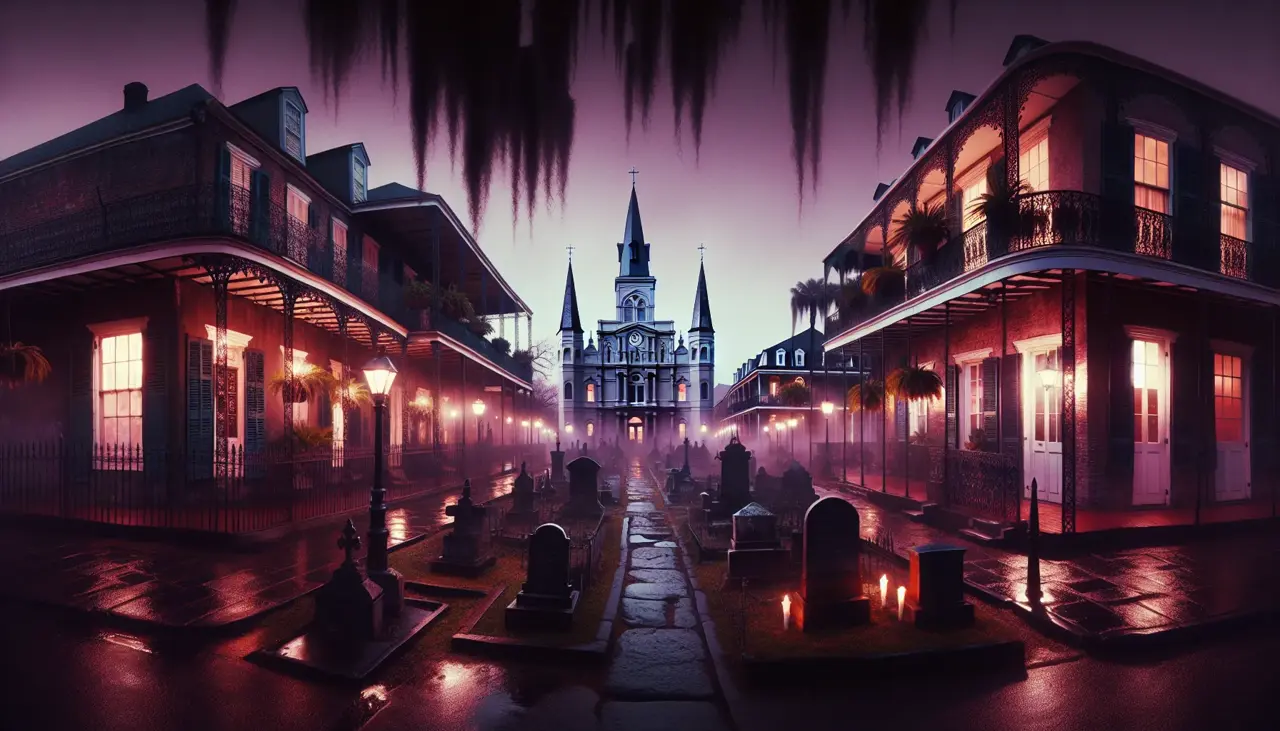
The bar’s dimly lit interior—illuminated primarily by candles—creates an atmosphere that practically demands ghost stories. Staff and patrons have reported apparitions, unexplained cold spots, and the figure of a man in early 19th-century clothing standing near the fireplace. Whether these experiences reflect genuine supernatural activity or the power of suggestion operating in a candlelit room full of history and alcohol is left to individual judgment.
Ghost Sightings Across the Quarter
Lafitte’s ghost is not confined to a single location. Sightings have been reported throughout the French Quarter, including near the old French Market, along the Mississippi River wharves, and in the vicinity of Jackson Square. The geographic spread of these reports reflects the scope of Lafitte’s historical operations—he was not a man who stayed in one place.
Some accounts describe a figure matching Lafitte’s historical appearance: dark-haired, well-dressed, carrying himself with the confidence of someone who operated outside the law by choice rather than desperation. Others are more generic—mysterious figures near the waterfront, unexplained sounds in old buildings, the feeling of being watched in narrow streets at night.
The Lafitte ghost stories function differently from those attached to sites of specific historical trauma like the LaLaurie Mansion. Lafitte’s haunting is romantic rather than horrific—the lingering presence of a charismatic outlaw rather than the echo of suffering. This reflects the selective nature of his mythology, which emphasizes the patriot and the rogue while minimizing the slave trader and the criminal.
Buried Treasure
No pirate legend is complete without buried treasure, and Lafitte’s is no exception. Stories of hidden caches of gold and jewels have been attached to locations throughout coastal Louisiana and Texas for two centuries. Barataria Bay, the shores of Lake Borgne, various points along the Gulf Coast, and several sites in Galveston have all been identified as potential hiding places.
No verified Lafitte treasure has ever been found. This has done nothing to diminish the stories, which continue to draw treasure hunters to coastal Louisiana. The treasure legend serves the same function as the ghost stories—keeping Lafitte present in the cultural landscape long after the historical man has disappeared.
Why New Orleans Keeps Him
New Orleans’ attachment to Lafitte reveals something about the city’s self-image. Lafitte represents a fantasy of noble transgression—the idea that breaking the law can be justified by charm, patriotism, or superior judgment. He is the gentleman outlaw, the criminal who serves the greater good, the rule-breaker who proves more valuable than the rule-followers.
This fantasy is seductive and dangerous. It romanticizes a man who trafficked in human beings. It elevates lawlessness to heroism. It flatters a city that has always maintained a complicated relationship with legal authority.
But it also captures something genuine about New Orleans’ character. This is a city built by overlapping colonial powers, sustained by smuggling and irregular commerce, shaped by people who lived between legal systems and cultural boundaries. Lafitte embodies that liminal quality—the refusal to be categorized, the insistence on operating by one’s own rules.
His ghost, whether real or imagined, represents the persistence of that spirit. New Orleans keeps Lafitte because Lafitte represents what New Orleans likes to believe about itself: that rules are suggestions, that charm outranks authority, and that the most interesting people are the ones who refuse to stay where they are told.
For more on this topic, see New Orleans ghost tours.