The Penitentiary Experiment
Eastern State Penitentiary opened on October 25, 1829, on a cherry orchard in what was then the outskirts of Philadelphia, Pennsylvania, at 2124 Fairmount Avenue. It was the most expensive building in America at the time of its construction — $780,000, a staggering sum that reflected the ambition of the project it housed. Eastern State was not simply a prison. It was a laboratory for a radical theory of criminal justice: that solitary confinement, silence, and forced reflection could transform criminals into penitent citizens. The word "penitentiary" — from the Latin paenitentia, meaning repentance — was coined to describe what its creators believed they were building.
This article is part of our American Prison History collection.
The theory originated with Philadelphia's Quaker community, particularly the Philadelphia Society for Alleviating the Miseries of Public Prisons, founded in 1787 by Quaker reformers. Benjamin Rush (1746-1813), a signer of the Declaration of Independence and the father of American psychiatry, was among its most prominent members. The Quakers argued that the existing system — public flogging, branding, mutilation, and execution — was both cruel and ineffective. Isolation and silence, they believed, would force prisoners to confront their sins and emerge reformed. It was a theory rooted in Quaker worship practice, where silent meditation was the path to spiritual truth.
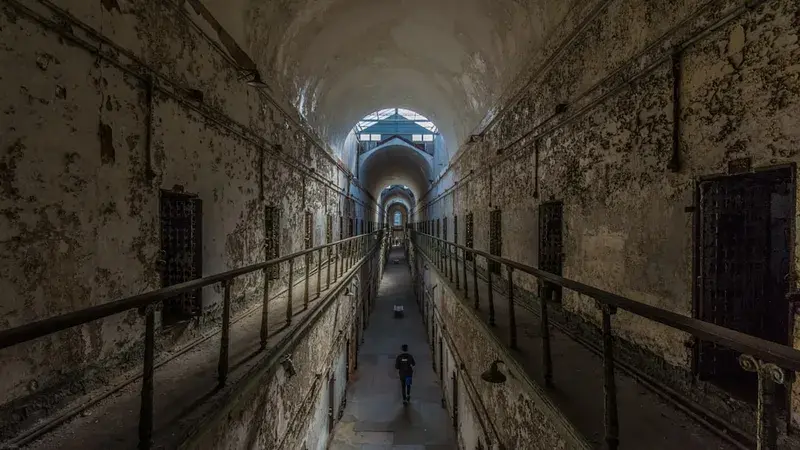
Haviland's panopticon-inspired design represented a revolutionary approach to surveillance and control. The central rotunda functioned as an observation point from which a single guard theoretically could monitor all corridors and cells simultaneously. This design principle, derived from Jeremy Bentham's theoretical panopticon and refined by Haviland, influenced the construction of over three hundred prisons worldwide. The architecture itself became a statement about the nature of punishment and reform: prisoners could never know if they were being watched, forcing them to internalize surveillance and assume constant observation. The prison's design was radical. Architect John Haviland (1792-1852) created a wagon-wheel layout with seven cellblocks radiating from a central surveillance hub — a plan that allowed a single guard at the center to monitor all corridors simultaneously. Each prisoner occupied a private cell measuring approximately 8 feet by 12 feet (96 square feet) with a small attached exercise yard. The cells had individual skylights — called the "Eye of God" — flush toilets, and central heating, amenities that exceeded what was available in most American homes and predated White House plumbing by decades.
The Architecture of Total Isolation
Haviland's design enforced isolation at every level. Cell doors opened onto individual exercise yards enclosed by walls too high to see over. Prisoners were hooded whenever they left their cells — a practice intended to prevent them from learning the prison's layout or recognizing other inmates. Meals were delivered through feeding slots. Work materials — weaving, shoe-making, woodworking — were provided in each cell. Prisoners could hear the chapel service through pipes that fed sound to individual cells but prevented communication between inmates.
The Gothic Revival exterior was deliberate intimidation. Haviland designed the facade to resemble a medieval fortress, with massive stone walls, castellated towers, and a single entrance through a heavy arched doorway. The message to the surrounding community was unmistakable: this was a place of punishment and transformation, and the architecture itself would discourage anyone who saw it from risking incarceration. The design was so influential that over 300 prisons worldwide copied it — in Europe, South America, Asia, and the colonial territories of multiple empires. For related history, see our al capone at alcatraz: the fall.
International visitors arrived constantly. Charles Dickens visited in 1842 and left horrified by the conditions. In his 1842 travel memoir, he described the system as "rigid, strict, and hopeless solitary confinement" and called it a punishment that "no man has a right to inflict upon his fellow-creature." Alexis de Tocqueville and Gustave de Beaumont studied the prison during their 1831 tour of American institutions, producing a report that influenced prison design across Europe. The stream of distinguished visitors — politicians, reformers, architects, writers — turned Eastern State into the most analyzed prison in the world.
The Failure of Solitary Confinement
The solitary system broke people. Prison records document inmates who descended into psychosis, self-mutilation, and catatonia. The silence that was supposed to prompt reflection instead produced hallucinations, paranoia, and permanent psychological damage. Suicide attempts were frequent enough to become a management problem rather than an exceptional event. The prison's own physicians documented the mental deterioration of long-term solitary inmates, though their reports were often suppressed or minimized by administrators who had staked their reputations on the system's success.
By the 1860s, the solitary system had effectively collapsed under its own weight. Overcrowding forced double-celling, which destroyed the single-occupancy principle. The exercise yards were roofed and converted into additional cells. The hooding practice was abandoned. Prisoners began to communicate, organize, and form the social hierarchies that the system had been designed to prevent. Eastern State became, against its founders' intentions, a conventional congregate prison — holding three times its designed capacity by the early 20th century.
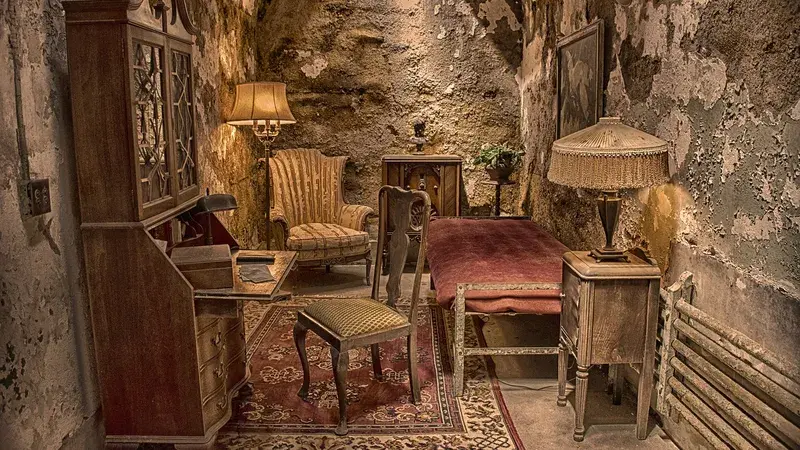
The prison's later years were marked by the same violence, corruption, and misery that characterized American prisons generally. Gang activity, drug smuggling, and guard brutality replaced the Quaker ideal of silent redemption. The most famous later inmate, Al Capone, occupied a cell in 1929-1930 that reportedly contained fine furniture, rugs, and a cabinet radio — a far cry from the enforced austerity that the prison's founders had envisioned.
Closure and Decay
Eastern State Penitentiary closed on April 14, 1970. All remaining inmates (approximately 250) were transferred to the newly opened State Correctional Institution at Graterford, Pennsylvania. The building was declared a National Historic Landmark in 1965 — five years before it actually closed — a designation that prevented demolition but did not guarantee maintenance. For the next two decades, the prison sat empty and decaying in the heart of Philadelphia's Fairmount neighborhood. For related history, see our the birdman of alcatraz: robert stroud's.
Nature colonized the ruin with startling speed. Trees grew through cellblocks, their roots splitting concrete and buckling floors. Feral cats established a colony in the exercise yards. Vines covered walls. Water damage from unrepaired roofs accelerated deterioration. The prison became an accidental wilderness preserve — a seven-acre urban forest enclosed by 30-foot walls, invisible from the surrounding streets, inhabited only by animals and the occasional urban explorer who scaled the walls illegally.
The decay created a visual spectacle that attracted photographers, artists, and filmmakers. The crumbling cellblocks, with their peeling paint, collapsed ceilings, and vine-wrapped bars, became one of the most photographed ruins in America. The aesthetic of beautiful decay — what the Japanese call wabi-sabi — turned Eastern State into a cultural landmark of a kind its builders never intended.
Preservation and Modern Tourism
The Eastern State Penitentiary Historic Site opened for public tours in 1994 under the direction of the Eastern State Penitentiary Task Force, operating under the principle of "stabilized ruin" — preserving the building in its deteriorated state rather than restoring it to any historical period. The approach was philosophically deliberate. A restored prison would be a museum of architecture. A preserved ruin was a meditation on the failure of the system the architecture was designed to serve.
The site's annual Halloween event, Terror Behind the Walls, ran from 1991 to 2021 and became one of America's premier haunted attractions, generating millions in revenue that funded preservation work. The event's cancellation after the 2021 season shifted the site's focus toward year-round programming that emphasizes criminal justice history, mass incarceration, and the legacy of solitary confinement — subjects that the prison's physical reality illustrates more powerfully than any textbook.
Eastern State now receives approximately 300,000 visitors annually. The audio tour, narrated by Steve Buscemi, guides visitors through cellblocks that range from relatively intact to completely ruined. Installations by contemporary artists address themes of incarceration, surveillance, and punishment. The prison that was built to be the most advanced correctional facility in the world serves, in its ruin, as the most eloquent argument against the system it pioneered.