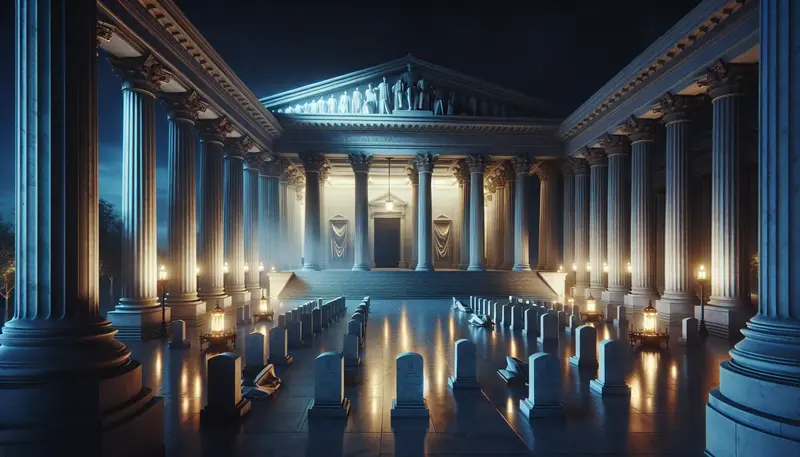
The Capitol has witnessed assassinations, lying in state ceremonies, and two centuries of political drama. Its most famous apparition is Abraham Lincoln; its strangest legend involves the \"Demon Cat of Capitol Hill,\" a black feline said to appear before national tragedies and deaths of prominent senators, last documented in the 1950s.
This article is part of our comprehensive Washington DC ghost tours guide. Whether you're planning a visit or researching from afar, these stories reveal a side of Washington DC most visitors never see.
Haunted Origins: Why the Capitol Feels Haunted
Have you ever wondered why so many people call the U.S. Capitol Building a place where the past refuses to leave? The answer lives in layered history: this is a building that burned, was rebuilt, expanded, and served as the site of national grief and political drama. On August 24, 1814, British forces set fire to the Capitol during the War of 1812; Congress chambers, offices, and library collections were badly damaged. Reconstruction began almost immediately under the direction of architect Charles Bulfinch, and subsequent construction phases — notably the long antebellum expansion culminating in the cast-iron dome completed in 1866 under Architect Thomas U. Walter — left the Capitol with multiple architectural strata. Those layers are the physical reason voices and footsteps are so often reported.
Beyond construction, the Capitol has long been a working city inside a single building. Thousands of people have passed through its corridors on any given day for more than two centuries: legislators, aides, clerks, servants, laborers, pages, and police. You can tie many ghost narratives to specific historic events. President Abraham Lincoln’s funeral procession and the period when his body lay in state in the Rotunda in April 1865 left a deep emotional imprint. The building’s address — U.S. Capitol, First St NE & East Capitol St NE, Washington, DC 20004 — marks it not just as a landmark but as a concentrated venue for national sorrow, triumph, and conflict. All of that context feeds the stories people tell about a ghost or a haunted seat of government.
Documented Paranormal Reports and Where They Came From
You’ll find most credible-looking Capitol ghost stories not in tabloid columns but in oral histories, guidebooks, and local-history books that collect staff testimony. One recurring source is John Kachuba’s Ghosthunting Washington, D.C. (2004), which compiles multiple firsthand accounts from long-term Capitol employees. Kachuba records, for example, reports of a Rotunda apparition described as Abraham Lincoln by staffers who worked evenings in the 1970s and 1980s; those witnesses described a tall man in a frock coat who vanished near the Lincoln statue and the Rotunda’s bronze doors. Kachuba’s role is important: he gathered these accounts as oral testimony rather than inventing them, which lets you evaluate patterns across witnesses.
Newspaper features and local magazines have also collected reports. A Washington Post feature on Capitol lore interviewed current and retired staff who described unexplained footsteps in empty corridors and a “woman in white” seen near the House wing staircases during late shifts. When official sources are available, they tend to be incident logs and interview transcripts held by the Architect of the Capitol and by the U.S. Capitol Police. Those records are typically restricted, but researchers who have accessed declassified logs note repeated references to after-hours disturbances that lack clear physical explanation. When you look at these accounts side by side, you’re not seeing a single sensational tale but a recurring pattern reported by people who worked in the building daily. For related history, see our the georgetown exorcist house: the true.
Famous Figures Said to Linger — Lincoln and Others
When people talk about a specter at the Capitol, Abraham Lincoln’s name comes up first. The historical anchor is indisputable: Lincoln was assassinated on April 14, 1865, by John Wilkes Booth at Ford's Theatre, and his remains lay in state at the Capitol Rotunda on April 19–21, 1865, before burial in Springfield, Illinois. The procession through Washington DC drew an estimated 25,000 mourners. That concentrated period of mourning and the national trauma of his death make it easy to understand why witnesses identify a tall, somber male figure as Lincoln. Reported sightings tend to occur near Lincoln’s statue in the Rotunda and the bronze doors leading into the space.
Other figures appear in the lore more intermittently. Some accounts mention a “woman in white” whose presence has been tied by employees to the wives and daughters of 19th-century lawmakers who worked or died in the building; another recurring figure is an unnamed soldier, sometimes localized to the Crypt or the Old Senate Chamber, whose uniform suggests Civil War-era service. You should treat these identifications carefully: eyewitnesses often assign historical identities only later, after learning more about the site. That said, when multiple independent witnesses describe similar details — clothing style, point of appearance, behavior — the pattern becomes significant, even if a direct historical tie cannot be proven.
Hotspots: Specific Locations Inside the Capitol Where Activity Is Reported
If you want to match stories to spaces, note several specific hotspots inside the U.S. Capitol where reports cluster. The Rotunda (floor level under the great dome) is the most commonly cited site; people report apparitions near the Lincoln statue and the bronze Rotunda doors. The Old Senate Chamber, located on the second floor of the north wing, is another frequent location for footsteps and voices; it’s a confined, acoustically reflective space where after-hours staff have reported feeling watched. The Crypt — below the Rotunda and originally intended as Washington’s burial site — is cold, stone-lined, and historically associated with ceremonial use and burials of congressmen; it’s also a place where staff have described sudden temperature drops.
Other named locations include Statuary Hall (west of the Rotunda), the House and Senate cloakrooms, and the east front concourse near the steps onto the Capitol grounds. Exact references matter: reports often cite the “north doorway off the Rotunda,” the “east wing corridor adjacent to Room S-212” (Old Senate offices), or the “lower-level tunnel to the Longworth House Office Building.” For modern administrative purposes the Capitol’s official address and mapped internal rooms help you locate these spots precisely: First St NE & East Capitol St NE, Washington, DC 20004, and room numbers published in public Architect of the Capitol maps. If you concentrate on these discrete areas, you’ll see how environmental factors (concrete, iron dome, HVAC ducts) can amplify sound and sensation, complicating any straightforward supernatural explanation while leaving room for lingering mystery. For related history, see our most haunted places in washington dc:.
How You Should Evaluate a Capitol Ghost Report
When you read or hear a ghost story about the Capitol, you should treat it like any historical claim: look for primary evidence, consider natural explanations, and weigh consistency among independent witnesses. Start by asking whether the account was collected in an oral-history interview, published by a reputable source, or recorded in official logs (such as incident reports held by the U.S. Capitol Police or statements archived by the Architect of the Capitol). Oral testimony is valuable, but it is shaped by memory and context; corroborating accounts and contemporary records strengthen the case.
Natural explanations matter. The Capitol’s architecture creates strange acoustics: footsteps and voices can carry oddly around the dome, and temperature variations create drafts that can be felt as sudden chills. Construction crews and maintenance work have historically produced after-hours noises that were later attributed to other causes. Medical or environmental factors — carbon monoxide, low-frequency infrasound, fatigue from long shifts — can also produce sensations interpreted as paranormal. That said, the pattern you should look for is consistency: similar descriptions of a figure, clothing, or behavior by unrelated witnesses across decades is what separates isolated anecdotes from a persistent tradition of sightings. Researchers like John Kachuba and local historians collect and compare those recurring elements while recognizing that folklore and personal experience both shape the final narratives.
Researching, Visiting, and Respecting the Capitol’s Haunted Reputation
If you’re planning to research or visit with the idea of finding traces of the Capitol’s past, do it with respect for the building’s function and the people who work there. You can consult primary sources at the Library of Congress and the National Archives to verify historical anchors (for instance, the 1814 burning of the Capitol under British General Robert Ross and the dates Lincoln lay in state in April 1865). The Architect of the Capitol publishes maps and historical guides that give you room numbers and locations for Rotunda, Crypt, and Old Senate Chamber references; these will help you match anecdote to place precisely. Public tours follow strict routes and security protocols, and access to many of the areas often mentioned in ghost stories is limited after hours.
When you approach staff testimony, use standard historical methods: record interviews with permission, cite dates, and ask for contextual details (shift times, lighting conditions, presence of other people). If you consult secondary compilers such as John Kachuba, cross-check the collected accounts against newspaper archives, oral-history repositories, and institutional incident logs when possible. Keep in mind the Capitol is an active workspace and a place of mourning; across the Potomac River sits Arlington Cemetery, another monument to national loss. Whether you come to see signs of the supernatural or to understand how the past shapes places, treat the stories as part of a wider civic memory. That balance — curious, skeptical, and respectful — is the best way to encounter the living history and the lingering tales of a ghost and a haunted hall of power.