Made famous by John Berendt’s 1994 bestseller Midnight in the Garden of Good and Evil, Bonaventure is part museum, part garden, and part ghost story.
This article is part of our comprehensive Savannah ghost tours guide. Whether you're planning a visit or researching from afar, these stories reveal a side of Savannah most visitors never see.
What makes Bonaventure Cemetery Savannah's hauntingly beautiful city of the dead?
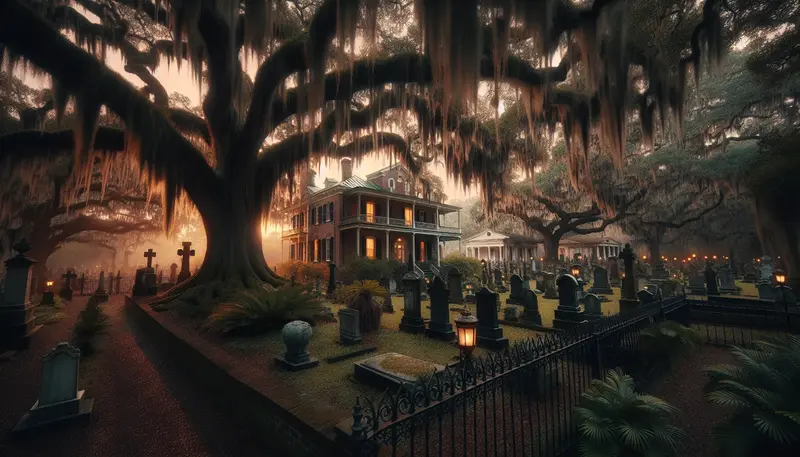
When visitors first step beneath the cathedral-like canopy of live oaks and Spanish moss at Bonaventure Cemetery, many say the place reads like a landscape painting that has been paused in the middle of a story. The cemetery’s combination of 19th- and early-20th-century funerary art, winding drives, and waterfront views on the Wilmington River give it a distinctive aesthetic that draws historians, photographers, and those interested in the ghost tradition. The question is not simply whether spirits linger, but why this site lodges so strongly in public imagination.
Bonaventure occupies land once part of the Bonaventure Plantation; the property’s human history predates its use as a municipal cemetery. The grounds became widely known as a burial place in the 19th century, and today the City of Savannah maintains the cemetery at 330 Bonaventure Road, Savannah, GA 31405. The 160-acre grounds were listed on the National Register of Historic Places on February 2, 2001. The land was originally part of a 600-acre plantation established by English Colonel John Mullryne in the 1760s; businessman Peter Wiltberger dedicated 70 acres for cemetery use in 1846, and the City of Savannah purchased it on July 7, 1907. Its popularity rests on both documented history—marked graves, inscriptions, and known interments—and the accumulation of folklore: stories tied to named figures such as Gracie Watson and Johnny Mercer, as well as to anonymous Confederate soldiers and families long associated with the plantation era.
Writers and local guides treat reports of strange lights, fleeting figures, and inexplicable photographs with respectful skepticism. Records, maps, and municipal deeds provide a framework for what can be verified; eyewitness testimony and photographic anomalies add layers that make Bonaventure a key location for anyone researching Savannah haunted places. Whether approaching Bonaventure as a historian, a photographer, or someone following haunted lore, the site rewards attention to detail: inscriptions, sculptural technique, and the way the landscape itself frames memory.
History and documented facts: who is buried where
Bonaventure Cemetery’s documented history is anchored in named people and dates. The land originally formed part of the Bonaventure Plantation, long associated with colonial-era families and later agricultural operations. Over the 19th and early 20th centuries the site evolved into a place of burial for local families, and it now contains sections that date from different eras—plantation-era markers, Victorian monuments, and 20th-century plots. The municipal address, 330 Bonaventure Road, appears on official City of Savannah maps and visitor materials, and the cemetery is managed under the Savannah Parks and Tree Department.
Notable interments with verifiable dates include composer and lyricist John Herndon "Johnny" Mercer (November 18, 1909 – June 25, 1976) and Pulitzer Prize–winning poet Conrad Aiken (August 5, 1889, Savannah – August 17, 1973, Savannah). The much-photographed grave of Gracie Watson—often referred to simply as "Gracie"—commemorates Gracie Perry Watson (July 10, 1882–April 22, 1889), who died of pneumonia at age six; families built elaborate monuments in that period, and Her father, W.J. Watson, managed the Pulaski House Hotel in Johnson Square and commissioned sculptor John Walz to carve the life-size marble statue from a photograph; completed in 1890, it became one of Bonaventure’s most visited markers. The cemetery also contains marked sections for Confederate soldiers and veterans, with monuments and inscriptions that tie the location to Savannah’s Civil War history. For related history, see our the mercer-williams house: murder, mystery, and.
Municipal records, burial ledgers, and archival photographs let researchers track who was interred and when. Those records are essential for separating folklore from fact: for example, records confirm Johnny Mercer’s burial in Bonaventure, but they do not record any official investigation supporting persistent claims of audible music emanating from his gravesite. Consulting the cemetery’s records at the office or local archives provides a factual baseline that thoughtful writers and tour guides use before reporting on supernatural claims.
Monuments, symbolism, and the landscape that shapes legend
The visual language of Bonaventure’s monuments contributes to its haunted reputation. Victorian funerary symbolism—draped urns, weeping angels, and carved children—was intended to communicate mourning, hope, and the endurance of memory. Those images, placed beneath long strands of Spanish moss and beside salt-washed river vistas, create a stage on which narrative and imagination naturally assemble. The live oak avenues function almost as processional routes, leading visitors from one sculptural scene to another.
Grave sculpture in Bonaventure ranges from classical motifs to individualized portraiture. The statue of Gracie Watson, rendered as a sleeping child, is often cited as an example of late-19th-century sentimentality translated into stone. Other monuments display standing soldiers, robed women, or Gothic crosses—each carrying symbolic meaning to contemporary viewers but also inviting anecdotes about movement, reflection, and presence. The cemetery’s edge along the Wilmington River allows coastal fog and tidal light to alter perceptions, so that a single scene can appear dramatically different across hours or seasons.
Short guide to common symbols
Reading monuments helps separate aesthetic effect from alleged phenomena. For instance, an angel with folded wings often denotes mourning and protection rather than literal guardianship; an urn draped in cloth symbolizes sorrow and the veil between life and death. Understanding these conventions allows historians and investigators to contextualize why visitors might report an emotional response that is later described as spectral or uncanny. The landscape’s own moods—wind in the moss, the river’s tide, and the long shadows of oak branches—play a major role in producing experiences people label as supernatural. For related history, see our most haunted places in savannah: a.
Reported paranormal experiences and named witnesses
Local lore around Bonaventure includes multiple recurring themes: sightings of a child near Gracie’s memorial, shadowy figures among the Spanish moss, and unexplained photography anomalies. Two widely referenced reports have names attached and are commonly cited by guides and authors who study Savannah haunted sites.
1) Gracie Watson sighting — Witness: Elizabeth Parker (tour guide, 2014): Elizabeth Parker, a longtime guide who worked private and public tours in Savannah, described an incident in October 2014 when she led a small afternoon group toward the east avenue beneath live oaks. According to Parker’s account, as the group paused at Gracie Watson’s monument, an older woman in the company of two children insisted she had just seen a small figure in a white dress move between the markers and then vanish near the riverbank. Parker later reported seeing an “odd shimmer” on two digital photos she took that did not appear on any other shot from the same roll. Parker framed her account with skepticism: she noted the play of light under moss and the frequency of costumed children in the area, but she also recounted the sight as vivid enough to enter local storytelling for years afterward.
2) Confessional EVP and shadow figure — Witness: Michael Davis (amateur paranormal researcher, 2009): In March 2009, Michael Davis, a Savannah resident who documented investigations on a local blog, recorded a segment of purported audio in the Confederate section. Davis reported capturing an EVP (electronic voice phenomenon) that sounded like a low voice saying a single word—variously transcribed as “home” or “remember.” He also described a photograph from that night that contained a darker vertical form at the margin of the frame; Davis and his companions claimed no one had stood there. Skeptical readers pointed to wind, distant traffic, and equipment artifacts; Davis acknowledged ambient noise but maintained the recording remained unexplained after review. The recording circulated among local enthusiasts and appears in several oral-history style compilations about the cemetery’s haunted reputation.
Both accounts are characteristic of Bonaventure lore: personal testimony framed with caution, mixed with sensory detail and a willingness to admit alternative explanations. They anchor ghost stories in named witnesses while leaving room for further inquiry.
Photography, recordings, and how evidence is evaluated
Bonafide investigations into Bonaventure’s reported phenomena tend to start where good historical method begins: with records, context, and repeatable observation. Photographs are among the most commonly cited forms of evidence—images that show orbs, streaks of light, or unexpected shapes. Investigators and skeptics alike note that the cemetery’s humidity, salt air, and particulate matter can produce optical artifacts: lens flare, backscatter (tiny droplets lit by flash), and long-exposure streaks from insects or passing cars. Credible photographic claims are stronger when accompanied by timestamps, multiple independent images, and corroborating witness testimony. For related history, see our savannah's civil war ghosts: sherman's march.
Audio evidence—EVPs—are more contested. Recordings made at Bonaventure often capture distant voices, traffic, and nature sounds; pareidolia can make random noise sound meaningful when listeners expect something supernatural. Therefore, many researchers recommend chain-of-custody notes, unedited audio files, and analysis using spectrographic software. Michael Davis’s 2009 recording (mentioned earlier) received that kind of amateur-level scrutiny: forums compared the waveform to ambient noise and found features that supporters argued were distinct from the recorded background, while critics cited normal low-frequency interference and site acoustics.
Thermal imaging and motion-activated cameras have also produced material discussed by enthusiasts. A frequently mentioned example is a night-time camera capture that registered a sudden temperature differential near a riverside tomb; available explanations included a thermal pocket caused by microclimate differences or the presence of wildlife. In every case, responsible commentators stress verification: control shots, multiple devices, witness overlays, and cross-referencing with documented facts. That methodology keeps Bonaventure’s discussions anchored between folklore and forensic inquiry, which in turn helps separate the genuinely anomalous from the perfectly ordinary.
Visiting, etiquette, preservation, and the cemetery’s cultural role
For those who come to Bonaventure because of its history or its reputation as a haunted landmark, responsible behavior is essential. The City of Savannah posts rules regarding hours, permitted activities, and the handling of monuments; visitors should note the municipal address—330 Bonaventure Road, Savannah, GA 31405—when planning a trip and consult official resources for current hours and any seasonal restrictions. Photography for personal use is generally allowed, but commercial shooting or organized night investigations often require permits and prior approval from the City of Savannah.
Etiquette matters because Bonaventure remains an active cemetery and a site of memory. Visitors should not touch or climb on monuments, remove flowers, or otherwise disturb grave markers. Those interested in researching the cemetery can consult burial ledgers and local archives; many guides who discuss the site’s ghost stories also emphasize the living families’ perspectives and the importance of preserving the graves themselves. Bonaventure’s landscape—old oaks, monuments, and river frontage—requires ongoing conservation efforts to manage erosion, root intrusion, and salt air corrosion.
Practical tips and respectful approaches
Plan visits in daylight for the clearest sense of layout and history; if attending a guided tour, choose licensed local guides who combine archival knowledge with an awareness of the site’s sensitivities. Photographers who aim to document alleged phenomena should keep logs (date, time, camera settings, and witness names), avoid intrusive flash use around fragile monuments, and report any damage they encounter to cemetery staff. In public conversation—on blogs, podcasts, or social media—credited witnesses and archival sources should be cited to separate anecdote from record. That approach preserves both the cemetery’s material fabric and the integrity of its stories.