The Rock Before the Prison
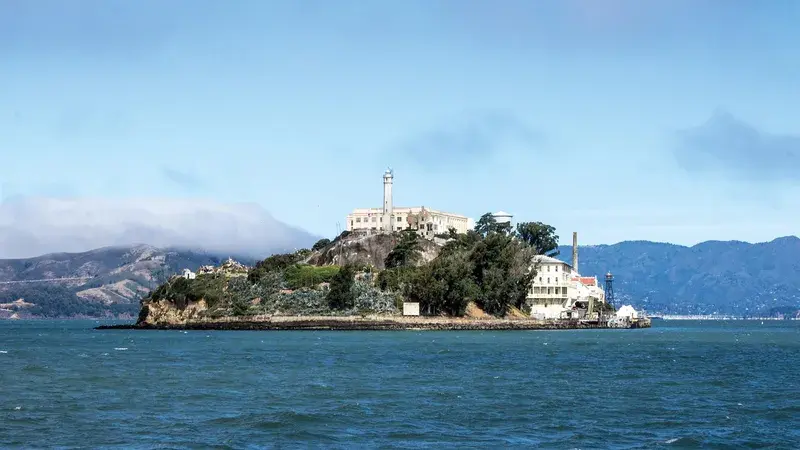
Alcatraz Island sits 1.25 miles offshore in San Francisco Bay, a 22-acre outcrop of sandstone that has served American power in three distinct phases — military fortification, military prison, and federal penitentiary. The island's strategic value was recognized during the California Gold Rush, when the Army began construction of a fortress designed to defend the entrance to San Francisco Bay. By 1859, Fort Alcatraz mounted over 100 cannons in a defensive position that could theoretically destroy any naval force attempting to enter the bay. The fort never fired a shot in anger.
This article is part of our American Prison History collection.
The military prison phase began informally during the Civil War, when the Army confined Confederate sympathizers and privateers on the island. The isolated location and cold surrounding waters made it a natural prison before anyone designed it as one. By 1868, the Army had designated Alcatraz as a permanent military prison, and the fortress began its long transformation from defensive installation to place of confinement. Military prisoners — deserters, insubordinates, and those convicted by courts-martial — built much of the infrastructure that the federal prison would later inherit.
The military prison held an unusual collection of inmates. Hopi prisoners of war were confined on Alcatraz in 1895 as punishment for resisting federal efforts to force their children into assimilation boarding schools. Conscientious objectors during World War I served sentences on the island. The military prison operated until 1933, when the Department of Justice took control and began converting the facility into a federal penitentiary designed for one purpose: to hold the inmates that other prisons could not control.
The Federal Penitentiary: 1934-1963
The Federal Bureau of Prisons opened USP Alcatraz on August 11, 1934, under Warden James A. Johnston, a reformer who had previously run San Quentin and Folsom State prisons as superintendent. Johnston's Alcatraz operated on a simple principle: privileges must be earned, not assumed. Inmates arrived with nothing — no commissary access, no work assignments, no recreational privileges, no visitors. Every comfort beyond basic food, clothing, and shelter had to be earned through compliance and good behavior over time.
The prison was designed as a maximum-security facility for the federal system's most problematic inmates — not necessarily the most dangerous, but the most disruptive, the most escape-prone, and the most corrupting. Inmates who bribed guards at other facilities, who organized resistance, who escaped repeatedly, or who posed management problems that other wardens could not solve were transferred to Alcatraz. The goal was not rehabilitation but containment — to isolate the worst influences in the federal system from the general prison population.
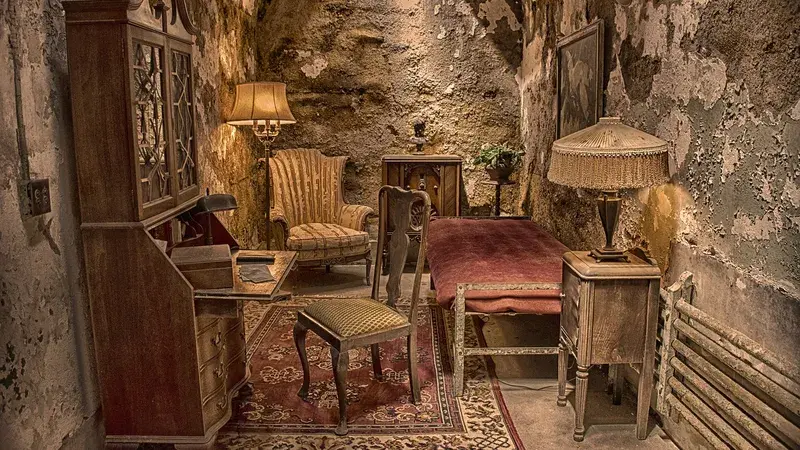
The facility held a maximum of 336 inmates in single cells. The cellhouse — a reinforced concrete structure built atop the old military citadel — contained four cellblocks designated A through D, with A block serving as a segregation unit. B and C blocks held the general population in cells measuring 5 by 9 feet with a fold-down bunk, a toilet, a sink, and a small shelf. D block, the isolation unit, held inmates in either closed-front cells that permitted no human contact or the "hole" — a pitch-dark cell with no furniture where inmates were held in total sensory deprivation for periods that could extend to weeks.
Daily Life on the Rock
The daily routine was regimented to the minute. Wake-up at 6:30 AM. Breakfast at 6:55 in the dining hall — a large, open room where guards watched from elevated gun galleries. Work assignments from 8:00 to 4:00, with a midday meal break. Dinner at 4:25. Lights out at 9:30. Twelve official counts per day confirmed that every inmate was physically present and accounted for. The counts were so precise that a single discrepancy could lock down the entire institution for hours.
The dining hall served what was widely considered the best food in the federal prison system. Johnston believed that food was the primary source of prison unrest and funded a quality kitchen operation that produced meals comparable to mid-range restaurants. Inmates ate in silence during the early years; talking was permitted during meals starting in the late 1930s. The dining hall was also the most dangerous room in the prison — over 250 inmates gathered in an enclosed space three times daily, creating conditions where violence could erupt and spread faster than guards could respond.
The library held approximately 15,000 volumes, and reading was the primary leisure activity. Robert Stroud, the so-called Birdman of Alcatraz, used the library extensively during his 17 years on the island to conduct ornithological research. Work assignments included the laundry, the kitchen, the dock, and various maintenance tasks. The industries program — garment manufacturing, furniture repair, and other productive work — occupied most inmates during working hours and was considered preferable to idle time in the cells.
Notable Inmates
Al Capone arrived in August 1934 as inmate number 85, stripped of the power and privilege he had enjoyed at other institutions. George "Machine Gun" Kelly, whose wife had reportedly coined the term "G-Men" for FBI agents, served 17 years on the island and was described by guards as a model prisoner who bore no resemblance to his public reputation. Alvin Karpis, the last "public enemy" personally arrested by J. Edgar Hoover, served more time on Alcatraz than any other inmate — 26 years from 1936 to 1962.
The inmates who attracted the most enduring attention were the escapees. Fourteen separate escape attempts involved 36 inmates during the 29 years of federal operation. Most were recaptured quickly. Several drowned or were presumed drowned. Two — Theodore Cole and Ralph Roe in 1937 — disappeared into the bay during a dense fog and were never found, though they are officially presumed dead. The 1962 escape by Frank Morris and the Anglin brothers remains the most famous prison break in American history, its outcome still unresolved.
Closure and Aftermath
Attorney General Robert Kennedy ordered Alcatraz closed on March 21, 1963. The decision was financial rather than penological — operating costs were approximately three times higher than comparable federal facilities, driven by the expense of transporting every supply by boat across a mile of open water. The salt air and fog had corroded the buildings beyond economical repair. Concrete was crumbling, rebar was exposed, and the infrastructure that had been aging since military construction in the 1850s was failing systematically.
The island's most dramatic post-prison chapter began on November 20, 1969, when a group of Native American activists calling themselves Indians of All Tribes occupied Alcatraz, claiming the island under the terms of an 1868 Sioux treaty that granted Native Americans the right to unused federal land. The occupation lasted 19 months, until June 11, 1971, drawing international attention to Native American civil rights, influencing federal Indian policy including the passage of the Indian Self-Determination and Education Assistance Act of 1975. The occupation's legacy — activist, symbolic, and legal — rivals the prison's in historical significance.
Alcatraz became part of the Golden Gate National Recreation Area in 1972 and opened to the public in 1973. Today it receives approximately 1.7 million visitors annually, making it one of the most visited sites in the National Park system. Ferry tours depart from Pier 33 in San Francisco and sell out weeks in advance during peak season. The audio tour, featuring recordings of former inmates and guards, guides visitors through the cellhouse with a combination of historical detail and atmospheric tension that few museum experiences can match.