
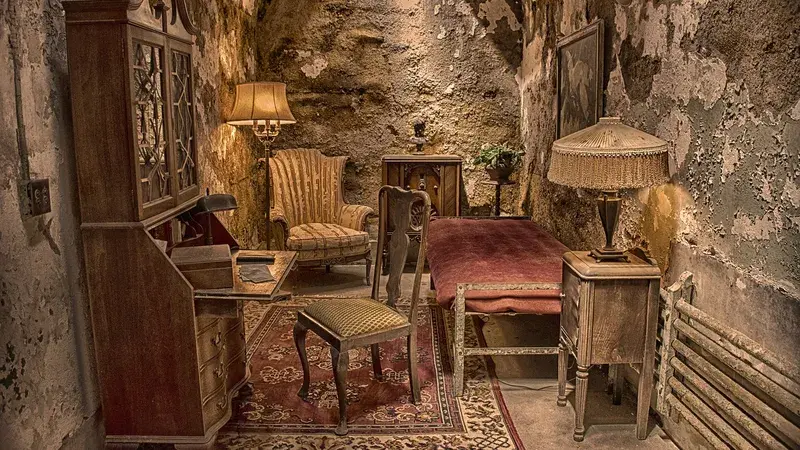
Arrival at the Rock
Alphonse Gabriel Capone arrived at Alcatraz on August 22, 1934, aboard a prison train from the United States Penitentiary in Atlanta, joined by 52 other inmates. He was 35 years old, serving an 11-year sentence for tax evasion. Attorney General Homer Cummings and Sanford Bates, director of the Federal Bureau of Prisons, had specifically orchestrated his transfer to a facility where his wealth and connections could not undermine security — the only charge federal prosecutors had managed to make stick against a man credibly accused of ordering dozens of murders, running a criminal empire that grossed an estimated $100 million annually, and orchestrating the 1929 Saint Valentine's Day Massacre. Federal authorities employed extraordinary secrecy measures for his transfer, disguising prisoner movements in shipping manifests marked "furniture" and routing the train through Tiburon, California, before a barge transported Capone to the island under cover of darkness. He was assigned inmate number 85, a designation that would define his identity in the most impersonal prison America had created.
This article is part of our American Prison History collection.
Warden James Johnston, determined to demonstrate that no inmate would receive preferential treatment regardless of criminal reputation, treated Capone exactly as he treated every new arrival: strip search, medical examination, assignment to a standard cell in B Block, and a work detail in the prison laundry. Capone's celebrity status, which had bought him private suites, catered meals, and personal valets at Eastern State and Atlanta, carried no weight on Alcatraz. Johnston had been specifically instructed by the Bureau of Prisons to demonstrate that no inmate, regardless of wealth or reputation, would receive special treatment. Capone was the test case.
The transition was brutal. At Atlanta, Capone had bribed guards, received visitors freely, conducted business by telephone, and maintained a lifestyle that more closely resembled a luxury hotel than a prison. He had a personal chef, expensive furnishings, and access to outside communication that allowed him to continue directing his Chicago organization. Alcatraz eliminated all of this overnight. The prison permitted no newspapers, no radio access, limited correspondence, and visits only from approved family members through a glass partition with monitored telephone communication.
Loss of Power and Identity
Capone's first months on Alcatraz were defined by failed attempts to reassert the influence he had wielded at other institutions. He reportedly offered to fund prison improvements in exchange for privileges. Johnston refused. He attempted to cultivate relationships with guards. Johnston rotated guard assignments to prevent familiarity. He tried to establish himself as a figure of authority among the inmate population. Other inmates — many of whom had criminal reputations equal to or exceeding Capone's — were unimpressed.
The prison's structure was specifically designed to prevent the kind of power accumulation that Capone represented. No inmate handled money. Commissary purchases were limited and standardized. Work assignments rotated. The absence of a prison economy eliminated the currency through which Capone had traditionally operated. A man whose power derived from the ability to buy loyalty found himself in an environment where there was nothing to buy and no mechanism for purchase. For related history, see our the birdman of alcatraz: robert stroud's.
Violence followed the loss of status. In June 1936, an inmate named James Lucas stabbed Capone with a pair of barber scissors in the basement of the cellhouse in what would be one of several violent altercations during his Alcatraz years. The wound was not life-threatening, but the attack demonstrated Capone's vulnerability in a way that would have been unthinkable outside Alcatraz. Capone was not the most powerful man in the room. He was not even particularly feared. On Alcatraz, he was simply inmate 85 — a laundry worker with a famous name and a declining capacity for self-preservation.
The Prison Band and the Attempt at Normalcy
Despite occasional disciplinary incidents—including a fight in the recreation yard that resulted in eight days of isolation—Capone found his most positive experience on Alcatraz through the prison band. He played banjo and mandola — a tenor mandolin — in a group that performed for the inmate population during recreation periods. Music provided structure, social connection, and a form of expression that the prison's rigid routine otherwise suppressed. Guards and fellow inmates noted that Capone appeared most stable and content during musical activities. Capone claimed knowledge of approximately 500 songs and even composed "Madonna Mia," a tribute to his wife Mae, while imprisoned. His musical literacy extended to extensive reading in the prison library on music appreciation and self-improvement, suggesting an intellectual dimension that his criminal reputation had obscured.
The band was one of several recreational opportunities available to inmates who had earned sufficient privilege credits. Movies were screened periodically in the dining hall. The recreation yard offered softball, handball, and card games during scheduled periods. The library circulated approximately 75 books per day among the 250-odd inmates. These privileges were earned incrementally — a new inmate started with nothing and accumulated access through months of compliant behavior. Capone, despite occasional disciplinary incidents, earned standard recreational privileges within his first year.
Mental Decline
Capone had contracted syphilis as a young man in Brooklyn, likely during his tenure as a bouncer and enforcer at the Harvard Inn in Coney Island. He never received adequate treatment. By the time he reached Alcatraz, the disease had progressed to neurosyphilis — the tertiary stage in which the spirochete bacterium attacks the central nervous system, causing progressive cognitive deterioration, personality changes, and eventually dementia. For related history, see our alcatraz island: from military fort to.
The symptoms became noticeable to guards and inmates by 1937. Capone would sometimes refuse to leave his cell for meals or work assignments. He was observed making his bed repeatedly, smoothing and re-smoothing the blankets in a compulsive loop. His speech became confused. He had difficulty following conversations. He would occasionally be found sitting in his cell staring at nothing, unresponsive to verbal commands. Prison physicians documented the decline but could do little — penicillin, which would later prove effective against syphilis, was not available for civilian medical use until the mid-1940s.
By 1938, Capone's mental state had deteriorated to the point where he was transferred from the general population to the prison hospital. He spent his last year on Alcatraz in the hospital ward, receiving what care was available but continuing to decline. The man who had run the most powerful criminal organization in American history could no longer reliably dress himself or carry on a coherent conversation.
Transfer, Release, and Death
Capone was transferred from Alcatraz to the Federal Correctional Institution at Terminal Island, California, on January 6, 1939, to serve the final year of his sentence in a facility better equipped to manage his medical condition. He was released on November 16, 1939, having served seven years, six months, and 15 days of his 11-year sentence (reduced for good behavior, a typical reduction of approximately 10 months per year of incarceration). He was 40 years old and, in the assessment of his physicians, would never recover the cognitive function he had lost.
Capone retired to his estate at 93 Palm Island in Miami Beach, where his wife Mae and other family members managed his care. The estate, purchased in 1928 for $40,000, became the setting for a long, slow decline that bore no resemblance to the violent glamour of his Chicago years. Capone spent his final years fishing in Biscayne Bay, puttering in his garden, and occasionally hosting family gatherings at which his erratic behavior alarmed even those who loved him most.
He died on January 25, 1947, of cardiac arrest following a stroke, at age 48. The syphilis that had been slowly destroying his brain since his twenties had, by the end, reduced the most famous gangster in American history to a confused, childlike figure who posed no threat to anyone. His earlier cell at Eastern State Penitentiary — furnished with rugs and fine art — and his standard-issue Alcatraz cell tell the story of his decline in architectural terms: from purchased luxury to enforced austerity to medical dependency. Alcatraz did not reform Al Capone. It outlasted him.