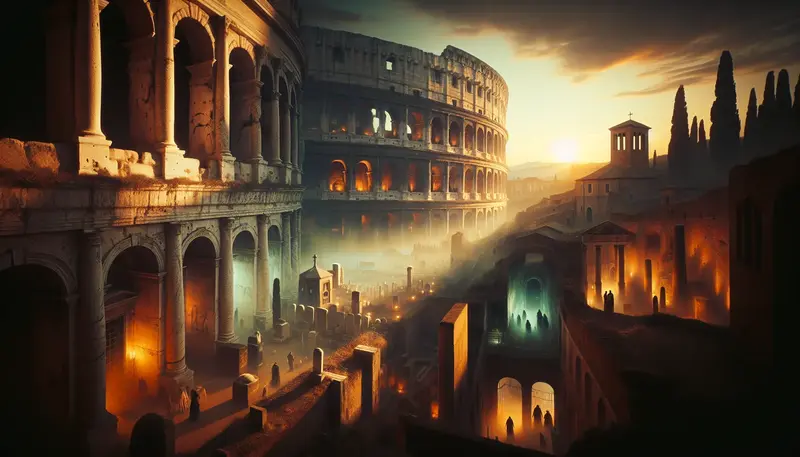
An estimated 400,000 people died in the Colosseum over four centuries of games. Night visitors report sounds, shadows, and presences among the ruins.
This article is part of our comprehensive Rome ghost tours guide. Whether you're planning a visit or researching from afar, these stories reveal a side of Rome most visitors never see.
The Arena's Question: What Haunts the Stones of the Colosseum?
?Has the ground at Piazza del Colosseo, 1 ever kept the echo of those who died there?
The Colosseum — officially the Flavian Amphitheatre — was begun under Emperor Vespasian in AD 72 and inaugurated under Titus in AD 80. For centuries it hosted spectacles that ranged from gladiatorial combat and animal hunts to public executions and staged naval battles. The physical layers of history — the travertine exterior, the underground hypogeum, the arena floor long since gone — make the site a focused repository of memory. Modern visitors often report an emotional charge in certain spaces: the arena edge, the remaining vomitoria, and the subterranean corridors known as the hypogeum. Those locations are frequently named in local reports of strange sensations and apparitions, and they map directly onto the documented places where violence and death occurred.
Scholarship and folklore intersect at the Colosseum. The historical record offers precise names and dates: Vespasian (Titus Flavius Vespasianus), the opening games of AD 80, and later imperial edicts such as the bans on gladiatorial contests issued by Honorius in AD 404. Folklore fills the cracks left by patchy sources. Reported paranormal experiences are typically tied to specific parts of the amphitheatre: the perimeter where gladiators entered, the shadowed arches, and the hypogeum beneath the arena where animals and combatants awaited their fate. That intersection of documented death and persistent personal testimony is why the site appears on itineraries for those researching a Rome ghost or Rome haunted itinerary: both the solid evidence and the human reports matter.
Gladiators, Bloodsports, and the Practicalities of Death
The spectacle that most people associate with the Colosseum — the gladiatorial game — involved a variety of combatants, each with a specialized fighting style. Types included the murmillo, who typically fought with a large rectangular shield and helmet; the retiarius, who fought with a net and trident; and the secutor, built as a counter to the retiarius's tactics. Gladiators were drawn from slaves, prisoners of war, and volunteers; they could earn fame, freedom, or a gruesome death. Ancient sources such as the historian Cassius Dio and inscriptions recovered from burial grounds and gladiatorial schools provide the evidentiary backbone for modern understanding.
Popular imagination overstates the fatality rate of gladiatorial bouts. Epigraphic evidence — tombstones and honorific inscriptions — shows many gladiators survived multiple engagements and were celebrated figures with pensions and patronage. At the same time, venationes (animal hunts), executions by wild beasts, and staged public executions were deliberately lethal and contributed heavily to the death toll. The hypogeum, the two-level network beneath the arena completed under Emperor Domitian after AD 81, was central to those spectacles: lifts and trapdoors placed animals and fighters into the open, heightening spectacle and danger.
Quantifying deaths is difficult. Contemporary estimates vary: thousands of animals died each year during the peak imperial period, while human deaths across centuries may number in the many thousands, but the lack of statistical records prevents precise totals. The combination of ritual, entertainment, and judicial execution made the Colosseum a site where public violence was both regulated and ritualized — and where human bodies became at once civic spectacle and historical trace. For related history, see our castel sant'angelo: rome's fortress of ghosts.
Martyrs, Telemachus, and the Question of Christian Executions
Christian martyrdom in the Colosseum occupies a large space in popular memory, although the historical record is complicated. The story of Saint Telemachus (or Telemachus of Constantinople) is pivotal: in AD 404 an ascetic monk is said to have intervened to stop a gladiatorial fight in Rome and was stoned to death by the crowd. According to later ecclesiastical writers — most notably Theodoret and later ecclesiastical tradition — his death moved Emperor Honorius to ban gladiatorial contests. That narrative places a named martyr and a causal relationship in the historical record, but modern historians caution that the story is filtered through ecclesiastical sources and moralizing agendas.
Beyond Telemachus, the belief that mass Christian martyrdoms were staged in the arena has been repeated for centuries. Archaeological and documentary research indicates that large-scale, systematically recorded martyrdoms at the Colosseum are difficult to substantiate. The area around the amphitheatre and nearby necropoleis does show Christian activity from late antiquity, and several martyrs are associated with the immediate topography, but direct evidence that the Colosseum served as a site of mass Christian execution is scant and debated. For instance, early pilgrim accounts and medieval chroniclers frequently conflated multiple sites of persecution across Rome into the amphitheatre’s liminal space.
Ultimately, the Colosseum’s status as a Christian symbol — reinforced by later medieval and modern commemorations — combines verified incidents, like Telemachus’s reputed death around AD 404, with centuries of devotional memory. That layered testimony contributes to contemporary perceptions of the site as haunted by martyrs, even as scholars stress careful separation of pious tradition from verifiable historical event.
Five Centuries of Death: Continuity, Collapse, and Reuse
When the title references "500 years of death," it gestures at a long, shifting chronology rather than a neat, continuous ledger. The Colosseum hosted lethal spectacles from its inauguration in AD 80 through the later Roman centuries; gladiatorial games declined after AD 404 following imperial edicts, but other forms of violent spectacle and public punishment persisted into the later 5th and even 6th centuries. By the Middle Ages the amphitheatre had been repurposed: by the 12th century it contained houses, workshops, and the fortress of the Frangipane family. For related history, see our most haunted places in rome.
The events that shaped the structure’s physical decline are well-documented. Major earthquakes — notably in 847 and again in 1349 — caused large sections of the outer ring to collapse. Over time the monument became a convenient quarry: blocks were removed for St. Peter’s Basilica and other Roman construction projects, and architects such as Michelangelo drew from its stones and proportions in their own work. During the medieval and early modern periods the Colosseum’s narrative shifted from functioning public arena to quarry, neighborhood, and powerful symbol. That long-term reuse complicates the “five centuries of death” idea: the site’s association with death remained culturally potent even when the amphitheatre was serving secular, domestic, or religious purposes.
From a haunted-history perspective, the continuity of presence matters more than continuity of spectacle. Where people lived, worked, worshipped, or were buried, memory accumulated. Those layers are precisely where modern witnesses say they feel impressions of the past — in subterranean corridors where prisoners might have waited, near the archways where crowds pressed in, and along the perimeter where combatants once strode out. The chronology matters, but so does the persistence of human activity in the space over at least a millennium.
Reported Paranormal Experiences: Witness Accounts and Local Testimony
Reports of strange occurrences at the Colosseum span the modern era and are often tied to specific locations within the monument: the hypogeum, the arena’s perimeter, and the arches on the eastern side. Two widely circulated accounts are emblematic and are presented here with respectful skepticism.
In April 1998, Marco Romano, then a night watchman responsible for the security gate at Piazza del Colosseo, reported to a local newspaper that he had heard "the clank of metal and the chant of a crowd" late one night while performing rounds near Arch 24 (eastern side). Romano described a sudden drop in temperature and a pressure that made him step back; when he turned, he said, "I saw the shadow of a man with a helmet" moving along the inner passage before fading into the stone. He filed an incident report with the Parco archeologico del Colosseo; the official log records an entry for that date noting a security alarm but no intruders. Romano's description has been widely cited on guided-tour scripts and regional folklore collections as a named, contemporary testimony to residual presence. For related history, see our the roman catacombs: miles of the.
Another detailed report came in August 2011 from Lucia Bianchi, a licensed tour guide who led a late-evening educational program for students. Bianchi reported feeling a "firm pressure on the shoulder" while standing at the arena edge, near the exposed remains of the hypogeum, and hearing "a low groan like leather meeting leather." Two students in her group independently described the same sensation and the impression of a figure standing behind them. Bianchi recorded the incident with her employer and later described it in a radio interview; the testimony circulated online and in local magazines. In both cases the witnesses were professionals with long experience in the Colosseum’s environment, and neither account sought sensational gain — both framed the experiences as puzzling, emotional, and worthy of respectful consideration.
Visiting, Researching, and Interpreting the Colosseum's Ghosts
For anyone interested in the Colosseum as both a historical site and a locus of reported hauntings, approach with a blend of curiosity and historical rigor. The archaeological and documentary record is richly detailed: construction under Vespasian (AD 72), inauguration under Titus (AD 80), expansion and modifications under Domitian, the hypogeum's development, and the gradual attenuation of gladiatorial spectacles after AD 404. The official site for tickets and conservation is managed by Parco archeologico del Colosseo; the address and main entrance remain at Piazza del Colosseo, 1, 00184 Roma RM, Italy. Practical matters — entry times, conservation rules, and restricted areas — are handled by the park authorities and should be respected.
Researchers who wish to treat the hauntings seriously should combine archival research, oral-history methodology, and site observation. Interviewing named local witnesses, such as guides, night staff, and archaeologists, is valuable when done openly and with attention to memory’s malleability. Photographic and audio records can document personal experiences but do not substitute for context. That said, the many accounts collected over decades — whether recorded in newspapers, radio interviews, or local guide testimonies — form a corpus that folklorists and cultural historians find meaningful. Visitors looking for a Rome ghost or Rome haunted perspective will find both: a robust, verifiable history of public death and a long tradition of personal testimony that gives the stones a human echo.
Interpret the Colosseum’s ghost stories as part of the site's living history: they are testimonies of contemporary people encountering a powerful past. Whether a skeptic, a believer, or somewhere in between, one ought to respect conservation rules and the memory of those who suffered there. The Colosseum remains simultaneously a monumental archaeological site and a place where many say the past is unusually present.