Two thousand years of history have left London with an extraordinary concentration of ghost stories — from Roman soldiers to wartime phantoms.
This article is part of our comprehensive London ghost tours guide. Whether you're planning a visit or researching from afar, these stories reveal a side of London most visitors never see.
The Tower of London: Royal Tragedy and Persistent Apparitions
?Have you ever wondered why the Tower of London keeps appearing on lists of London haunted landmarks?
You’ll find the Tower of London (Tower Hill, EC3N 4AB) at the centre of England’s uneasy memories of execution, imprisonment and betrayal. Constructed by William I of Normandy (also known as William the Conqueror) beginning in 1078, the Tower has been a royal palace, armoury and prison spanning more than 21 acres; its most notorious moments include the executions of Anne Boleyn (c. 1501–1536) on 19 May 1536 on Tower Green and Lady Jane Grey (1537–1554) on 12 February 1554 at age 17, both within the Tower's bounds. Those dates anchor the historical fact behind many of the Tower’s apparitions: when people report a presence, they’re often connecting a specific body of evidence to an equally specific historical event.
You’ll hear repeated stories of a headless figure on Tower Green, usually identified as Anne Boleyn. While such sightings are folklore at heart, credible witnesses have included guards and long-serving staff. Peter Underwood (1923–2014), the renowned British author, paranormal investigator, and founder of the Vampyr Research Centre, recorded accounts from Yeoman Warders in the mid-20th century who described a female apparition in Tudor dress near the chapel of St Peter ad Vincula. The description often matches contemporary portraits of Anne Boleyn: dark hair, Tudor gown in dark green damask, and a severe expression consistent with her courtier portraits from 1533–1536.
Other reports are less dramatic but equally persistent: the sound of ghostly footsteps in the White Tower, or cold spots in the Bloody Tower where the Princes in the Tower (Edward V and Richard of Shrewsbury) were last seen in 1483. You’ll hear these stories in the context of the Tower’s documented history—prison registers, execution records and eyewitness reports from the 16th century onward—so a visit encourages you to weigh archival fact against modern testimony when considering whether the Tower is a London ghost hotspot or a place where history simply feels very present.
Highgate Cemetery: Victorian Elegy and the ’70s Vampire Controversy
?Would you expect a cemetery’s Victorian landscaping to become the focus of national headlines about vampires?
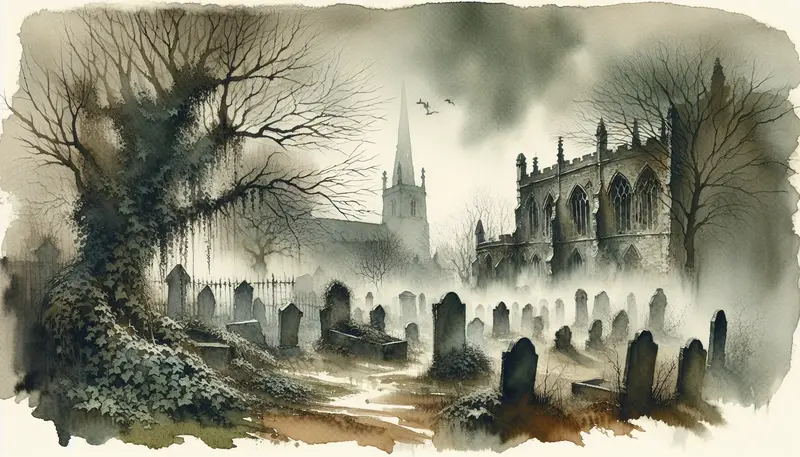
Highgate Cemetery (Swains Lane, London N6 6PJ) opened in May 1839 and quickly became the fashionable resting place for the wealthy and famous—Karl Marx (1818–1883) is entombed here, with his monument installed in March 1954. The cemetery’s towering mausoleums, ivy-clad walls and narrow paths create an atmosphere that many call evocative rather than eerie. That atmosphere changed into outright controversy in the 1970s when claims of a “vampire” in the North London graveyard attracted press attention and two prominent figures: David Farrant and Sean Manchester.
You’ll read about specific incidents from that period. In 1970 David Farrant, a London-based investigator, claimed to have seen a tall, dark-cloaked figure in the cemetery and publicised footprint evidence; Sean Manchester, another investigator, counter-claimed ritual evidence and led a group that performed an exorcism in 1970. Both men gave interviews and published accounts—Farrant in local papers and Manchester in his books—so their names are attached directly to the Highgate saga. Their differing narratives fuelled public fascination but also left the story contested: supporters of the sightings point to multiple witnesses and physical traces, while sceptics stress sensationalist media coverage and the tendency for folklore to grow once it’s in print.
When you walk Highgate today, you’ll encounter both the solemn records—Victorian burial registers and listed monuments—and the residue of 20th-century reporting. The cemetery illustrates how a London ghost narrative can form at the intersection of documented history, multiple eyewitness reports and media amplification. In short, Highgate is as much a story about perception and publicity as it is about the dead who lie there.
The London Underground: Subterranean Stories and Echoes on the Tube
?Have you ever noticed how the Tube seems to carry stories as well as passengers?
The London Underground is not just transport infrastructure; it’s a living archive of incidents, closures and human drama. Stations like Aldwych (originally opened in 1907 as the Strand line extension, renamed Strand, permanently closed in September 1994 and accessible only via tours at WC2N 4JU), Holborn, and the disused platforms at Charing Cross are frequently mentioned in lists of London ghost sites because disuse and darkness make them natural settings for spectral lore. The Underground’s history includes wartime shelters used during the Blitz (1939–1945) and the 1987 fire at King’s Cross (May 18, 1987), events that create emotional memory points where people later report residual phenomena. For related history, see our haunted pubs of london: where history.
You’ll hear staff stories—train drivers, cleaners and station attendants—who describe fleeting silhouettes on platforms or the sensation of being watched in empty tunnels. One widely reported type of experience involves late-night staff at Aldwych who claim to have felt a presence or seen an unaccountable movement of lights; these accounts, while anecdotal, come from named employees in oral histories collected by transport veterans. Another persistent tale concerns the “white lady” sighted at Leytonstone and along certain Central Line stretches; local commuters have given statements to community historians describing a pale woman appearing briefly in carriage windows on foggy mornings. Such claims are seldom backed by photographic proof, but their repetition among staff and commuters gives them a weight that’s social as much as supernatural.
For you, the Tube’s ghosts are partly psychological: the Underground is full of human stories—daily routines, wartime fear, accidents—that make it prone to afterimage sightings. If you’re investigating a London ghost on the Tube, you’ll want to combine official records (accident reports, closure dates and architectural changes) with oral testimony from named staff and passengers to build a balanced picture of what might be residual memory and what might be misperception under low light and stress.
Hampton Court Palace: Tudor Lives and Lingering Footsteps
?Does a palace rebuilt for display also keep the echoes of those who died within its walls?
Hampton Court Palace (Hampton Court Road, East Molesey, Surrey KT8 9AU), a 1,090-room royal residence, stands as a powerful example of how royal history invites ghost stories. Henry VIII (1491–1547) expanded the original Tudor manor from 1514 onwards, creating a monumental complex of approximately 55 acres and 1,000 rooms where court drama, executions and illness were commonplace. The palace registers, building records and Tudor correspondence give you concrete dates for these events: Henry’s wives, appointments and court ritual are well-documented, and certain rooms—most notably the Haunted Gallery—carry reputations that date back centuries.
You’ll encounter repeated mentions of Catherine Howard and Jane Seymour when people discuss Hampton Court’s apparitions. Visitors and staff over the years have reported a variety of phenomena: the sensation of being watched in the Haunted Gallery, unexplained cold spots near the Tudor kitchens, and a figure seen pacing by the river in 18th- and 19th-century accounts. Historic guidebooks from the 19th century collected these anecdotes alongside architectural descriptions, which helped cement their place in the palace’s narrative. More recent, named witnesses include guides who have given formal statements of occurring events—such as unexplained footsteps in closed rooms—reported to palace authorities, though management typically frames these as unexplained rather than definitive evidence of an afterlife.
When you approach Hampton Court as a possible London haunted site, you should look at the provenance of each story: whether it began as a contemporary diary entry, a Victorian guidebook anecdote, or a modern staff report. The palace demonstrates how the Tudor past’s tangible documents and the living memory of staff combine to make a location feel haunted, without forcing you to adopt any single interpretation. For related history, see our jack the ripper: a walking guide.
The Ten Bells and Whitechapel: Ghosts Linked to the Ripper Murders
?Can a pub’s streetside presence become inseparable from a dark historical crime?
The Ten Bells (84 Commercial Street, Spitalfields E1 6LY) sits in the heart of Whitechapel and is often cited in discussions of London haunted places because of its proximity to sites associated with Jack the Ripper’s murders in 1888. The Ripper murders are among the most documented criminal events in Victorian London; police reports, inquest records and contemporary press coverage provide a dense factual framework. That factual framework is precisely what fuels haunting narratives: when you stand outside the Ten Bells, you’re looking at a place where documented victims, such as Mary Kelly (murdered November 9, 1888) and Annie Chapman (murdered September 8, 1888), once walked through these streets.
Reporters and pub staff have given named statements about unusual late-night occurrences—cold spots, the smell of tobacco where none should be, and patrons who feel suddenly uneasy when told the Ripper context. Tour guides often recount a specific modern incident: in the early 2000s, a named bartender reported glasses moving on shelves and a sudden drop in temperature when the bar was empty; management told the local press these were unexplained but not headline-making. Such reports blend with an intense local archive of police notebooks and witness statements from 1888 that give the area its grim charge. The Ten Bells also illustrates how London ghost stories can be respectful remembrances: talking about Ripper-related hauntings often goes hand-in-hand with recalling the humanity of the victims, not just their notoriety.
If you’re assessing Whitechapel’s haunted reputation, balance the Ripper dossier—meticulous, archival and precise—with modern testimonies from named staff and local historians. That approach helps you see how historical trauma and modern perception merge to create a reputation that is as much cultural memory as it is supernatural claim.
Enfield and the North London Poltergeist: The Hodgson Case
?How do multiple witnesses change your view of a single haunting claim?
The Enfield Poltergeist case (Enfield, north London; the household at 284 Green Street) took place mainly from August 1977 through May 1979 and remains one of the most thoroughly documented alleged hauntings in London. The central witnesses were the Hodgson family—single mother Margaret \"Peggy\" Hodgson (1934–1997) and her children, including Janet Hodgson (born 1963) and Margaret Hodgson—who reported furniture moving, knocking on walls, and objects being thrown. Investigators Maurice Grosse (1917–2006) of the Society for Psychical Research and Guy Lyon Playfair (1935–2018) spent months interviewing and recording events; Playfair published a detailed account in his 1980 book \"This House Is Haunted,\" and Grosse left a lengthy archive of notes and tapes. Those named investigators lend the case a degree of documentary specificity you rarely find in single-family hauntings.
You’ll read both supporting and sceptical accounts. Supporters point to contemporaneous recordings, photographs and the persistence of phenomena in front of multiple witnesses. Skeptics, including some journalists and later researchers, argue that some events were exaggerated or staged—Janet Hodgson herself later admitted to having played pranks at times, while maintaining that many incidents were genuine. The presence of named investigators such as Maurice Grosse (who kept meticulous records until his death in 2006) and Guy Lyon Playfair (who continued to defend the case until his death in 2018) means you can consult primary-source material rather than only secondhand legends.
For you, Enfield offers a lesson in how to evaluate a London ghost claim: check for original tapes, investigator notes, police attendance records (Enfield police did respond on occasion), and direct testimony from named witnesses. The case will likely remain disputed, but its documentation provides you with an unusually rich basis for analysis—historical records and witness testimony that you can read, weigh and judge for yourself.