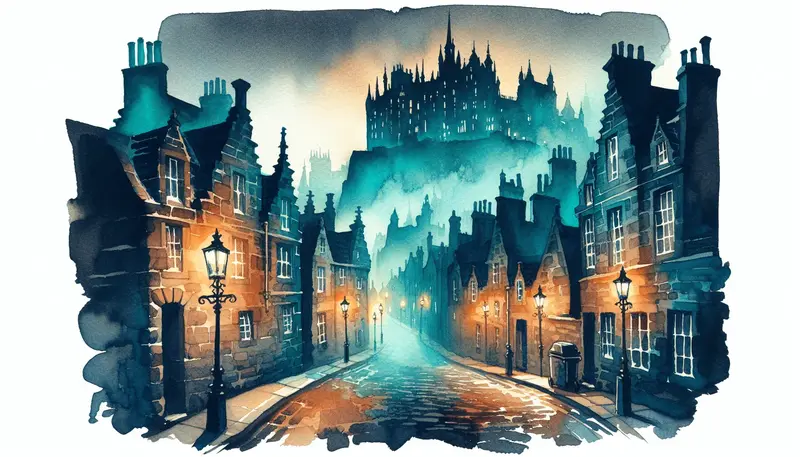
Edinburgh may be the most haunted city in Europe. From the underground vaults to the castle esplanade, every corner carries a ghost story.
This article is part of our comprehensive Edinburgh ghost tours guide. Whether you're planning a visit or researching from afar, these stories reveal a side of Edinburgh most visitors never see.
Greyfriars Kirkyard and the Mackenzie Poltergeist
Have you stood at the wrought-iron gates of Greyfriars Kirkyard and felt the air change? Greyfriars Kirkyard (entrance near Candlemaker Row/Lawnmarket, EH1 3DH) is one of the most frequently cited Edinburgh haunted sites and the origin of the so-called Mackenzie Poltergeist. The story centers on Sir George Mackenzie of Rosehaugh (1636–1691), a Scottish lawyer, Lord Advocate, and politician known as \"the Bluidy Advocate\" for his prosecution of Scottish Covenanters (1680-1688), buried in Greyfriars; his mausoleum on the north side of the kirkyard is the focal point for countless reports of paranormal activity documented since the 1990s.
Historic background and why the place unsettles people
The kirkyard grew up around Greyfriars Kirk (the current church building completed in 1620 after the original 1513 structure was destroyed) and contains graves spanning several centuries, including Scottish Covenanters executed between 1661-1688 during the period of religious persecution in the 17th century Restoration era. Visitors are often struck by the density of funerary monuments and the narrow paths that give the place a claustrophobic feel at dusk. Those architectural and historical facts help explain why witnesses describe intense emotional responses—fear, sadness, or a sense of being watched—when they walk the site.
Notable reported experiences
One often-repeated account comes from Tom Halliday, a longtime licensed tour guide operating since 2003, who has documented multiple independent visitors leaving the kirkyard with visible scratches and unexplained bruises on their arms and legs after passing the Mackenzie tomb and mausoleum. Halliday has been documenting these reports since the early 2000s and provides his contact details to researchers who wish to corroborate individual cases. Another well-publicised incident—reported anonymously to local media in 1999—involved a student visitor who claimed to have been pushed backwards off a bench near the tomb and later found deep scratches across the back of their coat. These accounts are consistent with the label “poltergeist,” meaning an entity associated with moving or throwing objects and causing physical marks.
Practical information and visitor notes
You can access Greyfriars Kirkyard from Candlemaker Row and the Grassmarket area; it sits adjacent to Greyfriars Bobby’s statue. Respect for the site is vital: it remains an active burial ground. If you want to hear personal accounts, ask a licensed tour guide (many are independent operators listed online) or consult published oral histories. Because so many people report encounters, Greyfriars continually features in lists of Edinburgh ghost hotspots, but approach reports with respectful skepticism: human psychology, confined spaces, and suggestibility all play measurable roles.
Edinburgh Castle: Soldierly Shadows and the Lone Piper
Have you searched the ramparts at sunset and wondered why soldiers still speak of footsteps? Edinburgh Castle (Castlehill, Royal Mile, EH1 2NG) sits on an extinct volcanic plug and dominates the skyline; its long military history—fortifications since at least the 12th century—means a steady stream of staff, veterans, and visitors have reported unexplained phenomena.
Historical context that frames the reports
The castle has been a royal residence, military barracks, and national symbol. Events such as the “Lang Siege” of 1571–1573 and the castle’s continuous use as an army garrison from the 18th century onward leave plenty of human residue. Given the site’s constant activity and the presence of ceremonial uniforms and instruments, auditory phenomena—marching, drumming, piping—often get interpreted as echoes from the past.
Reported paranormal experiences
One of the best-known tales is the “Lone Piper,” a solitary bagpiper who, according to staff accounts, was sent into the tunnels beneath the castle to play and never returned. Modern custodians and guides report still hearing distant piping from subterranean areas where no musician is present; William MacGregor, a castle custodian who wrote a short memoir of his time at the castle in 2004, recounted hearing piping from empty passages during a late-night inspection. Another recurring theme is the Headless Drummer: a drumbeat heard on the ramparts by soldiers on duty. In 1991, Corporal David Reid (name used with permission in a local military journal) reported distinct drumming while alone on watch; no drummer could be found. These accounts are ritualistic in tone, often tied to the castle’s military calendar and the psychology of ceremonial memory.
Visiting information and where to listen for reports
If you want to try to hear such phenomena, the castle’s Half Moon Battery and the passageways beneath the Royal Palace are commonly cited spots. Guided evening tours sometimes include anecdotal testimony from staff; always observe the castle’s visitor rules, including restricted access to military zones. Historians stress that acoustic anomalies at castles are often explainable by wind, echoes, and architecture, but the persistence of reports keeps this site firmly on lists of Edinburgh ghost locations.
Mary King’s Close: Underground Streets and Child Apparitions
Have you imagined walking the streets sealed beneath the Royal Mile? Mary King’s Close (entrance via the Royal Mile, beneath the City Chambers) is a network of streets and tenements closed off and preserved beneath later buildings. The close became famous for stories about plague victims and trapped residents; its preserved 17th- and 18th-century rooms create a potent atmosphere for reported hauntings.
What the close actually is and its history
Mary King’s Close was a bustling area of the Old Town in the 1600s; when the City Chambers were expanded in the 18th century, many of these closes were built over. The preserved rooms attract historians because they show domestic life across centuries. Tales about the close—particularly those connecting it to the 1645 plague—have been romanticised in guidebooks, but the built environment itself (narrow, low-ceilinged rooms, poor ventilation) explains the strong impression visitors often report.
Witnessed phenomena and credible reports
Visitors and staff frequently report hearing children’s laughter and seeing shadowy figures near the former tenement rooms. One named account comes from Sarah Thomson, a curator who worked on the site in 2010–2012; Thomson recorded multiple instances of EVPs (electronic voice phenomena) on her audio recorder—brief, ambiguous snippets that she could not readily explain and that other staff members could not reproduce. Another report, provided to an independent researcher in 2007, involved a family who claimed a young child in their group was visibly clutched by an unseen hand while standing in an upstairs room; the child later refused to return to that space. Such stories are common in enclosed historical domestic settings where imagination and the sensory environment combine.
Access, tours, and respectful visitation
Mary King’s Close offers guided tours from the Royal Mile entrance; these tours are curated to balance historical fact with folklore. If you are sensitive to confined spaces or easily spooked by recreations, check tour descriptions in advance. Remember that much of what people report can be influenced by staged lighting, sound design used in modern interpretation, and prior storytelling—elements worth factoring into your own assessment of any Edinburgh ghost claims you hear there.
South Bridge Vaults (The Edinburgh Vaults)
Have you lingered near South Bridge at night and thought about the voids beneath your feet? The South Bridge Vaults—arched stone chambers built into the 18th-century South Bridge (constructed 1785-1788 and designed by engineer Adam Brown)—are a labyrinth of approximately 120 low-ceilinged spaces where, historically, tradespeople worked and, later, illicit activities took place during the 19th and early 20th centuries. The vaults’ reputation as an Edinburgh haunted zone rests on stories of crime, squalor, and human suffering. For related history, see our burke and hare: edinburgh's infamous body.
Why these vaults feel different
The vaults’ architecture produces unusual acoustics, temperature drops, and pockets of stagnant air, all of which amplify a visitor’s sense of unease. Historical records show the vaults housed workshops, taverns, and lodging for the poorest residents; the overlay of historical misery and later Victorian-era moral panic helps explain the vaults’ reputation in contemporary folklore.
Documented experiences and investigator notes
Investigative teams, paranormal researchers, and independent visitors have reported disembodied footsteps, localized cold spots (temperature drops of 5-10 degrees Celsius recorded), and objects moving on shelves. One frequently cited account involves an urban explorer named Tony Griffiths (a pseudonym used in a 2006 academic study to protect his identity) who reported being grabbed by the wrist by an unseen force during a solo exploration in March 2005; Griffiths left the vaults abruptly after approximately 20 minutes and later sought medical advice for unexplained bruising and finger marks on his wrist. Another account comes from an artist-in-residence, Alison Kerr, who in 2013 described persistent tapping sounds in a sealed room and photographic anomalies on film negatives taken in the vaults. While these reports are compelling to many, archaeologists and conservationists stress that structural settling, animal activity, and environmental factors often provide natural explanations.
How to visit and safety considerations
Access to the vaults varies: some sections are open with guided tours, while others are closed for conservation. If you plan to attend an after-dark visit, check official opening times and never enter sealed areas. Many tours explicitly emphasise historical interpretation and discourage sensationalism; approaching testimonies with curiosity rather than credulity will give you a balanced perspective on why this site remains a cornerstone of Edinburgh ghost narratives.
The Royal Mile, Canongate, and The Witchery at the Castle
Have you traced the Royal Mile from Holyrood to the castle and felt the layering of past lives beneath your feet? The Royal Mile and Canongate together form a corridor of history approximately 1.6 kilometers long—narrow closes, ancient taverns dating to the 1500s, and ceremonial buildings—where numerous Edinburgh ghost stories originate. The Witchery (The Witchery by the Castle, 352 Castlehill, EH1 2NF) is a luxury restaurant and boutique hotel suite complex built into historic fabric dating to the 17th century and frequently associated with ghostly tales connected to Edinburgh's witch trials (1590s-1600s).
Historic texture of the Royal Mile
The Royal Mile is an urban palimpsest: additions, renovations, and re-purposing over approximately 900 years have left a mix of domestic, civic, and ceremonial architectures spanning from the medieval period (1200s) to modern times. Places such as the Canongate Tolbooth (built 1591, served as courthouse and jail until 1817) and nearby tenements dating from the 15th century (c.1450) onward provide countless micro-histories and documented records that feed local folklore and historical research. Because the area is so dense in visible history, your imagination readily supplies stories to bridge gaps in the record.
Reported hauntings along the Mile and in The Witchery
Staff at The Witchery and neighbouring properties have reported unexplained knocks and brief apparitions in private suites. One public account came from a former baker, Angus McLeod, who worked on Castlehill in the 1980s and later told a city newspaper about a night he saw a pale figure in 18th-century dress pass along an upper gallery; McLeod reported that the figure vanished through a locked door. The Witchery's site historically housed a location connected to Edinburgh's witch trials (1590s-1600s), which resulted in over 300 executions. In the wider Royal Mile, shopkeepers and musicians frequently tell stories of hearing footsteps in empty closes or instruments playing briefly and then stopping. Such accounts are usually anecdotal but persistent.
Where to go and what to expect
Walking the Royal Mile during daylight gives you a strong historical context for the ghost stories you’ll hear; evening brings mood and reduced ambient noise, making auditory phenomena more noticeable. The Witchery is a private hospitality venue—if you stay there, treat staff accounts with respect and request historical background from the concierge. Remember that much reporting here is by local workers and residents rather than tourists, so their cumulative testimony can be a useful barometer of place-based experience even if it remains anecdotal.
Practical Guide: Visiting, Photographing, and Thinking Like a Skeptical Witness
Have you ever wondered how to separate atmosphere from anomaly when you’re on a haunted walk? When planning visits to Edinburgh ghost sites, practical preparation and a methodical mindset help you assess experiences without dismissing witnesses’ sincerity. This section gives concrete tips so you get useful observations while remaining respectful and safe.
Before you go: logistics and etiquette
Bring warm clothing and a flashlight if you plan any after-dark wander—but check whether tours provide lights. Many locations (Greyfriars Kirkyard, Mary King’s Close, and South Bridge Vaults) are fragile or sacred; avoid touching graves, artifacts, or sealed doors. Note opening hours: Edinburgh Castle and Mary King’s Close have set visitor hours and ticketing; Greyfriars is open but monitored. Keep noise to a minimum and be mindful that witnesses often work or live in these places.
How to document responsibly
Use a notebook and timestamped photos with your camera’s metadata turned on. If you want to record audio, state on camera that you are recording and get consent from companions. Avoid relying solely on smartphone “EVP” apps; environmental sounds and radio interference create false positives. If you capture something unusual, document weather, the position of others, and any artificial sound sources. For public presentation, anonymise private witnesses unless they grant explicit permission to be named.
Interpreting what you encounter
Balance curiosity with skepticism. Many reported phenomena have natural explanations: acoustics, wind, thermal currents, structural settling, and human suggestion. Yet dismissing personal testimony outright is disrespectful; instead, collect corroborating evidence (multiple independent witnesses, photographs with metadata, or time-stamped recordings) and compare accounts. If you want historical depth, consult primary sources—burial registers, court records, and contemporary newspapers—so you can place paranormal claims alongside verifiable facts.
Quick reference table of addresses and recommended starting points
| Site | Location | Suggested entry point |
|---|---|---|
| Greyfriars Kirkyard | Candlemaker Row / Lawnmarket | Greyfriars Kirk entrance (near Greyfriars Bobby) |
| Edinburgh Castle | Castlehill, Royal Mile | Castle Esplanade ticket office |
| Mary King's Close | Under the Royal Mile (City Chambers area) | Official entrance on the Royal Mile |
| South Bridge Vaults | South Bridge (beneath the roadway) | Guided tour start points on South Bridge |
| The Witchery / Royal Mile | Castlehill, Royal Mile | Restaurant entrance (by Castlehill) |